Background:
Higher risk of suboptimal neurodevelopment has been identified among children who are HIV-exposed but uninfected (HEU) compared to children born to women without HIV in some studies. However, academic performance of school-aged children by HIV exposure status has not been well studied.
Methods:
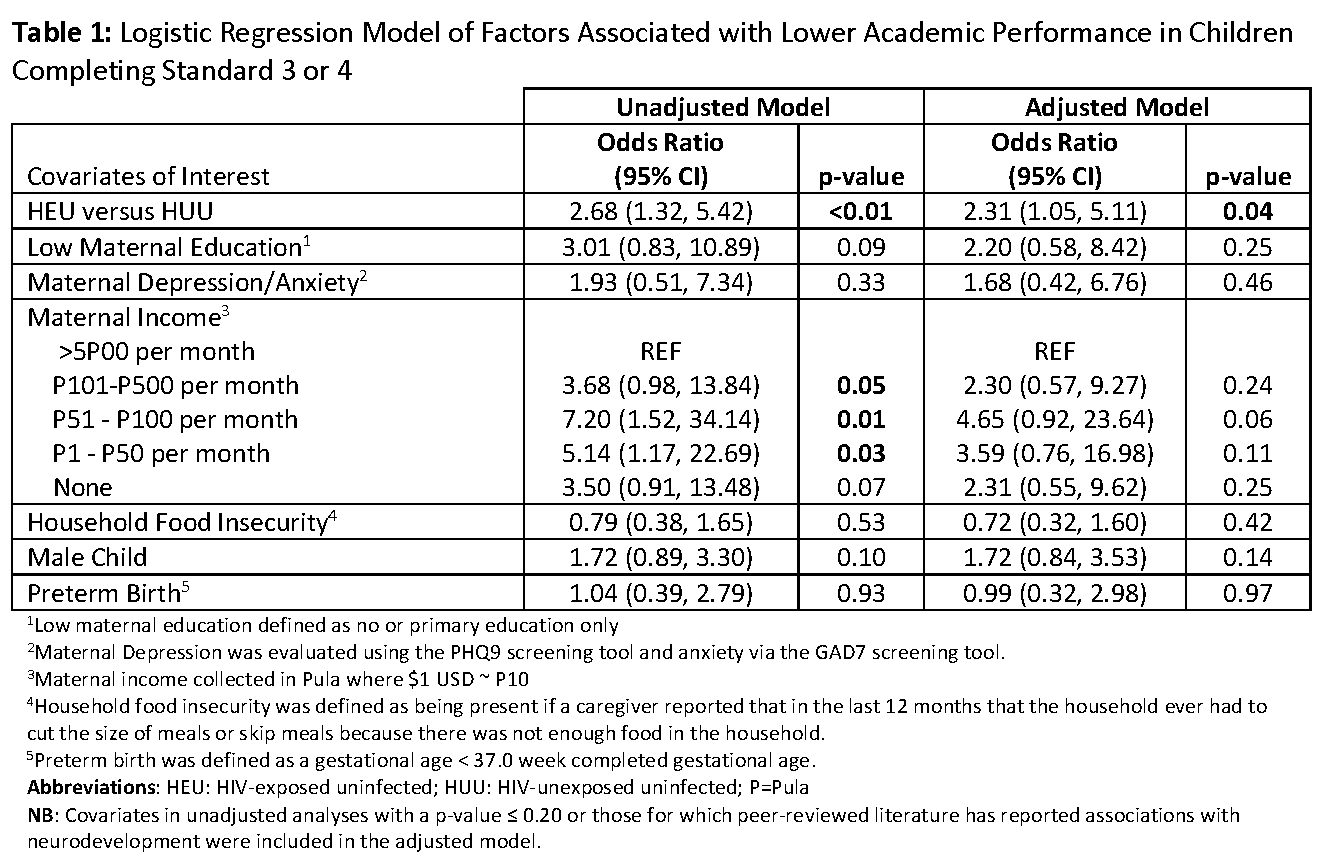
The Botswana-based FLOURISH study is an ongoing prospective observational study re-enrolling mother-child pairs who previously participated in maternal-child health studies through the Botswana Harvard AIDS Institute Partnership and for which data on maternal HIV status, antiretroviral treatment (ART), obstetric history, and child HIV status and outcomes through at least 18 months-of-life had been prospectively collected. FLOURISH parents report their child’s past school grades at enrollment. A Cochran-Mantel-Haenszel test was used to compare academic performance between children who are HEU vs. HIV-unexposed uninfected (HUU) and whose last grade completed was standard 3 or 4 (4th and 5th grade United States equivalence). Lower academic performance was defined as an overall grade for all coursework of “C” or lower (≤55%). Unadjusted and adjusted logistic regression models were fit to identify factors associated with lower academic performance.
Results:
Of 160 children, 114 were HEU. 16 (14%) children HEU were born preterm (< 37 weeks gestation) compared to 4 (9%) children HUU. Among children HEU, 76% were exposed in utero to triple ART, 23% to only zidovudine, and 1% had no fetal antiretroviral exposure. Women with HIV were more often older at enrollment, a higher proportion had no or primary education only (16% versus 0%), and less likely to have breastfed (19% vs 100%),. A higher proportion of children HEU had lower academic performance compared to their HUU peers (71% vs 48%; p=0.013). In adjusted analyses, children HEU remained significantly more likely to have lower academic performance (Adjusted odds ratio: 2.31 [95% Confidence Interval: 1.05, 5.11]; p=0.04) (Table 1).
Conclusions:
In this small cohort in Botswana, primary school academic performance was lower among children HEU compared to children HUU. If confirmed, this could have significant human capital implications for countries, such as Botswana, where >20% of infants are born HEU. Identifying modifiable contributors is of paramount importance, as is the development of screening tools to identify children at risk of poor academic achievement and interventions to mitigate the risk well before initiation of formal education.