Background:
Higher levels of sex hormone binding globulin (SHBG) are associated with decreased risk for type 2 diabetes mellitus (T2DM) in men and women in the general US population. By contrast, higher total testosterone (TT) has been associated with increased T2DM in women, but not in men. Women with HIV (WWH) are reported to have lower androgen hormone levels but higher SHBG levels than women without HIV (WWOH). Few have examined the association of androgen hormones with incident T2DM in WWH. We evaluated the association of TT, dehydroepiandrosterone sulfate (DHEAS), a marker for adrenal androgen secretion, and SHBG with incident T2DM in WWH and WWOH.
Methods:
As part of the sex steroid sub-study of the Women’s Interagency HIV Study (WIHS) beginning in April 2003, women had TT, DHEAS, and SHBG measured from morning blood draws. After exclusion of women with prevalent T2DM or who were pregnant, 929 WWH and 364 WWOH were included in the analysis and followed through 2019. Incident T2DM was defined by either report of anti-diabetic medication or by confirmation of a HgbA1c>6.5%, fasting glucose >126mg/dl, or self-reported T2DM. Parametric time-to-event regression models were used with relative times as the measure of association and age as the time scale. All analyses incorporated time-dependent sex steroid and SHBG levels into regression models and were adjusted for current menopausal phase, race/ethnicity, year of WIHS enrollment, current smoking, BMI, HCV status, and HIV-related factors.
Results:
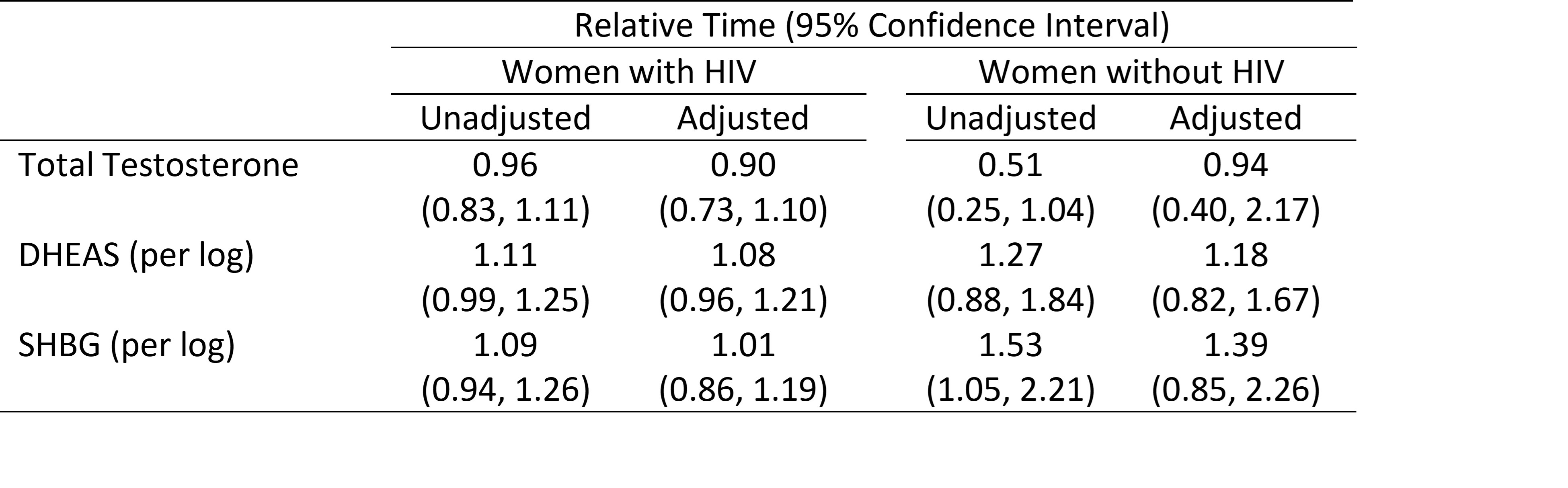
Nearly half of the women identified as Black. At the index visit, WWH were older (median 41 vs 36 yrs), less likely to be pre-menopausal (47% vs 65%) and had lower median BMI (27 vs 29 kg/m2). Among WWH, median CD4 count was 435 cells/mL and 70% reported taking antiretroviral therapy. WWH had 9389 person-yrs of follow-up and 137 (15%) developed T2DM; WWOH had 4009 person-yrs of follow up and 50 (14%) developed T2DM. The table shows that after adjustment, higher DHEAS and SHBG were non-significantly associated with longer time to T2DM whereas higher TT was non-significantly associated with shorter time to T2DM regardless of HIV status. In WWH and WWOH, BMI was significantly associated with shorter time to T2DM.
Conclusions:
We found that the association of TT, DHEAS, and SHBG with T2DM were in the expected direction regardless of HIV status, but associations were not significant. Whether the magnitude of these associations is altered in post-menopausal women needs study.
Relative Time to T2DM Among Women With and Without HIV