Background:
The Italian monkeypox (MPX) outbreak involved essentially the Milan area starting from mid-June 2022. As observed in other European regions, new cases decreased significantly by October but no reasons for this epidemiologic trend have been established yet. We aimed to assess whether reduction in sexual activity and at-risk behaviors and/or vaccination might explain this finding in PrEP users attending a community-based service.
Methods:
Milano Checkpoint provides assistance to the largest Italian cohort of PrEP users. At each visit clients are tested for sexually transmitted infections (STIs) and fill self-administered questionnaires about their behavior in the previous 3 months. Subjects with a visit in July to November 2022 were selected: overall and condomless sexual intercourses, chemsex practices, and STIs incidence were compared to what registered in the previous visit. Descriptive statistics and non-parametric tests (Pearson’s Chi-square, Mann-Withney U, McNemar exact, and Wilcoxon signed-rank) were used to compare groups, while incidence rates of STIs and incidence rate ratio (IRR) were calculated. Logistic regression model was built to describe factors associated to change in sexual encounters.
Results:
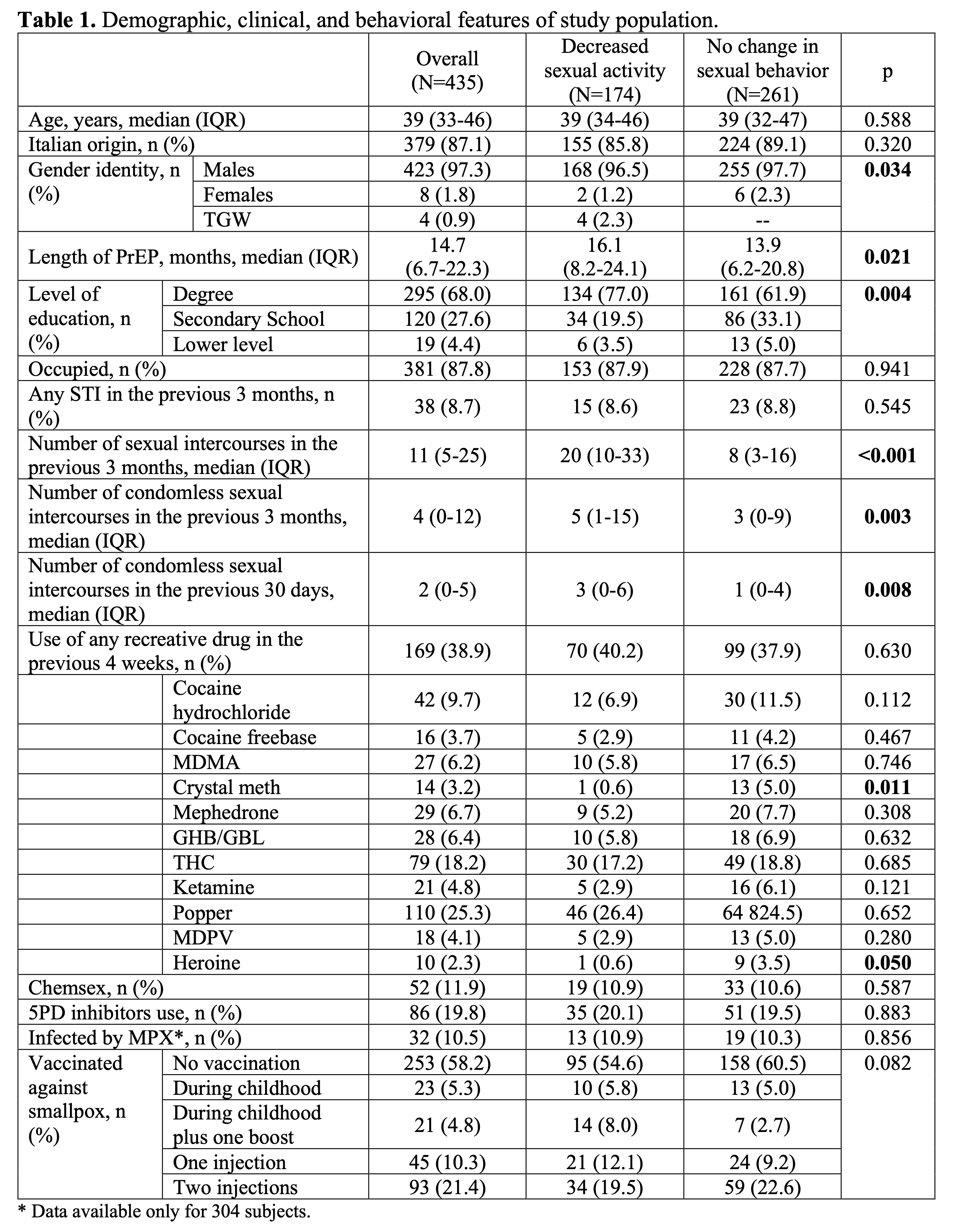
We selected 435 individuals: Table 1 describes features of study population. Smallpox vaccine was available from the second half of August and only a minority (26.2%) completed the full course. A reduction in the number of intercourses was observed in 174 (40.0%) PrEP users, but the majority did not change the number of sex acts during the MPX outbreak: the overall number of sexual contacts arose from 11 (IQR 5-25) to 12 (IQR 5-26) in the epidemic months (p=0.070). Condomless intercourses and use of chemsex did not change (p=0.459 and p=0.766, respectively). The incidence of STIs was 87.3 per 100 PYFU in the pre-epidemic versus 84.8 per 100 PYFU in the epidemic period (IRR 1.03, 95% CI 0.80-1.32, p=0.813). The only factor associated to reduction in sexual activity was a lower level of education (OR 0.69, 95% CI 0.54-0.86, p=0.001). Sexual behavior did not change after vaccination (p=0.593) nor a diagnosis of MPX (p=0.856).
Conclusions:
Both reduction of risky sexual behavior and MPX vaccination do not explain the vanishing of epidemics. Saturation of high-risk groups or hesitancy to contact health facilities to avoid quarantining policies should be investigated.