Background:
Metabolic alterations related to insulin resistance (IR), development of DM2 and hepatic steatosis (HS) are aspects of great interest in PLWH. There is little knowledge about the metabolic characteristics at the time of diagnosis of HIV infection in individuals who will develop DM2 during follow-up and the impact of initial ART on the evolution of these alterations.
Methods:
6007 patients included in prospective cohort (CoRIS) who initiated ART between Jan-2010 Nov-2019, without HBV/HCV coinfection. All DM2 diagnoses during 5 years follow-up were collected and their characteristics were analyzed. In addition a subanalysis of subjects who initiated and maintained the same ART for at least 24 months, between 01-2010 and 12-2019, was performed. Changes in TyG-insulin resistance and TyG-hepatic steatosis indexes were analyzed according to the four most frequent ART regimens used: TDF + (3TC or FTC)ç + EFV (Nf638), TDFç+RPV (Nf521), TDFç+DRV (Nf211), ABCç+DTG (Nf739).
Results:
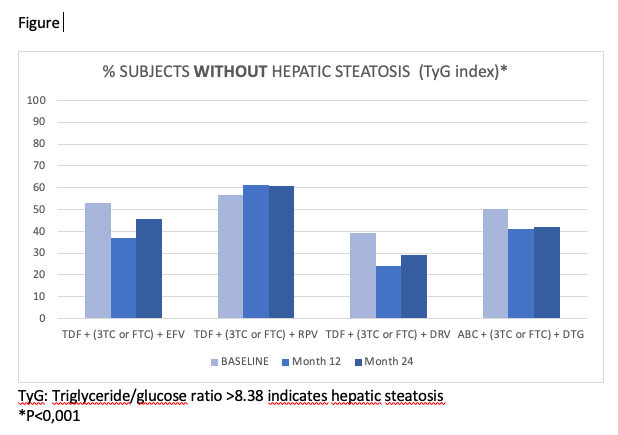
At baseline median age (IQR) was 35 years (29- 43), 12% female, 9.5% stage C3, median CD4+ 375cell/L (224-534). A total of 119 diagnoses of DM2 were recorded. Age, glucose, triglyceride, and BMI values were significantly higher at baseline, prior to ART initiation, in those who developed DM2. 29.5% of the subjects presented IR and 49% HS by TyG indexes, finding significant differences between those who develop DM2 at 5 years and those who do not (TyG-IR TyG-HS 50% vs 25% p < 0.001 and 75% vs 40% p < 0.001). Regarding changes in TyG indexes at 12 and 24 months after initiation of ART, only in patients who received TDFç+RPV the proportion of cases with IR/hepatic steatosis was reduced, this difference being significant (Figure). A multivariate analysis was performed on factors associated with the presence of IR/steatosis by TyG indexes at 12 and 24 months, with TDFç+RPV being associated with less steatosis, OR 0.38 and 0.56 p < 0.05 respectively.
Conclusions:
PLWH who develop DM2 have very high prevalence of insulin resistance prior to ART initiation. Patients with recently diagnosed HIV infection in whom metabolic alterations related to insulin resistance are determined should be closely monitored and appropriate measures should be implemented to reduce its impact. First ART regimen could condition a different evolution of metabolic alterations related to IR/hepatic stetatosis. The TDFç+RPV regimen has an excellent metabolic profile and could have a protective effect on IR/liver steatosis, as measured by noninvasive markers.
% Subjects without Hepatic Steatosis (TyG Index)