Background:
The immune system is highly susceptible to changes of zinc levels and this might imply a different response against infection. Prior evidence suggests some benefit on viral infection prognosis after zinc supplementation. We aim to study the efficacy of zinc supplementation in SARS-CoV-2 infection outcomes.
Methods:
This is an unicenter prospective, randomized cliinical trial where unvaccinated individuals with moderate SARS-CoV-2 infection without end-organ failure were randomized to standard of care+oral zinc for 15 days (three times per day a tablet of 83mg of Zn acetate equals to 75 mg of Zn element) (zSoC) (n =37) or standard of care alone (SoC) (n = 34). The primary combined outcome was death due to SARS-CoV-2 or intensive care unit (ICU) admission. Secondary outcomes included length of hospital stay (LoS) and time to clinical stability (defined as: oxygen saturation >94% [FiO2 21%], normalized level of consciousness [baseline], HR < 100rpm, systolic BP >90mm Hg,Temperature < 37.2ºC). Wilcoxon–Mann–Whitney test generalized Odds ratio (ORs) and 95% confidence intervals (CIs) for differences in outcomes between SoC and zSoC. A logistic regression model was fitted adjusted by age, sex, severity and comorbidity to compare the primary outcome between SoC and zSoC.
Results:
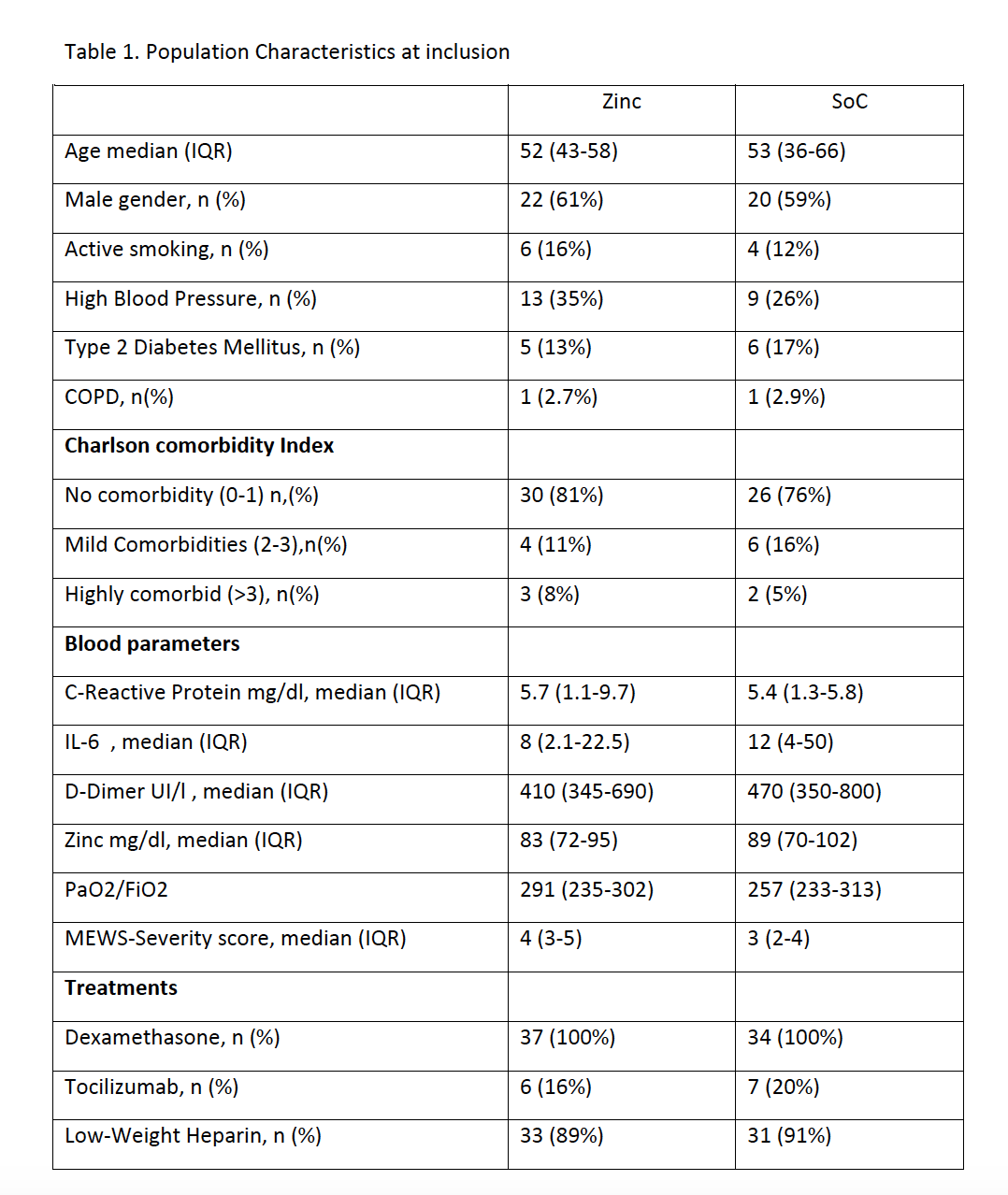
Seventy-one participants were recruited. No significant differences in terms of age, gender and comorbidities nor in SoC were found between groups (Table 1). 14-day Mortality was 2.90 % (2 participants) in the SoC group and none in zSoC. ICU admission rates were, respectively, 8 (23%) and 1 (2.7%) (OR: .098; 95% CI .013–.766). The principal combined outcome occurred in 8 participants (23%) in SoC and in 2 (5.4%) in zSoC (OR: 0.18; 95% CI .03–.946). In a logistic regression model adjusting by age, sex, comorbidity and severity the OR for the combined outcome in those in zSoC was 0.091 (95% CI: 0.007-0.913; p=0.045). LoS was shorter in zSoC (6.9 days (SD 6.1) vs 12.7 (SD 11.6);p=0.013) respectively. Time to clinical stability was significantly shorter in zSoC (5 days (SD 6.1)) compared to SoC (11.9(SD 9.1)); p=0.005. No significant differences in changes in inflammatory markers were found among groups. No severe adverse events were observed during the study.
Conclusions:
Daily zinc supplementation with 240 mg of zinc acetate for 14 days during the acute phase of SARS-CoV-2 infection resulted in lower rates of severity (less death and ICU admission) and faster clinical recovery along with shorter hospital stay.
Table 1. Population Characteristics at inclusion