Background:
The COVID-19 pandemic disproportionally affected black communities but the impact on HIV care in this group remains poorly understood. We evaluated measures of HIV care during the COVID-19 pandemic in the GEN-AFRICA cohort of black people with HIV living in the United Kingdom.
Methods:
We evaluated interruptions to HIV care during the COVID-19 pandemic (01/2020-09/2022) in the GEN-AFRICA cohort at nine UK clinics who provided HIV outcomes for >80% of their participants. We ascertained death, transfers of care, loss to follow up for >12 months, the highest HIV virus load, and interruptions to antiretroviral therapy (ART). We evaluated factors associated with the composite outcome of HIV viraemia (virus load >200 c/mL) and/or an ART interruption using logistic regression analysis; factors associated (P< 0.1) in univariable analysis were included in the multivariable model. We also summarized reasons for ART interruptions where recorded.
Results:
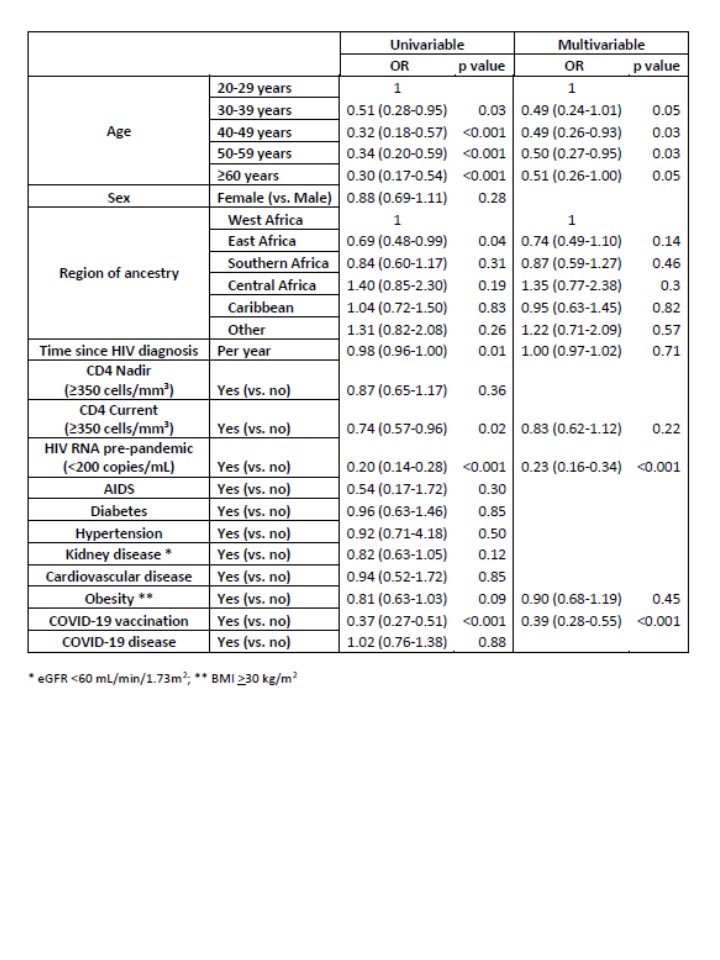
On 01/01/2020, 2321 GEN-AFRICA study participants (mean age 51.3 years; 55.8% women; pre-pandemic current/nadir CD4 of 500/204 cells/mm3 and HIV RNA < 200 c/mL in 92.3%) were under active HIV follow up. Thirty (1.3%) subsequently died, 24 (1.0%) transferred care, and 48 (2.1%) became lost to follow up; 523 (22.7%) reported an episode of COVID-19 and 1771 (87.1%) having been vaccinated against SARS-CoV-2. The composite outcome could be evaluated in 2130 (91.8%); 259 (11.2%) had a documented HIV VL >200 c/mL, 228 (9.8%) an ART interruption, and 325 (14%) had HIV viraemia/ART interruption. In multivariable analysis, older age, a pre-pandemic HIV RNA < 200 c/mL and being vaccinated against SARS-CoV-2 were associated with reduced odds of HIV viraemia/ART interruption (Table) while sex, CD4 (current/nadir), comorbid status and having had COVID-19 were not or no longer associated. Reasons for ART interruption were available for 52 participants; 38% cited domestic logistic reasons, 27% issues related to foreign travel, 19% psychological reasons, 12% lockdown or changes to the daily routine, and 4% personal choice.
Conclusions:
During the COVID-19 pandemic, one in seven black individuals with HIV experienced an ART interruption and/or HIV viraemia. Pre-pandemic measures of suboptimal engagement in care, pandemic restrictions, and wider health beliefs as reflected by SARS-CoV-2 vaccination status, contributed to these undesirable HIV outcomes.
Factors associated with HIV viraemia/ART interruption