Background:
Among people living with HIV (PLWH) enrolled in the Neurocognitive Assessment in the Metabolic and Aging Cohort (NAMACO) study, we have observed a neurocognitive impairment (NCI) prevalence of 40% by Frascati criteria. However, most patients have asymptomatic neurocognitive impairment (ANI), and analysed trajectories at two-years follow-up showed no signs of decline. In the current study, we examined neurocognitive performance (NP) after four years, and its associated characteristics.
Methods:
The NAMACO study is an ongoing prospective, longitudinal, multicentre and multilingual (French, German, Italian) study embedded within the Swiss HIV Cohort Study. PLWH ≥ 45 years old were recruited and assessed with standardized neuropsychological tests performed by neuropsychologists at baseline (between 2013 and 2016) and then at two- and four-years follow-up. NP was described by Frascati criteria, and by global and per cognitive domains z-scores. To evaluate factors associated with changes in NP over time, we defined our outcome as mean yearly changes in global mean z-scores from baseline. Uni- and multivariable linear regression models were performed and subsequently weighted for the inverse probability of dropping out of the study. Probabilities of dropping out of the study were obtained by multivariable logistic regression adjusted for all baseline characteristics.
Results:
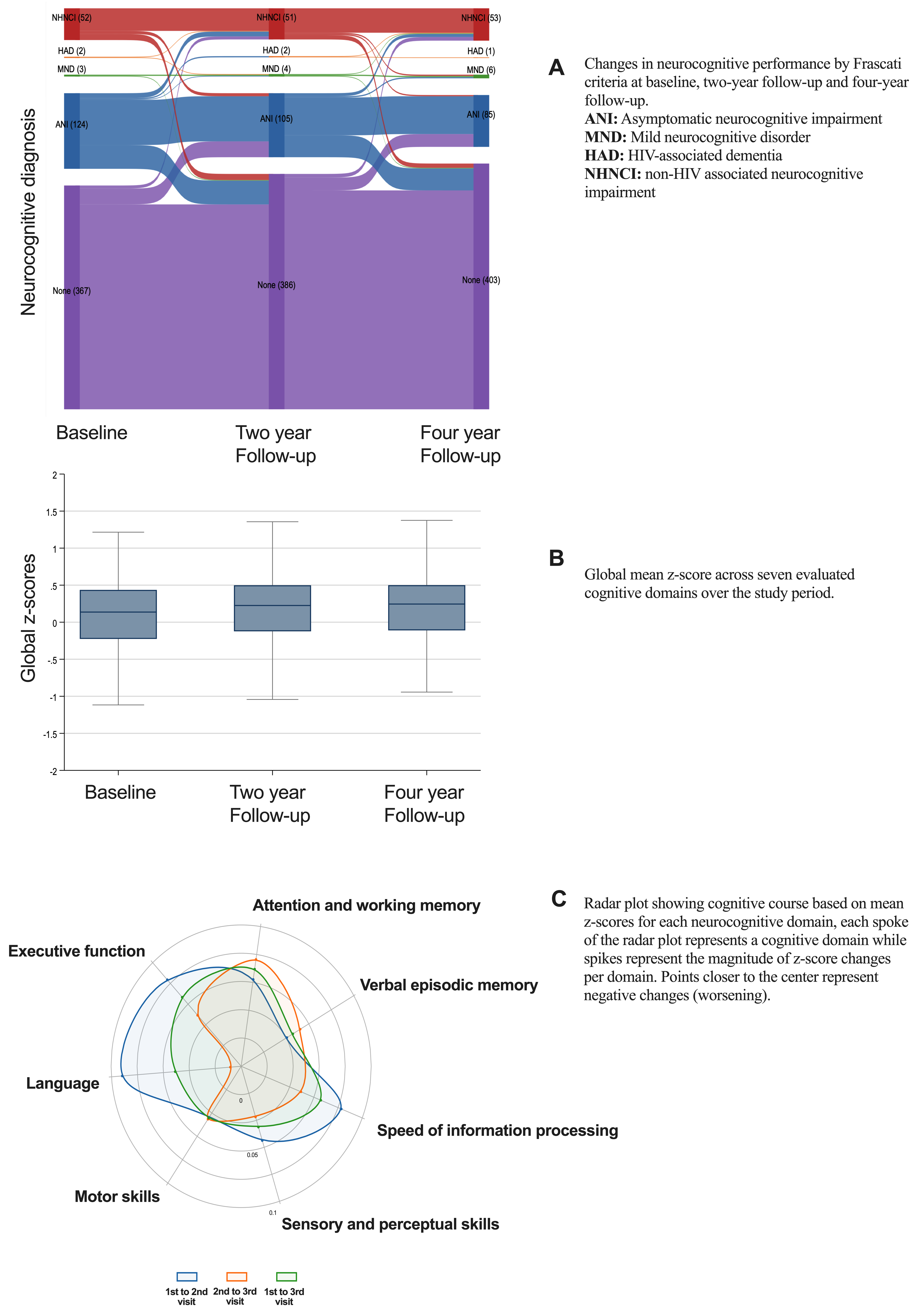
At baseline, 981 participants were recruited. A total of 548 (55.9%) completed all three assessments (median age 53, male 80%, Caucasian 91%, MSM 56%, highly educated 88%, smoking 32%, severe alcohol consumption 18%, HIV viral loads ≤ 50 copies/mL 97%, and median CD4+ 618 cells/μl. PLWH lost to follow-up were more likely to have ANI at baseline, mild or severe depression, being smokers and to have a moderate or severe alcohol consumption. Neurocognitive trajectories over the study period are presented in Figure 1 (panel A to C). After adjusting for confounders, age over 65 years was the only factor associated with a decline in NP, measured by changes in z-score, after four years (Coeff. -0.03 95% CI -0.05 to -0.01, p-value = 0.005).
Conclusions:
In a well-treated population of PLWH we observed stability or improvement of NP after four years of follow-up. Age remained the only factor associated with changes in NP.
Figure 1.