Background:
There has been limited exploration of sexual and drug use behaviours following treatment for recent hepatitis C virus (HCV) infection (duration of infection < 12-months). This analysis modelled behavioural trajectories following treatment for recent HCV infection and assessed HCV reinfection and sexually transmitted infection (STI) incidence.
Methods:
Participants treated for recent HCV in the Recently Acquired HCV Infection Trial (REACT) were followed at 3-monthly intervals for up to 2-years to assess longitudinal drug use and sexual behaviours. Population averaged behavioural changes were estimated using generalized estimating equations. Distinct behavioural trajectories within the population were identified using group-based trajectory modelling; this method models a variable of interest throughout time and identifies groups of individuals with similar behavioural profiles or patterns. HCV reinfection and STI rates were calculated using person-years (PY) of observation.
Results:
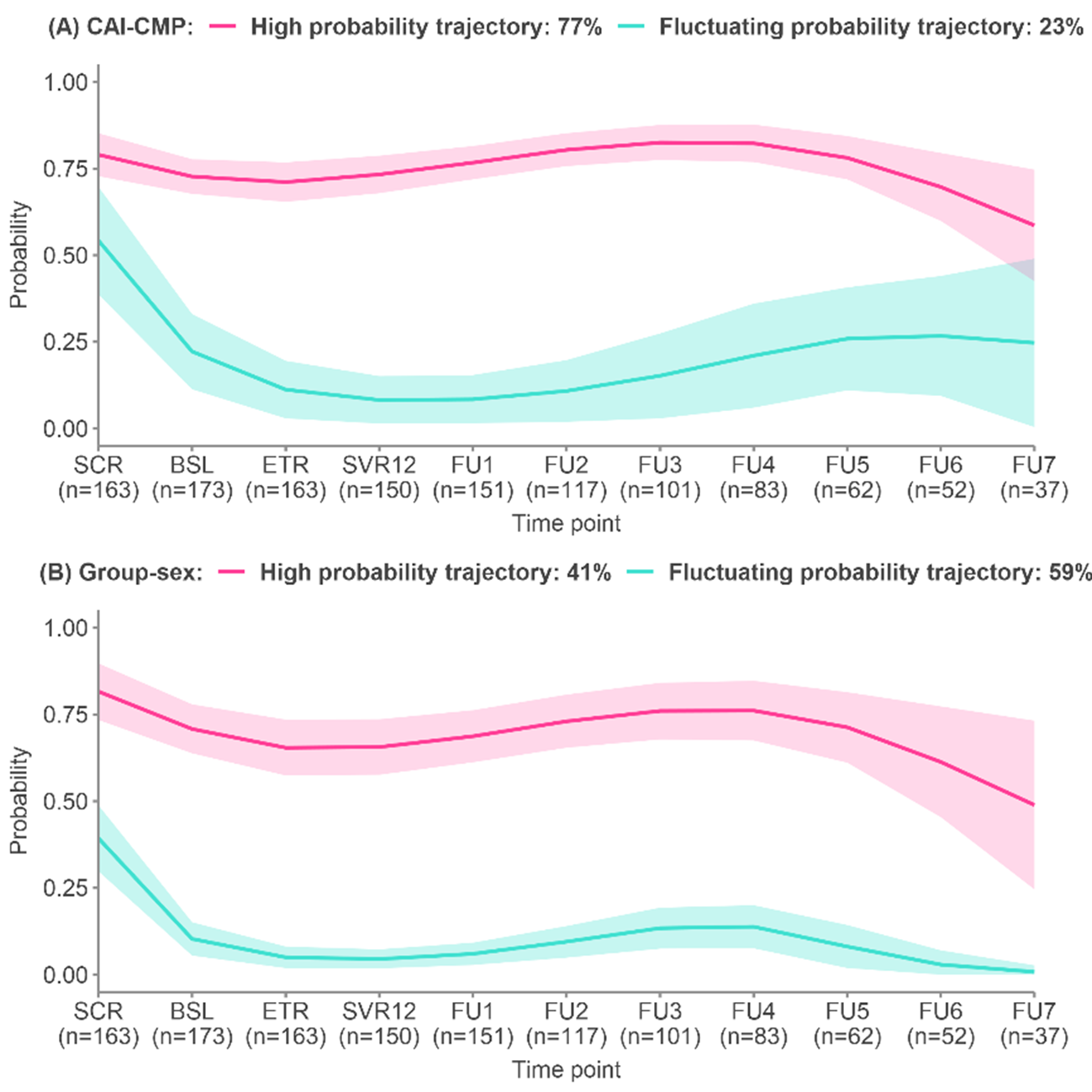
During follow-up of 212 participants (median age 43 years; 96% male; 84% gay and bisexual men [GBM]; 69% HIV; 26% injecting drug use [IDU] in the past month), behavioural trajectories for IDU in the past month and stimulant use did not change. Population averaged decreases in the likelihood of daily IDU (adjusted odds ratio [AOR] 0.83; 95% CI 0.72, 0.95) and opioid use (AOR 0.84; 95% CI 0.75, 0.93) were observed. Among GBM, behavioural trajectories for chemsex (sexualised drug use) did not change; 41% had sustained high probability of chemsex throughout the study. Population averaged decreases in condomless anal intercourse with casual male partners (CAI-CMP; AOR 0.95; 95%CI 0.90, 0.99) and group-sex (AOR 0.86; 95%CI 0.80, 0.93) were observed, but masked distinct trajectories of behaviour. While a proportion of the population showed decreased probability of CAI-CMP and group-sex during treatment, a substantial proportion retained high probability of these behaviours (Figure). HCV reinfection incidence was highest for those with sustained high IDU (33.0/100 PY; 95%CI 17.7, 61.3) and chemsex behaviours (23.3/100 PY; 95%CI 14.5, 37.5). STI incidence was highest for those with sustained high group-sex behaviour (161.1/100 PY; 95%CI 136.4, 190.2).
Conclusions:
Limited behavioural change was observed following treatment for recent HCV infection. Findings support regular reinfection surveillance and rapid access to retreatment.
Figure. Group based trajectory modelling of sexual behavioural outcomes among gay and bisexual men. Behavioural trajectories for (A) condomless anal intercourse with casual male partners, and (B) group-sex, during, and following treatment for recent HCV infection. The legend includes the proportion of the population assigned to each trajectory. Abbreviations: CAI-CMP, condomless anal intercourse with casual male partner; SCR, screening; BSL, baseline; ETR, end or treatment; SVR12, sustained virological response testing 12-weeks post treatment; FU, follow-up