Background:
High frequency HIV drug resistance mutations (DRMs) are known risk factors for treatment failure (TF), but the association between low frequency DRMs and TF is controversial. We explore this association using deep sequencing methods that accurately sample low frequency DRMs.
Methods:
We enrolled pregnant women with HIV in Malawi who were either ART naïve (A), had ART failure (B), or defaulted on ART and were resuming (C). At entry, A & C began a TDF/3TC/EFV regimen and B started TDF/3TC/ATZ/r. TF was defined as either undetectable viremia followed by rebound, or failure to suppress by 6 months. We used Primer ID MiSeq to sequence partial pol gene to identify regimen-relevant DRMs in entry & TF plasma samples. This approach labels each RNA genome with a unique molecular identifier to correct sequencing errors & define sampling depth. We used a Cox proportional hazards model to calculate hazard ratios (HRs) for high/low frequency entry DRMs and TF. Low frequency DRMs were defined as DRMs present at ≤ 20%.
Results:
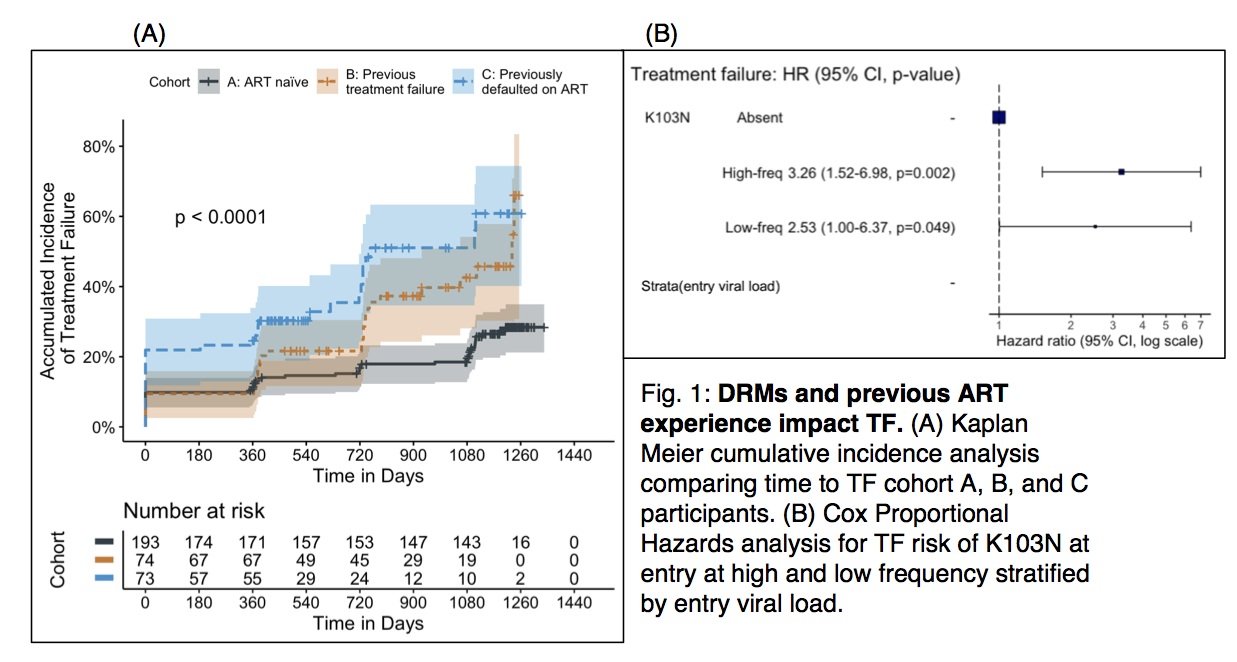
A total of 428 participants were selected for sequencing from 1,881 enrolled women. We successfully sequenced 340 participants, of which 193 were from cohort A, 74 from cohort B and 73 from cohort C. At entry, 28.5% of participants had the K103N DRM, 8.8% had K65R, and 11.8% had M184V; cohorts B & C had significantly more DRMs than cohort A. PI DRMs were rarely seen except for M46I/L at low frequency. Cohort B & C participants were more likely to have TF than those in cohort A (Fig. 1A), at TF rates of 26% (A), 41% (B), and 44% (C) (p< 0.001). Presence of K103N at entry significantly increased TF risk among participants on an EFV-based regimen at both high & low frequency, with HR of 3.26 [1.52-6.98, CI 95%] and 2.53 [1.00-6.37, CI 95%] respectively in multivariable analysis stratified by entry viral load (Fig. 1B). For all other DRMs at low frequency we found no significant association with TF. At TF, we observed the selection of DRMs in 45% of participants, while remaining participants lacked selection pressure from ART. Only one participant who received a PI-based regimen failed with new PI DRMs. Overall, DRMs to INSTIs were rare, but 1.5% of participants had Q148R at entry despite never taking INSTI drugs.
Conclusions:
Previous ART experience was associated with increased TF rates, as was K103N at both high & low frequencies for people on NNRTIs. High background of NNRTI DRMs provides additional evidence supporting the transition to INSTI based regimens adopted by Malawi.
DRMs and previous ART experience impact treatment failure