Background:
Whether interventions on the microbiota can help reduce chronic inflammation during treated HIV infection remains unclear. In a fecal microbiota transplant (FMT) trial in PWH, we found that Lachnospiraceae and Ruminococcaceae families–with known anti-inflammatory properties– were the taxa more robustly engrafted across time points. Here, we aimed to better characterize the FMT effects on systemic inflammation.
Methods:
We randomized 30 PWH on ART to either weekly fecal microbiota capsules or a placebo for eight weeks. Stool donors were selected based on anti-inflammatory microbiota profiles (high Faecalibacterium and butyrate abundance). We measured the plasma expression of 368 inflammatory proteins at weeks 0, 1, 8, and 24 using the Proximity Extension Assay by Olink. We fitted mixed models to compare the protein trajectories and selected the most significant to explore their correlations with Lachnospiraceae and Ruminococcaceae families. We performed a functional analysis using Gene Set Enrichment Analysis.
Results:
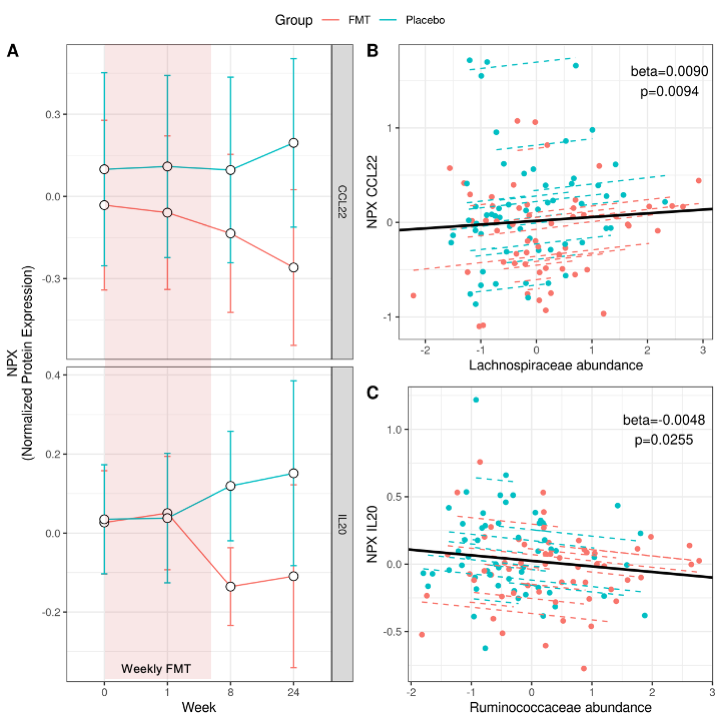
FMT resulted in a significant decrease of 24 proteins related to cytokines and leukocyte activation compared to placebo. CCL22, CD22, FGF5, and JUN showed the most consistent pattern of decline after each FMT; CCL22, IL20, and JUN were those with the most apparent effect at week 24 (17 weeks after the last FMT); and AOC1 and IL13 showed the most significant differences between groups (p=0.0045 and p=0.0003)(Figure 1A). From these 24 proteins, increases in Lachnospiraceae and Ruminococcaceae families correlated with increased CCL22 (p=0.0094) and decreased IL20 expression (p = 0.0255)(Figure 1B-C).
Conclusions:
Repeated FMT downregulated the expression of inflammatory proteins related to cytokines and leukocyte activation. The effects of FMT on Lachnospiraceae and Ruminococcaceae abundance correlated with CCL22 and IL20 kinetics, with known roles on Th17 cell preservation in HIV and the immune response against bacterial infections. Our results support investigating interventions on the microbiome to modulate systemic inflammation in PWH on effective ART.
Figure 1. A. Observed changes in normalized CCL22 and IL20 expression in each group. B. Associations between weekly changes in Lachnospiraceae and Ruminococcaceae (scaled abundance) and CCL22 and IL20 (normalized expression) weekly changes estimated from linear mixed models with interaction terms with time. Dashed lines represent individual correlations between bacteria and protein changes and black lines the coefficients obtained from mixed models.