Background:
Strengthening outreach and community mobilisation are promising approaches for reducing HIV transmission attributable to sex work.
Methods:
We allocated 22 clusters using restricted random allocation (1:1) to usual care or AMETHIST interventions. A cluster was the female sex worker (FSW) population around a clinic providing the services listed below.Usual care: FSW-friendly services, HIV testing, PrEP / referral to government ART services, contraception, condoms, STI syndromic management, health education and legal advice; all supported by peer educators.AMETHIST: usual care plus peer-led microplanning (outreach tailored to address individual vulnerability) and participatory self-help groups to support risk-differentiated HIV prevention, testing, ART/PrEP and adherence. 1o outcome: proportion of all FSW at risk of HIV transmission (HIV-positive, not virally suppressed and not consistently using condom) or HIV acquisition (HIV-negative and not protected by condoms or PrEP).Outcomes were determined in a respondent driven sampling (RDS) endline survey in all 22 clusters after 28 months of intervention delivery. Analyses were pre-specified, RDS-weighted and age-adjusted.
Results:
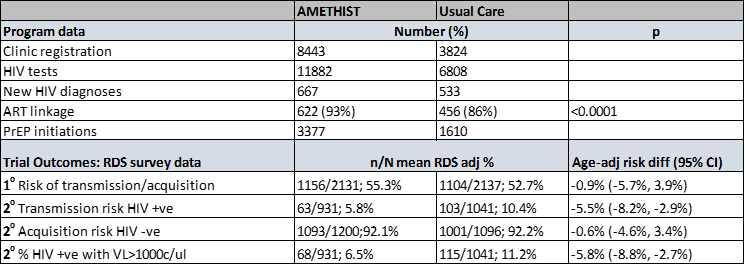
AMETHIST was implemented June 2019-October 2021. During this period there were more clinic registrations, HIV tests and PrEP/ ART initiations at AMETHIST compared to Usual care sites. 4444 FSW aged 18+ were enrolled in the endline survey, providing questionnaire data, biospecimens (n=4443) including dried blood spot (HIVAb, HIV viral load), plasma (TDF levels) and self-taken vaginal swabs for STI and Y-chromosome testing (to validate condom use reports). 46.2% were living with HIV of whom 1790/1973 (90.7%) were virologically supressed. 586/2334 (25.1%) of the HIV negative women reported currently taking PrEP, but only 2 had plasma TDF levels >700fmol/punch. There was no impact on the primary endpoint of population level risk of HIV transmission/acquisition. The proportion of HIV positive FSW with a viral load >1000copies/uL was low in both arms, and significantly reduced in the AMETHIST intervention arm. There was no impact of AMETHIST on risk of HIV acquisition.See Table 1 AMETHIST.
Conclusions:
Risk of HIV transmission in HIV positive women was low (95:95:95 achieved) and further improved by the AMETHIST Intervention. Risk of HIV acquisition was high and unchanged. Sustaining testing and treatment and strengthening HIV prevention including through long-acting PrEP is critical.
Table 1 AMETHIST