Background:
Pre-clinical and early-phase studies of a bedaquiline-pretomanid-moxifloxacin-pyrazinamide (B-Pa-M-Z) regimen show significant treatment-shortening potential for TB. Pa has been studied clinically in various combinations, with and without Z. Safety has been carefully monitored in these studies.
Methods:
SimpliciTB study was an open-label safety and efficacy study in 303 DS-TB patients randomized 1:1 to 4-months BPaMZ vs 6-months HRZE, and 6-months BPaMZ in 152 DR-TB patients. Primary efficacy endpoint was time to culture negative status through 8 weeks; a key secondary endpoint was relapse-free cure at week 52. In a separate analysis, 3 groups representing PaZ-containing regimens (PaZX, n=841), BPaL (n=290), and HRZE (n=340) were aggregated across all 6 TB Alliance studies of ≥8 weeks. Liver safety (max treatment-emergent [TE] ALT elevations) was analyzed through 8 weeks.
Results:
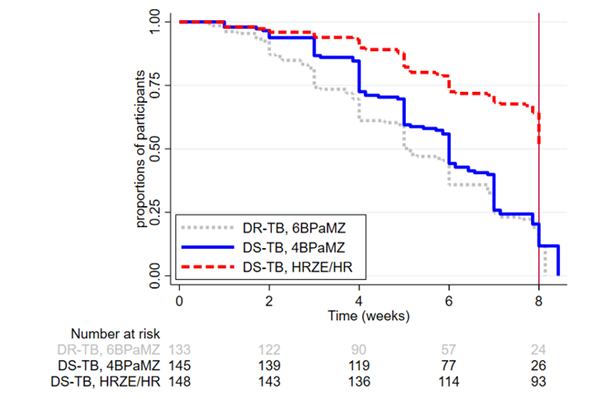
In the SimpliciTB MITT population, 47% and 84% of DS-TB participants (and 86% of DR-TB participants) were culture-negative by week 8 in HRZE and 4BPaMZ arms respectively, meeting superiority of 4BPaMZ over HRZE; HR 2.9 (95% CI 2.2 – 4.0) (figure 1). At week 52, 7%, 17%, and 17% of participants had unfavourable outcomes in the HRZE, 4BPaMZ and 6BPaMZ arms, respectively (TB-MITT population); 4-month BPaMZ did not meet non-inferiority (12% margin) vs HRZE. The higher proportion of BPaMZ unfavourable outcomes was driven primarily by hepatotoxicity-related treatment discontinuations: HRZE (0%), 4BPaMZ (7%) and 6BPaMZ (6%). In the PP population (treatment discontinuations excluded), 4BPaMZ was non-inferior to HRZE: risk difference 1.8% (95% CI: -2.9%-6.5%). The multistudy analysis showed incidences (95% CI) of TE ALT elevations >3xULN of 10.8% (8.8-13.1), 8.6% (5.7-12.5), and 5.6% (3.4-8.6), respectively, in those receiving PaZX, BPaL, and HRZE. Severe (grade 4) TE ALT elevations >8xULN occurred in 4.6% (3.3-6.3), 1.0% (0.2-3.0), and 2.7% (1.2-5.0), with median increases of 20x, 10x, and 10x, respectively, for PaZX, BPaL, and HRZE.
Conclusions:
SimpliciTB results validate observations from pre-clinical relapsing mouse model experiments which identified BPaMZ as a regimen with high efficacy and treatment shortening potential, but hepatic toxicity precluded treatment completion in ~6-7% of patients. The multistudy analysis showed that Pa-Z-containing regimens were associated with a hepatic safety profile distinct from BPaL, with a higher incidence and degree of grade 4 ALT elevations.
SimpliciTB Primary efficacy analysis Time to culture negative status by 8 weeks (MITT)