Background:
The TRUNCATE-TB trial (NCT03474198) found that the TRUNCATE strategy – initial treatment for 8 weeks (with BDQ/LZD regimen; extended up to 12 weeks for unsatisfactory clinical response); post-treatment follow-up; prompt retreatment (standard regimen) for relapse – was non-inferior to the standard treatment strategy at 96 weeks. Here we analyse efficacy and safety of the trial regimens (distinct from the efficacy and safety of the overall TRUNCATE strategy in which they were deployed).
Methods:
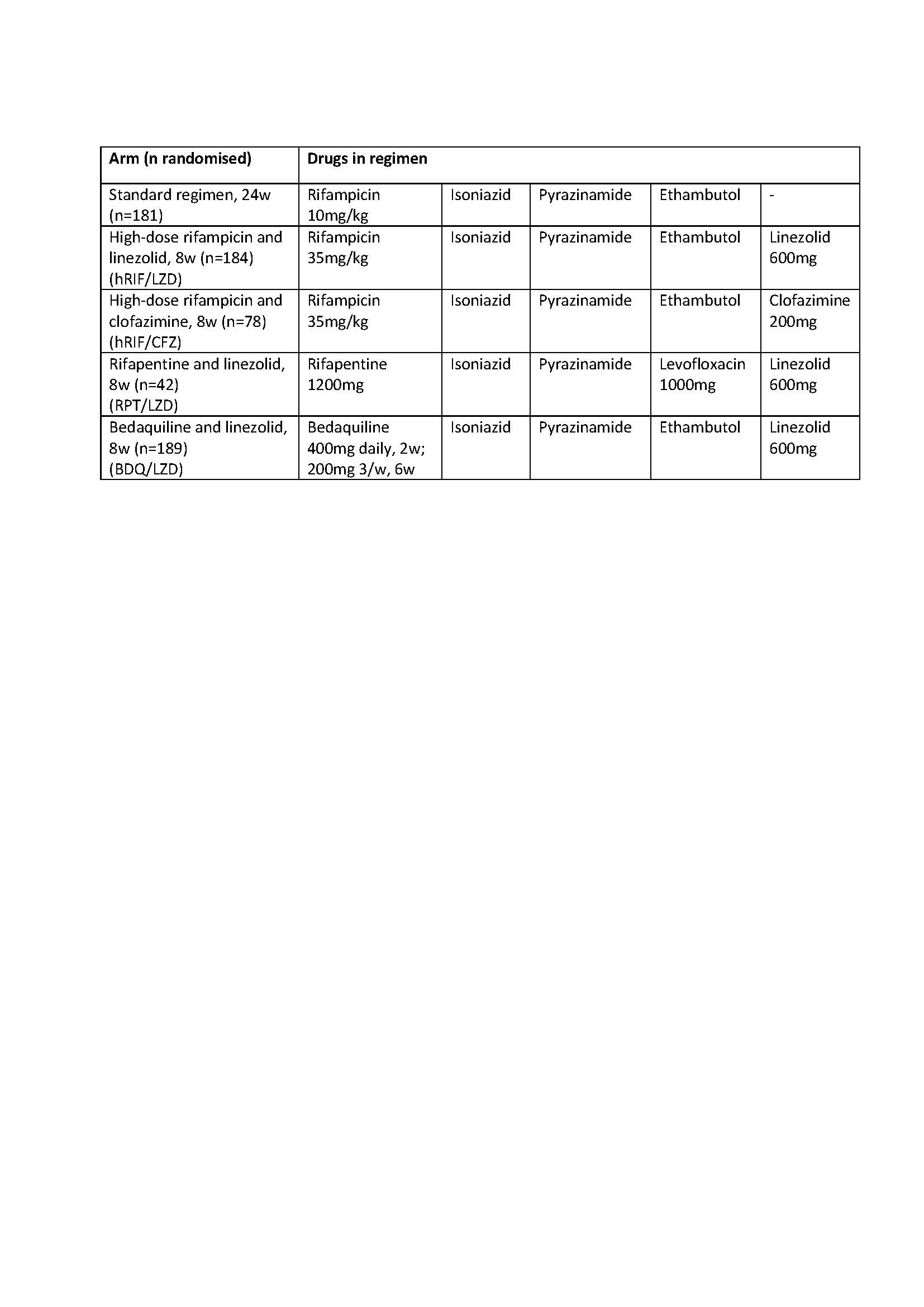
Participants with rifampicin-susceptible pulmonary TB at 18 Asian/African sites were randomised (adaptive design) to receive the standard regimen for 24 weeks or one of four novel 5-drug regimens for 8-weeks (up to 12 weeks; table). We assessed regimen efficacy using unfavorable outcome (UFO; composite including treatment failure; relapse; death; non-attendance at week 96, without evidence of prior disease clearance); and estimated Bayesian probability that UFO risk difference vs standard treatment was < 12%. Safety was assessed by adverse events of grade ≥3 (AE≥3) during/within 30 days of stopping the initial regimen.
Results:
Of the 674 randomised participants (male 62%, smear positive 73%, lung cavitation 54%), 4 withdrew/were lost to follow-up by week 96; overall, 80% assigned novel regimens stopped after exactly 8 weeks, 9% extended up to 10 weeks; 3% extended up to 12 weeks. Three arms (standard, hRIF/LZD, BDQ/LZD) enrolled to full sample size; two (hRIF/CFZ, RPT/LZD) ceased enrollment early for pragmatic reasons (not efficacy/safety; n in table). Proportions with UFO were 3.9%, 25.0% and 13.8% in the standard, hRIF/LZD and BDQ/LZD arms respectively; probability that risk difference vs standard arm was < 12% was 0.01 in hRIF/LZD and 0.81 in BDQ/LZD arm; the risk difference vs standard arm was reduced in subgroups with lower disease burden. Proportions with AE≥3 were 13.8%, 10.9%, and 11.1% in the standard, hRIF/LZD and BDQ/LZD arms respectively; 2 (1.1%) acquired BDQ resistance in the BDQ/LZD arm, none acquired resistance in other arms.
Conclusions:
Unfavourable outcome was more frequent with 8-week regimens than the 24-week regimen, as expected. However, with the BDQ/LZD regimen the excess was modest and likely can be reduced further by adjusting criteria for treatment extension by subgroup; the regimen was safe. An 8-week initial treatment duration appears to be a feasible target for most people with TB, with the excess of unfavourable outcomes manageable within the TRUNCATE strategy.
Table: Randomised drug regimens