Background:
HPTN 071 (PopART) was a community-randomized trial conducted in Zambia and South Africa (2013-2018); 21 communities were randomized into three arms in 7 triplets matched on baseline HIV prevalence and location (Arm A: combination prevention intervention with universal antiretroviral treatment [ART]; Arm B: combination prevention intervention with ART provided according to local guidelines; Arm C: standard of care). In the primary analysis, intervention effect was assessed using longitudinal observed HIV seroconversion. Arm B had 30% lower incidence than Arm C, in contrast, the intervention effect was similar in Arms A and C. In this report, we used cross-sectional incidence (CSI) testing to estimate HIV incidence in each community at baseline (PC0) and two-year visit (PC24).
Methods:
CSI was estimated using the LAg assay and HIV viral load (mean duration of recent infection: 130 days; false recent rate: 0.2%). This method was shown to accurately estimate incidence in this cohort. The Sedia Incidence Calculator was used to determine incidence estimate. Intervention effect compared CSI at PC24 between arms, adjusted for community age and sex composition and PC0 CSI.
Results:
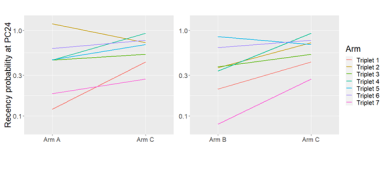
At PC0, 37,128 individuals were surveyed; 7,998 were HIV+ and 187 were classified as recently infected. At PC24, 27,896 individuals were surveyed; 6,254 were HIV+ and 73 were classified as recently infected. CSI testing was performed for 99.5% of all HIV+ samples. HIV incidence at enrollment was highest in Arm A in 4 of 7 triplets. The unadjusted incidence estimates for Arms A, B and C were 1.95, 1.49 and 1.58 at PC0 and 1.03, 0.90 and 1.55 /100py at PC24, respectively. Based on CSI, the adjusted HIV incidence ratio for Arm A vs. C was 0.69 (95% CI: 0.44-1.07, p=0.095) and for Arm B vs. C was 0.54 (95% CI: 0.34-0.84, p=0.011).
Conclusions:
In this large community-randomized trial, HIV incidence decreased over time in both study arms that included a combination prevention intervention. The decrease in incidence was similar in communities with universal ART (Arm A, 31% reduction) and ART provided according to local guidelines (Arm B, 46% reduction). The methods used for the intervention assessment using CSI align with those used for the primary study analysis and suggest that intervention was similarly effective in both intervention arms. Additionally, the apparent dissonance in the effects in Arms A and B (in the primary analysis) may have been due to a chance imbalance in HIV incidence at baseline.