Background:
Index testing, a WHO-endorsed form of contact tracing, is an evidence-based approach to enhance detection of people living with HIV (PLHIV). To optimize impact and efficiency, the process should rapidly identify contacts of newly diagnosed PLHIV and link them to immediate treatment. We estimate the time taken (in days) for each milestone along the index testing pathway from contact elicitation to linking HIV-positive contacts to treatment in one of the highest HIV burden states in India, Telangana.
Methods:
As part of a PEPFAR-funded program, we implemented index testing in 50 testing and treatment facilities in five districts of Telangana. We analyzed program data from July 2020-January 2022. We calculated time (same day, within a week, > a week) between steps along the index testing continuum defined as the date when: 1) contact elicitation was started; 2) contact was notified; 3) contact was tested for HIV; 4) contact received results; and 5) HIV positive contact was linked to treatment. Associations between contact characteristics and time category were evaluated using chi-square tests.
Results:
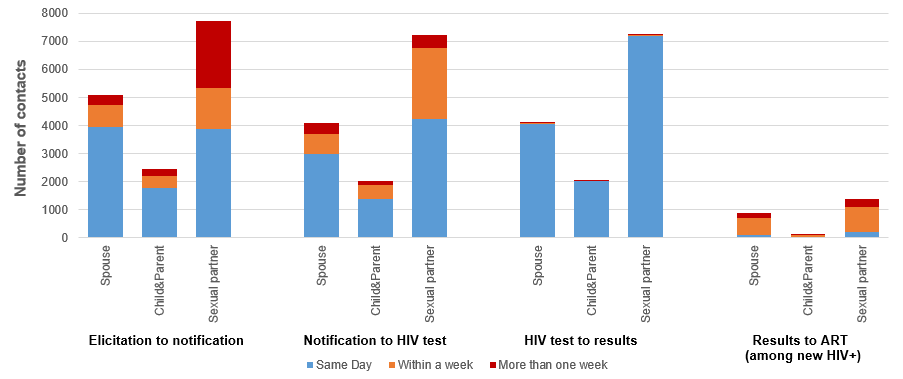
In total, 15,253 contacts were elicited and notified, 13,335 were tested and received results, 2,626 (20%) were diagnosed with HIV among whom 2,423 (92%) initiated on treatment. The median age of contacts was 32 years; 51% were non-spousal sexual partners, while 33% were spouses, and 16% biological children or parents. The time between each milestone varied significantly by age, gender, notification method, district and the type of contact (p< 0.05). Relative to spouses and children, sexual partners experienced delays at each of the first three steps, with the primary delay at the elicitation to notification step (31% took > a week vs. 7% of spousal contacts; Figure). Among sexual partners who took over a week for this initial step, the median delay was 41 days (interquartile range, 17-92) with 24% eventually testing HIV positive (compared to 15% positivity in spousal contacts who took > a week). Once HIV testing was complete, the experience of sexual partners was comparable to spousal contacts. Results were received the same day and most were linked to treatment within a week.
Conclusions:
Overall, index testing was an efficient way to identify contacts and initiate newly diagnosed PLHIV on antiretroviral therapy. However, these data highlight challenges in identifying vulnerable sexual partners and the need for differentiated approaches to avoid delays and curtail ongoing HIV transmission.
Figure – Time Between Index Testing Milestones by Type of Contact Elicited