Background:
SARS-CoV-2 variants resistant to monoclonal antibodies, and drug-drug interactions and potential mutagenicity of direct acting antivirals, heightens the need for additional therapeutics to prevent progression to severe COVID-19. Exogenous interferon beta is a promising therapeutic option against SARS-CoV-2 given its broad-spectrum antiviral activity and data suggesting impaired endogenous IFN production in individuals with severe disease.
Methods:
The safety and efficacy of orally inhaled nebulized interferon-β1a (SNG001) was evaluated in a Phase II randomized controlled trial on the ACTIV-2/A5401 platform (NCT04518410). Adult outpatients with confirmed SARS-CoV-2 infection within 10 days of symptom onset were randomized to SNG001 once daily for 14 days or blinded pooled placebo. Primary outcomes included treatment-emergent Grade ≥3 adverse event (TEAE) through day 28; time to symptom improvement of 13 targeted COVID-19 symptoms collected by daily study diary through day 28; and SARS-CoV-2 RNA < lower limit of quantification (LLoQ) from nasopharyngeal (NP) swabs at days 3, 7, and 14. All-cause hospitalization or death through day 28 was a key secondary outcome.
Results:
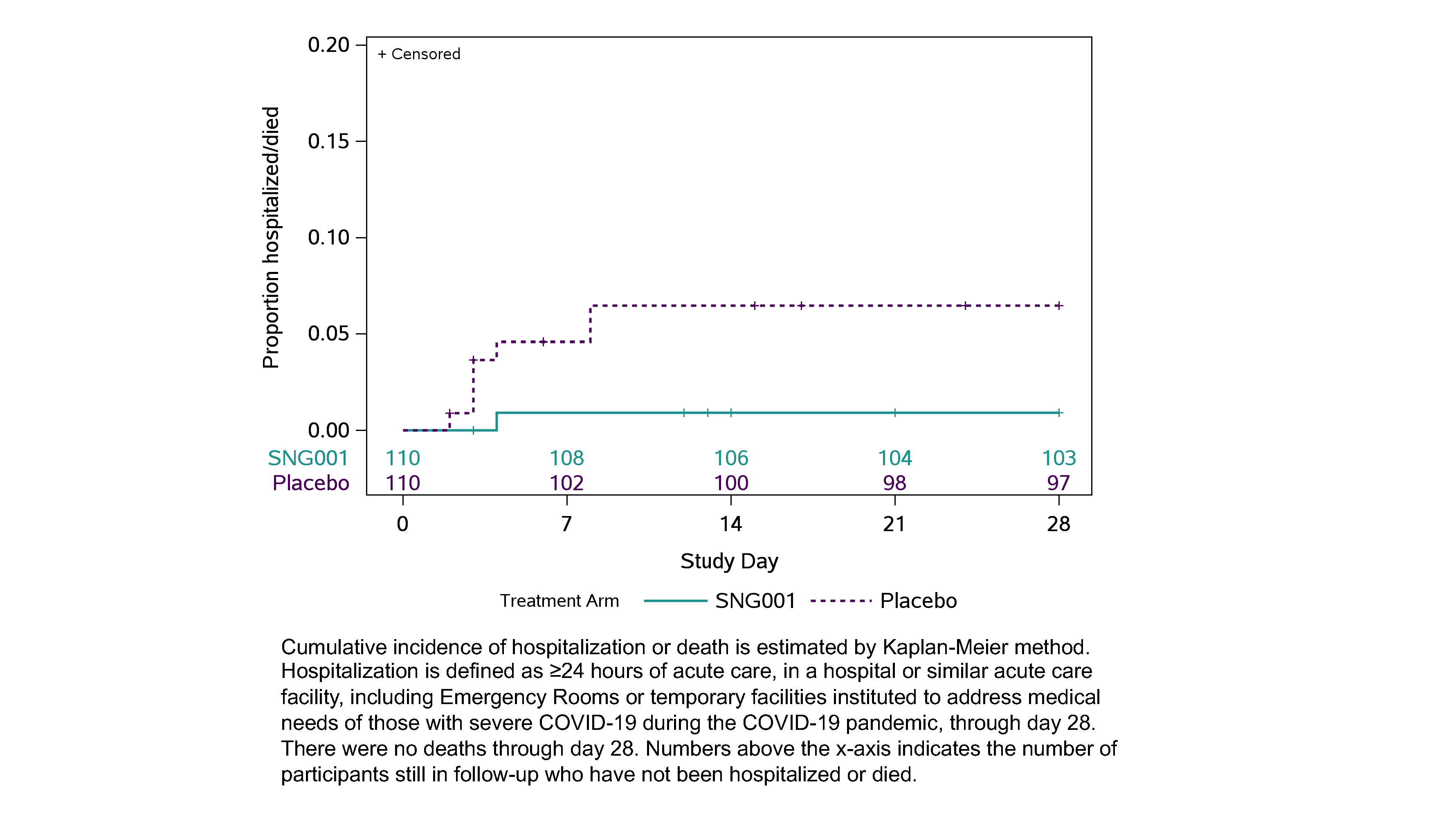
Of 221 participants enrolled at 25 US sites between February and August 2021, 220 (110 SNG001, 110 placebo) initiated study intervention, with a median age of 40 years, 55% female, and 20% SARS-CoV-2 vaccinated. There was no significant difference between SNG001 and placebo in Grade ≥3 TEAEs (4% vs 8%, Fisher’s exact test p=0.25). Median time to symptom improvement was 13 days for SNG001 and 9 days for placebo (Gehan-Wilcoxon test p=0.17). There was no difference in the proportion of participants with SARS-CoV-2 RNA < LLoQ at day 3, 7 or 14 (SNG001 vs placebo, Day 3: 28% vs. 39%; Day 7: 65% vs. 66%; Day 10: 91% vs. 91%; joint Wald test p=0.41). There were fewer hospitalizations with SNG001 (n=1; 1%) compared with placebo (n=7; 6%), but this difference was not statistically significant (Fisher’s exact test p=0.07; Figure). All hospitalizations were due to COVID-19 and occurred among unvaccinated participants without protocol-defined high-risk factors.
Conclusions:
Inhaled nebulized SNG001 was safe and well tolerated but did not reduce SARS-CoV-2 RNA levels in the nasopharynx nor decrease time to improvement of COVID-19 symptoms in outpatients with mild-to-moderate COVID-19. The non-statistically significant decrease in hospitalizations among SNG001 participants warrants further investigation in a phase 3 clinical trial.
Cumulative incidence of hospitalization or death comparing SNG001 vs. placebo