Background:
IL10 and PD1 contribute to HIV reservoir persistence impeding HIV eradication. IL10 contributes to lack of effector function, antigen-presentation and promotes HIV reservoir survival. PD1 leads to T cell exhaustion and HIV latency. We hypothesized that the dual blockade of IL10 and PD1 could synergize and lead to viral rebound control post-ATI (Analytical Treatment Interruption) by impeding on the survival of infected T cells and by rescuing T cell exhaustion and promoting memory and effector T-cell differentiation and function.
Methods:
28 rhesus macaques (RMs) infected with SIVmac239 started antiretroviral therapy (ART) 42 days post-infection which was maintained for 14-months. Rhesusized aIL10 (n=10), aIL10/aPD1 (Combo therapy – n=10), or vehicle (n=8) was administered every 3-weeks starting 12 weeks pre-ATI and stopped 14-weeks post-ATI (week 26 PTX). Animals were followed longitudinally for biospecimen collections.
Results:
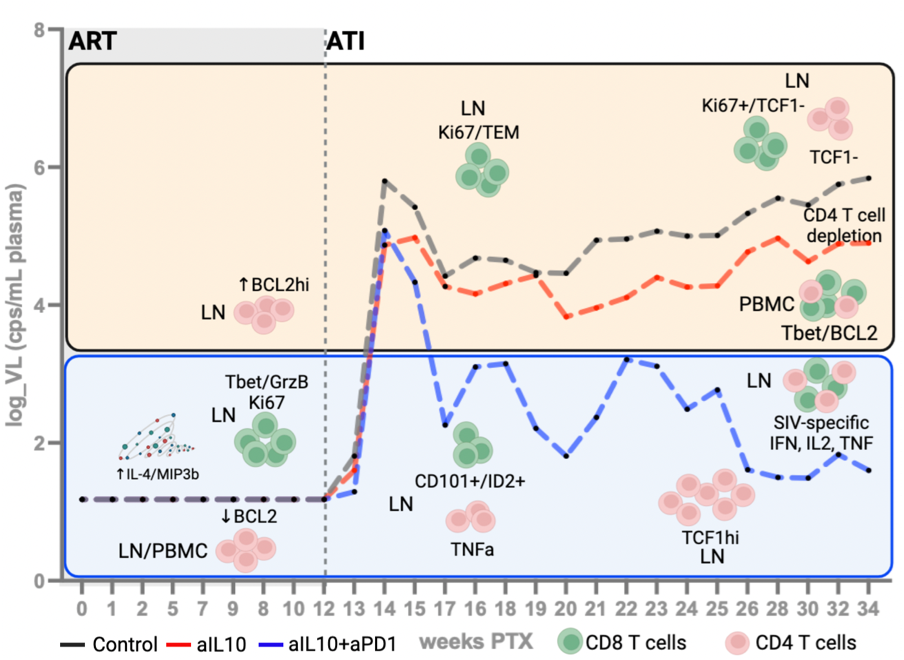
Durable viral load control post-ATI (less than a 1000 cps/mL in 80% of the animals up to 6 months) in the combo treated RMs was associated with a biphasic immune response (Fig 1). I) pre-ATI poised immune response with i) significant induction of effector (GrzB+, Tbet+) and proliferating (Ki67+) CD8 T cells in LNs; ii) significant decay in the pro-survival protein BCL2 in CD4 T cells in LNs and PBMCs; we and others have shown that BCL2 levels are higher in infected cells and iii) elevated plasmatic pro-inflammatory environment (IL1b, IL18, IP10, MIP3b and MCPs). These pre-ATI features were associated with control of viremia 24 weeks post ATI (week 36 PTX) and highlights a poised state of T cell differentiation providing advantage to the combo treated RMs as compared to aIL10-treated and control RMs. II) Post-ATI (36 weeks PTX – 6 months on ATI) there was i) a significant expansion of SIV-specific CD4 and CD8 T cells in LNs associated with viral control; ii) preserved CD4 T counts and iii) contraction of effector T cells to cells with a stem-like phenotype (TCF1+).
Conclusions:
The combo therapy set the stage for a poised immune effector state prior to ATI that enabled post-ATI differentiation and expansion of SIV specific CD4 and CD8 T cells leading to viral rebound control. A homeostatic environment, with preserved CD4 T cell counts and increased frequencies of cells expressing high levels of the stemness transcription factor TCF1, was uniquely observed in RMs that controlled the virus systemically and in tissues post-ATI.
Fig 1. Graphical abstract. Phases of the immune response induced by the combo therapy leading to viral rebound control post-ATI.