Background:
In 2018, Rwanda implemented HIV recency testing as part of active case surveillance and index testing to inform prevention strategies. Recency testing can shed light on transmission dynamics by helping to distinguish recent and long-term (LT) infections among newly diagnosed people. We examined yields of HIV positivity and HIV recency among sexual partners of newly diagnosed people in Rwanda.
Methods:
We conducted a prospective cohort study of 1,238 newly diagnosed people undergoing recency and index testing at 60 health facilities selected using probability sampling in all five provinces in Rwanda from August 2021–October 2022. We classified recent and LT infections based on a rapid test for recent infection (RTRI) followed by baseline viral load (VL). RTRI recent with a VL of ≥1000 copies/mL were classified as a recent case. RTRI LT with a VL of ≥1000 copies/mL were classified as a newly diagnosed LT case. We compared the average number of sexual contacts elicited, and HIV positivity and HIV recency yields among the sexual contacts of recent vs. LT cases over a 6-month period using Fisher’s exact test. HIV positivity yield was defined as the number of new HIV positive sexual contacts identified among all sexual contacts tested for HIV. HIV recency yield was defined as the number of sexual contacts with a recent infection identified among all sexual contacts tested for HIV.
Results:
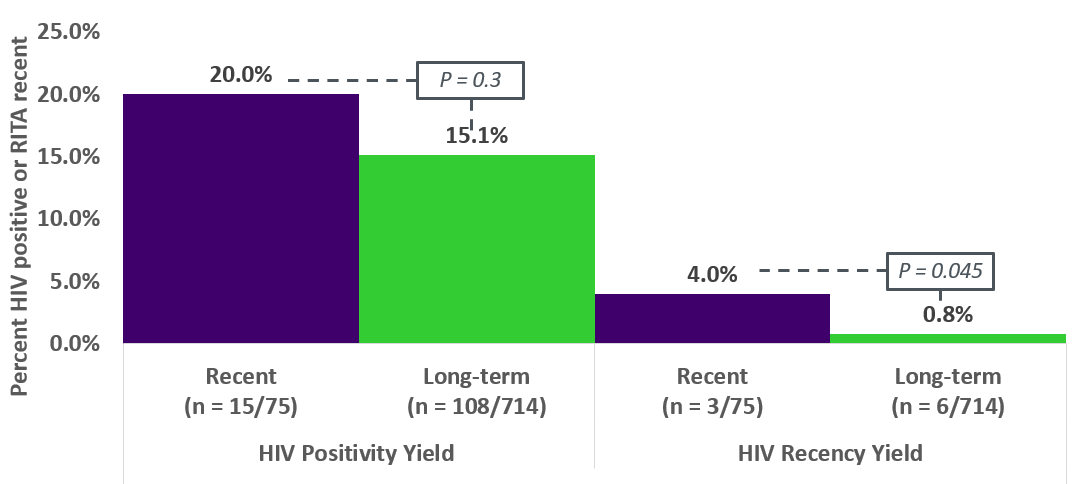
We enrolled 98 recent and 1,140 LT newly diagnosed people who identified 1,738 sexual contacts as part of index testing. Index cases had an average of 6.6 clinic visits during study follow up. Recent Index cases were more likely to be female compared to LT cases (79% vs. 62%), under 35 years of age (72% vs. 60%), single (38% vs. 30%), and men who have sex with men or female sex worker (22% vs. 9%) (p < 0.01 for all comparisons). For every recent index case, 1.67 sexual contacts were elicited compared to 1.38 contacts per LT case (p=0.06). HIV positivity yield among sexual contacts of recent and LT index cases were 20% and 15%, respectively (p=0.3) while HIV recency yield was 4% vs. 0.8% (p=0.045).
Conclusions:
Newly diagnosed people with recent infections compared to those with LT infections were associated with more sexual contacts with recent infections. HIV recency with index testing provides an important opportunity to identify new infections earlier and timely offer prevention resources to curb onward transmission.
Figure 1: HIV Positivity Yield and HIV Recency Yield among Sexual Contacts of Study Index Cases by RITA Status (n=789)