Background:
Suboptimal antiretroviral (ART) adherence can lead to virologic failure with consequent HIV-1 resistance. Tenofovir diphosphate (TFV-DP) in dried blood spots (DBS) is a powerful biomarker of cumulative ART adherence that is predictive of present and future viremia in persons with HIV (PWH) in South Africa (SA) and the US. This study explored the relationship of TFV-DP concentrations with antiretroviral drug resistance at the time of treatment failure in SA.
Methods:
Adult PWH from health clinics in Cape Town, SA on efavirenz-based first-line ART containing tenofovir disoproxil fumarate, who had an undetectable ( < 50 copies/mL) HIV viral load (VL), were prospectively enrolled in an observational cohort for 12 months. Monthly study visits included blood collection for HIV VL and DBS for TFV-DP. Viral breakthrough (VB) was defined as the first confirmed HIV VL >400 copies/mL, and HIV-1 genotyping was completed at the next visit after VB. ART adherence was monitored using an electronic adherence (EA) monitor, and estimated as a percent for the 30-days prior to VB. Non-parametric statistics were used to compare median [IQR] TDF-DP by genotype outcome.
Results:
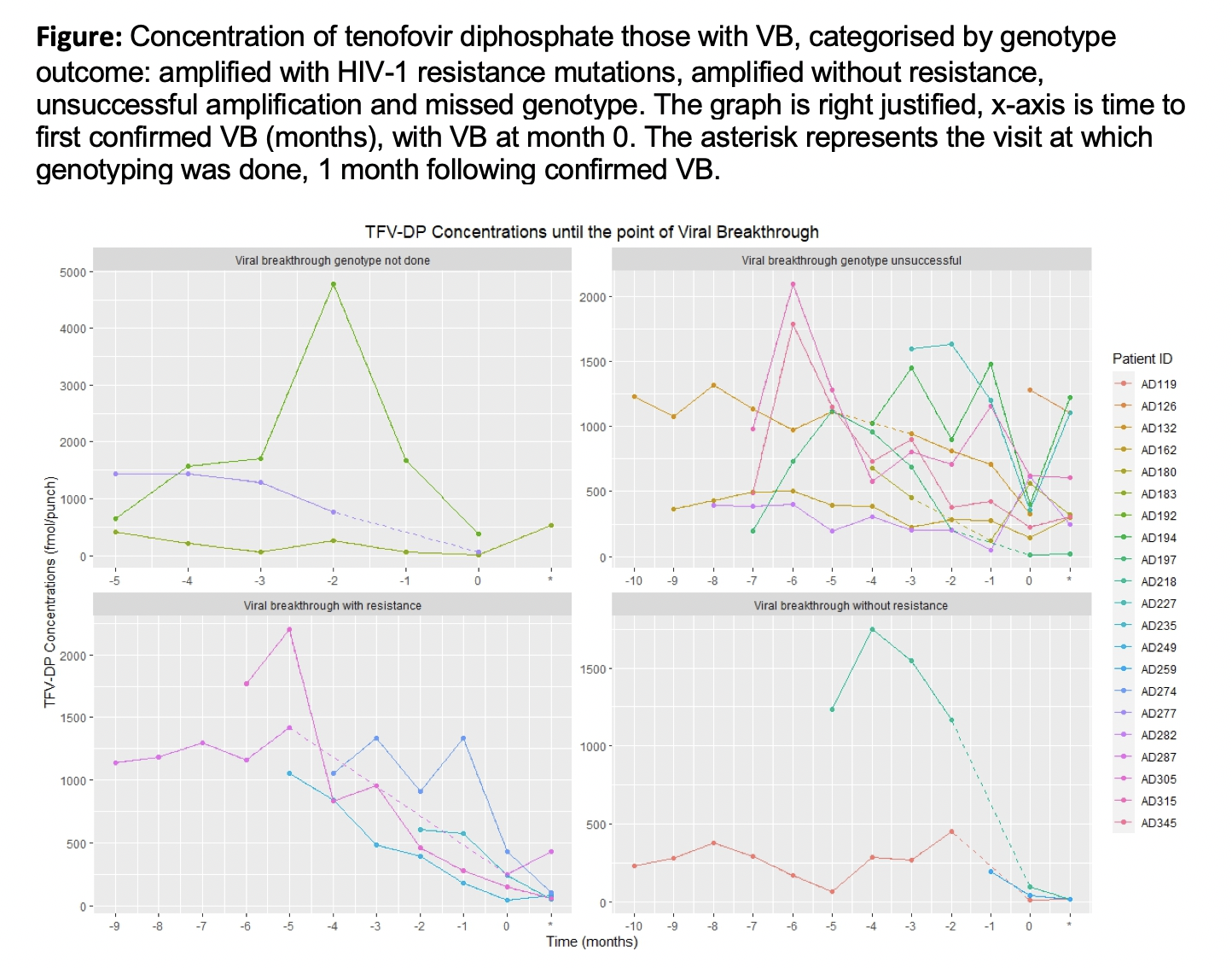
Of 250 participants (n=195, 78% women), 21 experienced VB, with a median (IQR) of 5 [4;7] months on study, and a median EA of 33.3 [13.3;53.3] %. There were no demographic differences between those with and without VB. Median (IQR) VL at VB was 4.0 [3.2;4.5] log copies/mL. TFV-DP concentrations trended downwards towards the VB visit (Figure). Median [IQR] TFV-DP concentrations were compared (p=0.035) and were significantly higher those whose HIV-1 genotype did not amplify due to being virally suppressed at the subsequent visit (n=10; 380 [227-661] fmol/punch, ; EA 45 [24.9; 59.2]%); than in participants who were successfully genotyped with evidence of drug resistance (n=5, 241 [150-247] fmol/punch, EA 20 [6.7;36.7]%) and in participants who were genotyped and did not have resistance (n=3, 39.9 [16.6; 93.9] fmol/punch; EA 33.3 [16-38]%). Five genotypes were missed. Only non-nucleoside reverse transcriptase inhibitor-associated mutations were identified at VB (K103N, E138K, Y118H).
Conclusions:
TFV-DP in DBS showed a step-wise inverse relationship with VB and drug resistance, with evidence of low (but not completely absent) cumulative low ART adherence in PWH who developed antiretroviral resistance in SA. Monitoring TFV-DP concentrations could be a valuable tool not only for predicting future VB but also for predicting future resistance.
Figure 1