Differentiated service delivery (DSD) models aim to lessen the burden of HIV treatment on patients and providers in part by reducing requirements for facility visits and extending dispensing intervals. With the advent of the COVID-19 pandemic, minimizing patient contact with healthcare facilities and other patients, while maintaining treatment continuity and avoiding loss to care, has become more urgent, resulting in efforts to increase DSD. In March, the Zambian Ministry of Health urgently promoted the 3- and 6- multi-months dispensing for patients on antiretroviral treatment (ART). We assessed the extent to which DSD coverage and ART dispensing intervals have changed during the COVID-19 pandemic in Zambia.
We used patient data from SmartCare, Zambia’s electronic medical record system, for 737 health facilities, representing about 3/4 of all ART patients nationally, to compare the numbers and proportional distributions of patients enrolled in DSD models and the average duration of drug dispensing between February 15 2020, and October 30 2020, 8 months after the first recorded COVID-19 case in Zambia on March 18, 2020.
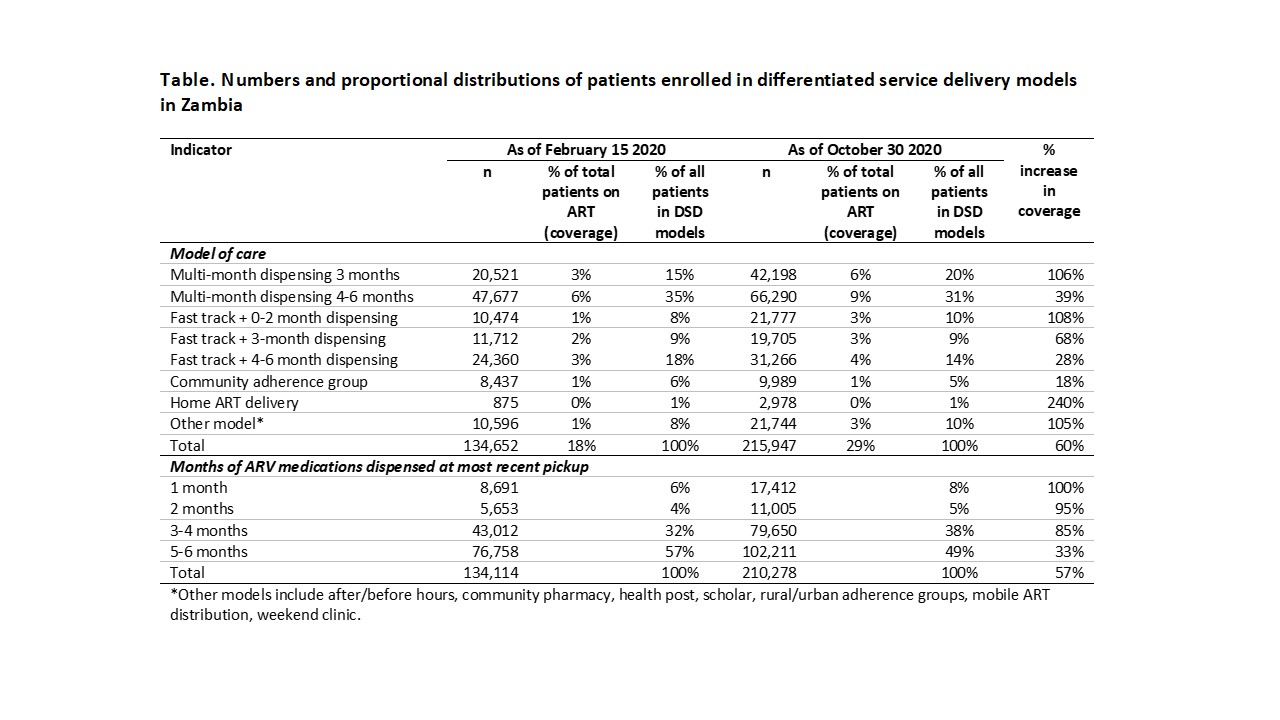
As expected, participation increased for all DSD models. The number of patients presently enrolled in a DSD model increased by 60% between February and October, from 134,652 (18% coverage) to 215,947 (29% coverage), though remaining below one third of all patients. Home ART delivery saw the greatest percent increase in utilization (240%), while community adherence groups experienced the smallest change (18%), potentially a reflection of efforts to discourage group models due to COVID-19 transmission risk. Although 6-month dispensing is Zambia’s national policy for stable patients, the proportion of patients receiving 6-month supplies fell from 57% to 49%, while the proportions of patients receiving a 1, 2 or 3month supplies rose. The shortening of dispensing intervals is primarily due to patients switching temporarily back from Tenofovir Lamivudine Dolutegravir (TLD) to Tenofovir lamivudine Efavirenz (TLE) to mitigate threats of TLD global supply chain.
The months of the COVID-19 pandemic showed increased participation in DSD models for stable ART patients in Zambia but shorter dispensing intervals. Efforts to eliminate obstacles to longer dispensing intervals should be prioritized to achieve the expected benefits of DSD models and minimize COVID-19 risk.