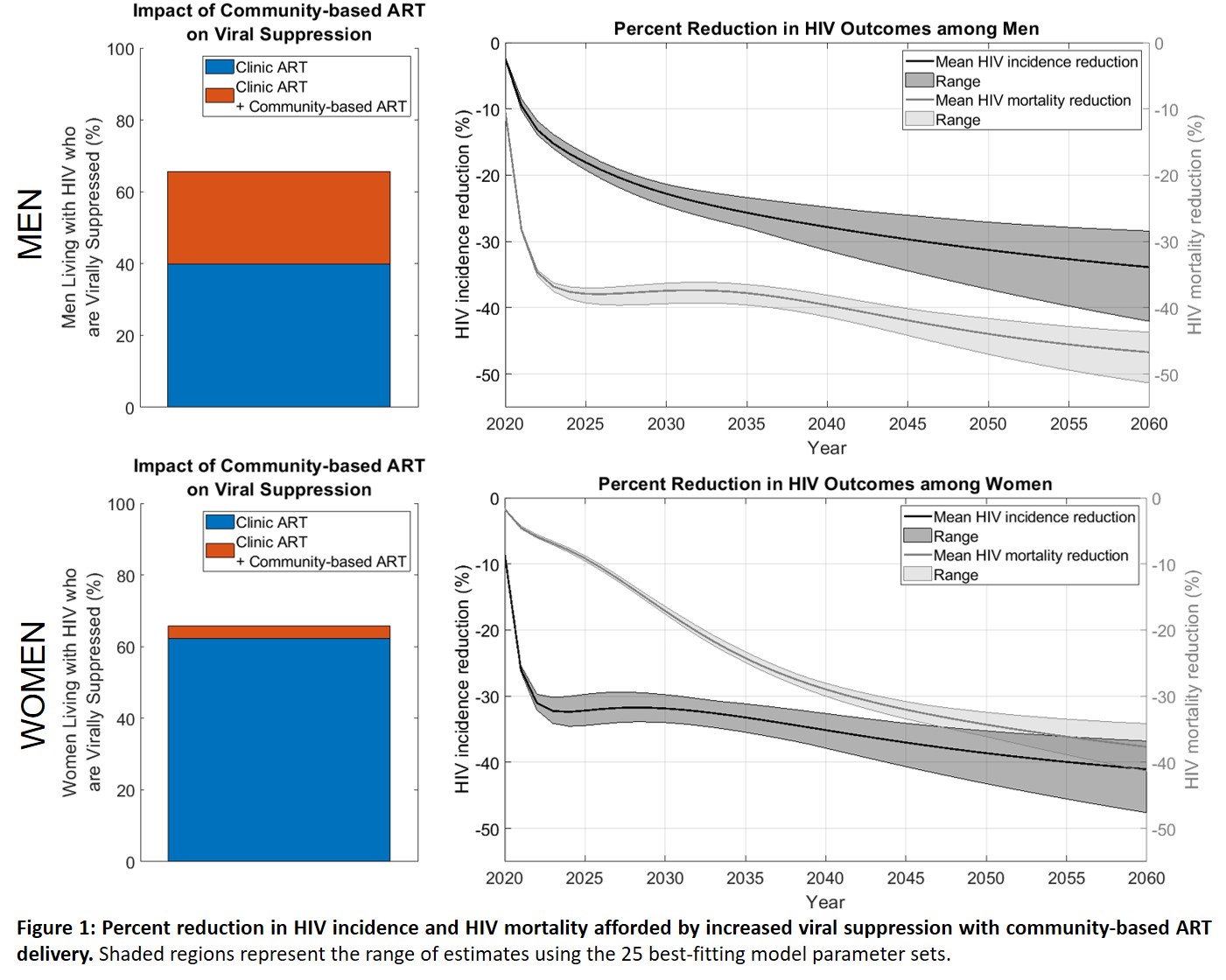
In South Africa, a lower proportion of men living with HIV are virally suppressed than women. The Delivery Optimization of Antiretroviral Therapy (DO ART) Study recently demonstrated that community-based delivery of antiretroviral therapy (ART) significantly increased HIV viral suppression compared to standard clinic delivery and eliminated the gender disparity in viral suppression. However, the impact of community-based ART delivery on population-level HIV incidence and mortality is needed.
We parameterized an HIV transmission model with data from the DO ART Study and population surveys to evaluate the impact of community-based ART delivery on HIV in KwaZulu-Natal, South Africa, a province with 27% HIV prevalence. Based on outcomes from the standard of care arm of DO ART, we estimated that 62% of women and 40% of men living with HIV are virally suppressed with clinic-based services. To represent community-based ART delivery, we modeled HIV testing campaigns that linked 90% of persons living with HIV not engaged in care to community-based ART, of whom 73% of women and 72% of men achieved viral suppression (66% suppression overall). We evaluated the 5 and 40 year impact on prevalence, incidence, and mortality of this expanded strategy compared to standard services.
Under clinic-based standard of care, the projected annual HIV incidence in 2020 is 2.5% (Range using 25 best-fitting parameter sets: 1.7-3.4%) among women and 1.1% (Range: 0.7-1.7%) among men. Within 5 years, we estimate that community-based ART delivery reduces HIV incidence in women by 32.2% (Range: 29.7-34.4%). By 2060, HIV mortality in women decreases by 37.7% (Range: 34.1-41.3%). Among men, HIV mortality declines by 37.9% (Range: 37.0-39.3%) within 5 years, and HIV incidence decreases by 33.9% (Range: 28.4-42.0%) by 2060. With community-based ART, the ratio of female to male HIV prevalence narrows from 2.9 (Range: 2.3-3.3) in 2020 to 2.1 (Range: 1.7-2.4) in 2060. In total, we estimate that community-based ART delivery will avert 843,421 (Range: 667,114-1,013,236) HIV cases and 683,776 (Range: 548,375-829,802) HIV-associated deaths by 2060.
Community-based ART has the potential to quickly and significantly reduce mortality in men and HIV transmission to their female partners, consequently decreasing HIV incidence rates among women. Eliminating disparities in viral suppression is projected to substantially increase population health in generalized epidemic settings with high HIV prevalence.