The COVID-19 pandemic and national responses to mitigate this public health threat have disrupted activities of daily living with economic and health impacts globally. The extent of these disruptions is evolving. Our objectives were to characterize participants who missed study visits during the pandemic and assess the impact of COVID-19 on HIV outcomes, employment, food security and trauma among people living with HIV (PLWH).
AFRICOS began enrolling adults at risk for HIV and PLWH at 12 PEPFAR-supported clinics in Tanzania, Uganda, Kenya, and Nigeria in 2013. At 6-monthly visits sociodemographic questionnaires were administered and clinical outcomes assessed. Chi-squared tests were used to describe differences between those presenting for and missing a study visit since the pandemic began, using data from participants’ most recent visit before 19 March 2020. Generalized estimating equations were used to estimate odds ratios (ORs) and 95% confidence intervals (95% CIs) comparing social and clinical indicators before and during the pandemic. Models were adjusted for age, sex and site; food security models were also adjusted for employment status. Analyses were restricted to those with a pre-COVID-19 visit on or after 1 January 2019 and at least one visit during the pandemic.
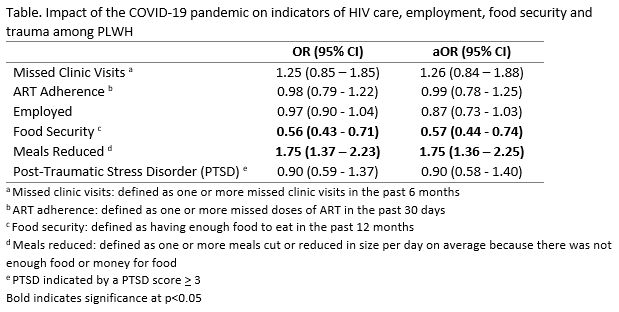
As of 1 November 2020, 1023 (44.5%) of 2298 PLWH with a pre-COVID-19 visit since 1 January 2019 had a visit during the pandemic. PLWH who missed a study visit during COVID-19 were less adherent to antiretroviral therapy (ART) (70.0% vs 88.6%, p<0.001), less adherent to clinic visits (77.5% vs 95.4%, p<0.001) and a greater proportion had a viral load >=1000 copies/mL on ART (17.5% vs 4.6%, p<0.001). Participants seen during the pandemic were less likely to be food secure (aOR: 0.57, 95% CI: 0.44 - 0.74) and more likely to have cut/reduced one or more meals per day (aOR: 1.75, 95% CI: 1.36 – 2.25; table). No significant impacts of COVID-19 were observed on clinic visit or ART adherence, employment, or Post-Traumatic Stress Disorder. Among 665 PLWH with available data, 597 (89.8%) had a >=3-month supply of ART during COVID-19.
PLWH missing study visits during COVID-19 were less engaged in care prior to the pandemic. Innovations such as multi-month dispensing, telemedicine, and other differentiated service delivery strategies should be used to retain PLWH in care. During the pandemic, HIV outcomes remained stable, but food insecurity needs to be addressed.