Women worldwide face multiple health risks such as unintended pregnancy and HIV. Multipurpose prevention technologies (MPTs) can simultaneously address the need for contraception and prevention of infectious disease with one product. Here, we are developing a long-acting (LA) biodegradable implant comprising a multi-drug formulation for HIV prevention and contraception.
We selected two well-characterized progestins, levonorgestrel (LNG) and etonogestrel (ENG), and two inhibitors of the reverse transcriptase, the NRTI tenofovir alafenamide (TAF) and an investigational NRTTI. Polycaprolactone extruded tubes were filled with various ARV-hormone combinations and heat sealed. In-vitro release from devices (in phosphate buffered saline, pH 7.4 at 37?C) was monitored using UV-vis spectroscopy or high-performance liquid chromatography (HPLC), while maintaining sink conditions.
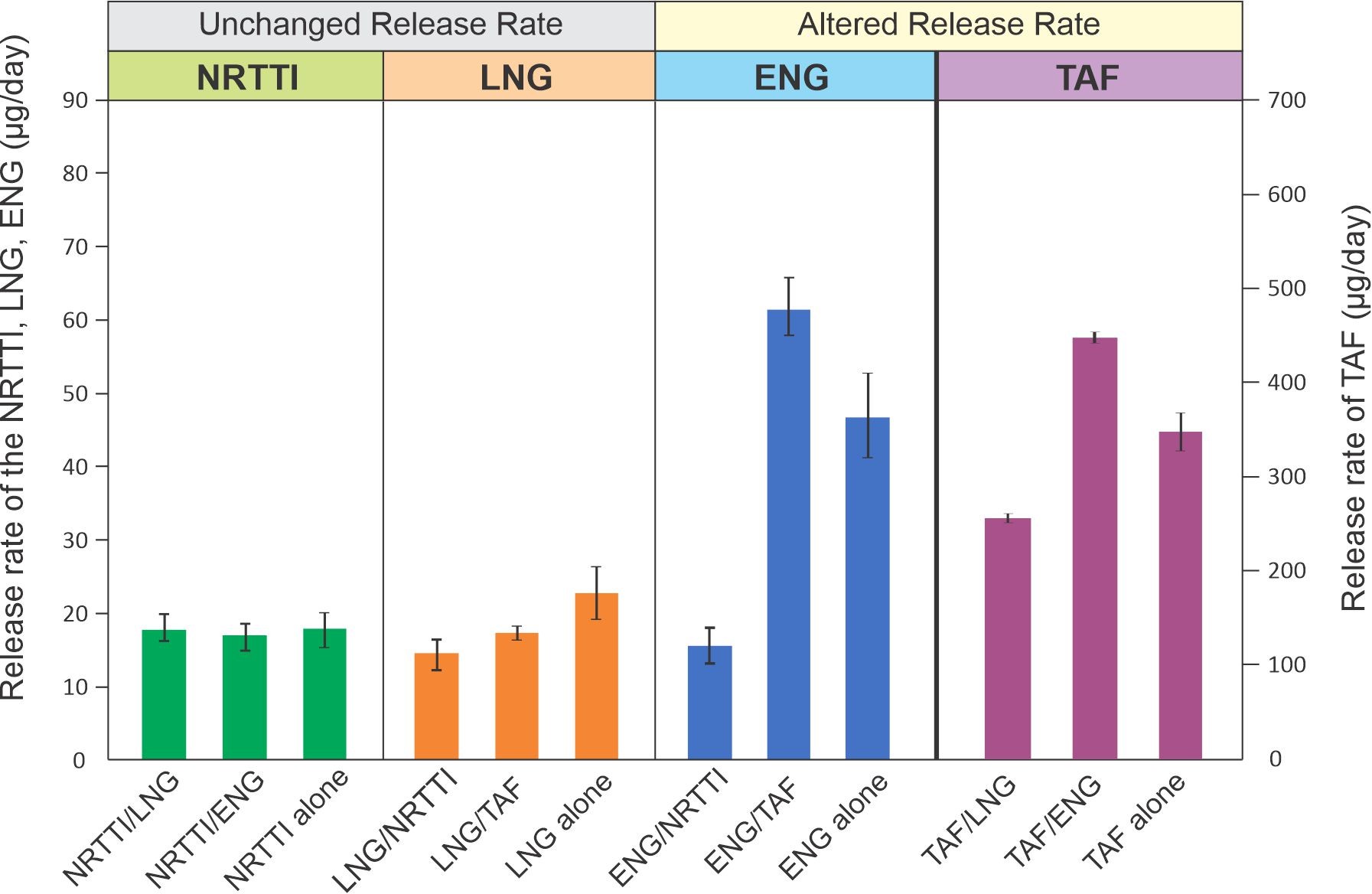
We evaluated 20 MPT multi-drug formulations, each containing varying ratios of an ARV, a hormone, and an excipient (e.g., 50/35/15, 50/25/25 wt.%). Implants comprising the multi-drug formulations exhibit linear release of both ARV and hormone up to 12-months. Variations in the drug to excipient ratios did not affect the release rate, indicating a membrane-controlled release process. Interestingly, the release rates of TAF and ENG are affected by the presence of another drug within the formulations, whereas the release rates of the NRTTI and LNG remained comparable to their respective single-drug formulations (Figure 1). Specifically, co-formulating the NRTTI with ENG lowered the release of ENG while maintaining the release rate of the NRTTI. On the contrary, co- formulation of ENG and TAF exhibited enhanced release rates for both drugs.
We developed a LA MPT implant containing multi-drug formulations for sustained delivery of ARV and hormones with zero-order kinetics. Co-formulating ARVs and hormones showed varied effect in vitro on the release rate of each drug, increasing our ability to tailor the release rates of ARVs and hormones via the co-formulation process. Using a single co-formulated implant can simplify administration and willingness to use and may improve compliance by eliminating the need for insertion of multiple rods containing individual drugs.