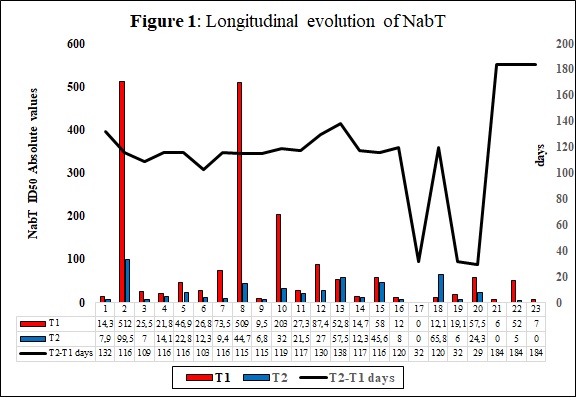
Development of neutralizing antibody (Nab) is crucial for protection from SARS-CoV-2 reinfection. The aim of the study was to analyze Nab titers (NabT) and kinetics over time in a cohort of 85 unselected not hospitalized Italian subjects (pts) with COVID-19 infection, with mild or no symptoms, tested after symptoms onset or for surveillance of healthcare workers.
Two-fold serial dilutions of heat-inactivated sera were incubated with 100 TCID50 of SARS-CoV-2 virus (lineage B) at 37°C for 1 h in 96-wells plates. Then, pre-seeded 10,000 Vero E6 cell lines per well (ATCC CRL-1586) were treated with serum-virus mixtures and incubated at 37°C. After 72h, cell viability was determined through the commercial kit Cell-titer Glo 2.0 (Promega). The NabT was defined as the reciprocal value of the sample dilution that showed a 50% protection of virus cytopathic effect (ID50). NabT ?5 ID50 were defined as SARS-CoV-2 positive and neutralizing. Chi squared, Wilcoxon, Fisher’s exact test and Spearman’s correlation coefficient were used.
Female were 57 (67.1%) and median age was 48 years. Pts were classified as early tested (ET, <60 days, n=40) and late tested (LT, >60 days, n=45). Overall, 30 (35.3%) pts had low (<10 ID50) NabT, 33 (38.8%) had intermediate NabT (ID50 11 to 50), and 22 (25.9%) had high NabT (ID50 >51, 9 of them >100). The frequency of each NabT class was comparable in ET and LT: low NabT was found in 11 (27.5%) and 19 (42.2%), intermediate in 16 (40%) and 18 (40%) and high in 13 (32.5%) and 8 pts (17.8%), respectively. However, no NabT higher than 200 ID50 was found in LT vs 5 in ET (p=0.04). No correlation between age and gender and NabT was found. At now, 23 pts had 2 NabT available during the follow up (T1 and T2); the interval between the two tests was 117 days (median). Almost all pts (20/23, 87%), showed NabT decrease: the median value of percentage decrease respect to the previous value was 63.2% (IQR 30.8-85.7) (p=0.0006). One pt had undetectable NabT at both times and two pts experienced an increase (Figure 1). No correlation between interval length, T2 value and percentage of decrease was observed.
One third of pts had a very low level of NabT regardless of test timing. After 60 days from diagnosis a subset of pts had a value >100 but no >200, differently from the first 60 days, suggesting that NabT level could be a useful tool for dating past infections. The observed decrease of NabT has implications for reinfection and vaccine.