Multi-assay algorithms (MAAs) developed for estimating HIV incidence from population-level surveys have also been used to identify individuals with recent infection. Little is known about the performance of these methods for individual-level recency assessments. The most widely used MAA for incidence estimation includes the limiting antigen avidity assay (LAg-Avidity) plus HIV viral load (CDC MAA). We compared the performance of the CDC MAA to three other MAAs for identifying persons infected <1 year as recently infected.
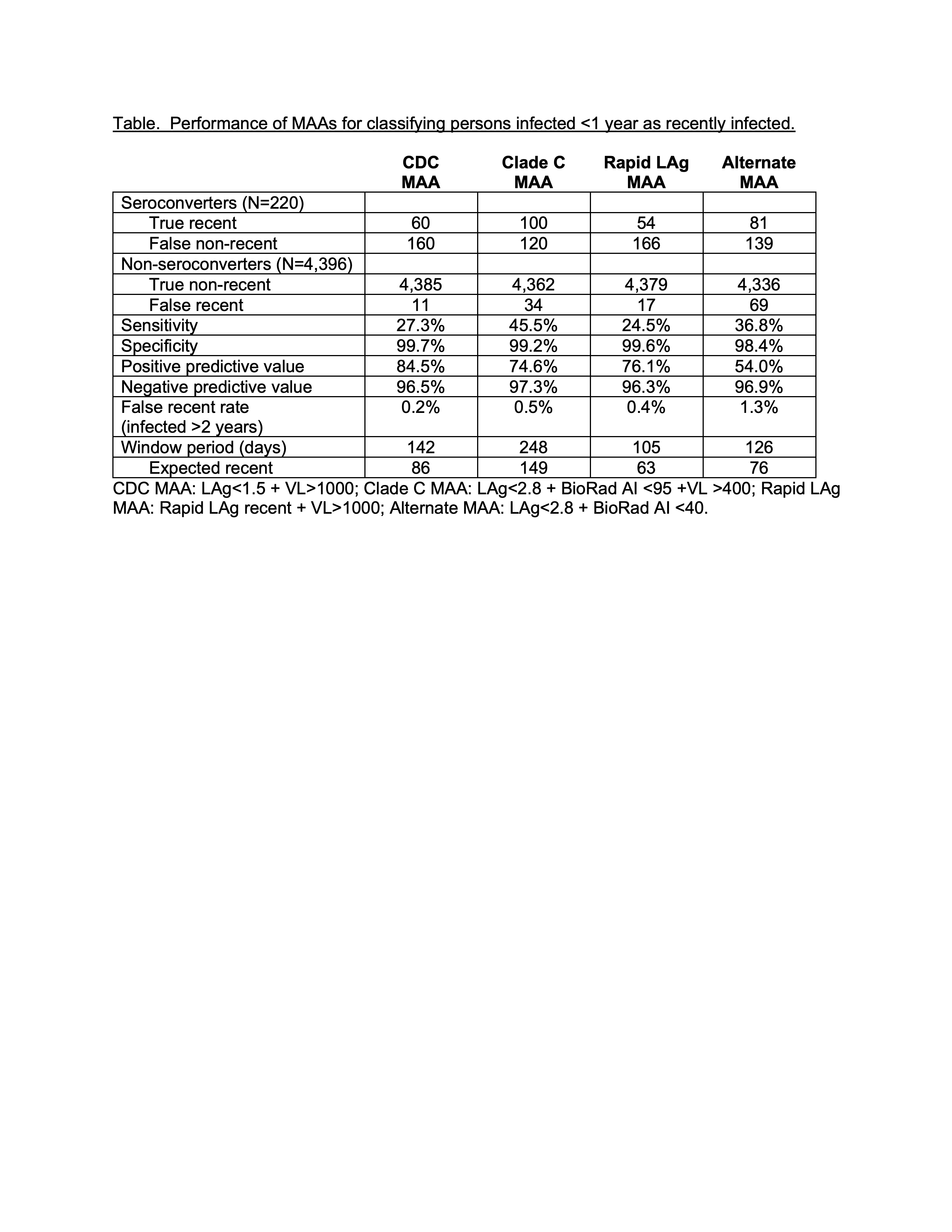
This study included samples from 220 seroconverters (infected <1 year) and 4,396 non-seroconverters (infected >1 year) enrolled in an HIV prevention trial in Zambia and South Africa; 28.6% of seroconverters and 73.4% of non-seroconverters were virally suppressed at sample collection (viral load ?400 copies/mL). Samples were tested using two laboratory-based assays (LAg-Avidity, BioRad-Avidity) and a point-of-care assay (Assanté HIV-1 Rapid Recency assay; rapid LAg). Four MAAs were evaluated that included different combinations of assays with different assay cutoffs (Table).
The four MAAs classified different numbers of seroconverters (54 [24.5%] to 100 [45.5%]) and non-seroconverters (11 [0.3%] to 69 [1.6%]) as recently-infected. Sensitivity, specificity, and the false recent rate for identifying seroconverters as recent varied among the MAAs (Table). Two MAAs classified fewer seroconverters as recent than expected based on their mean window periods (CDC MAA, p=0.0004; Clade C MAA, p <0.0001). The 60 seroconverters classified as recent by the CDC MAA were a subset of the 100 seroconverters classified as recent by the Clade C MAA. Seventy-two seroconverters were classified as recent by the CDC MAA and/or the Rapid LAg MAA; these MAAs use different LAg assays with the same viral load cutoff. These 72 seroconverters included 12 classified as recent by the Rapid LAg MAA only, 18 identified as recent by the CDC MAA only, and 42 classified as recent by both MAAs.
Substantial differences were observed in the performance of four MAAs for identifying individuals infected <1 year as recently infected. Each MAA classified different groups of individuals as recent vs. non-recent, even when the MAAs differed only in the type of LAg assay used (lab-based assay vs. rapid). These performance issues should be considered when using these MAAs for applications designed to identify individuals with recent HIV infection.