The present study employed a combination of data science and inferential analytic methods to delineate the early and ongoing risk factors for clinical phenotype variability in a large group of individuals who initiated treatment during acute HIV (AHI).
Participants included 412 Thai adults enrolled in RV254/SEARCH 010 who completed longitudinal multi-omic (e.g., viral, immune, neuro, psychosocial) assessments before and after 144 weeks of ART. Individuals were classified into favorable vs. unfavorable clinical phenotypes at weeks 96 and 144 using previously established criteria (CD4 T cell count >500, CD4/CD8 T cell ratio >1.0, and presence of viral blips). Outcomes included phenotype designation, baseline predictors, and risk trajectories modeled through weeks 96 and 144 post ART. Group comparisons and hierarchical clustering examined correlates of trajectory subgroup membership.
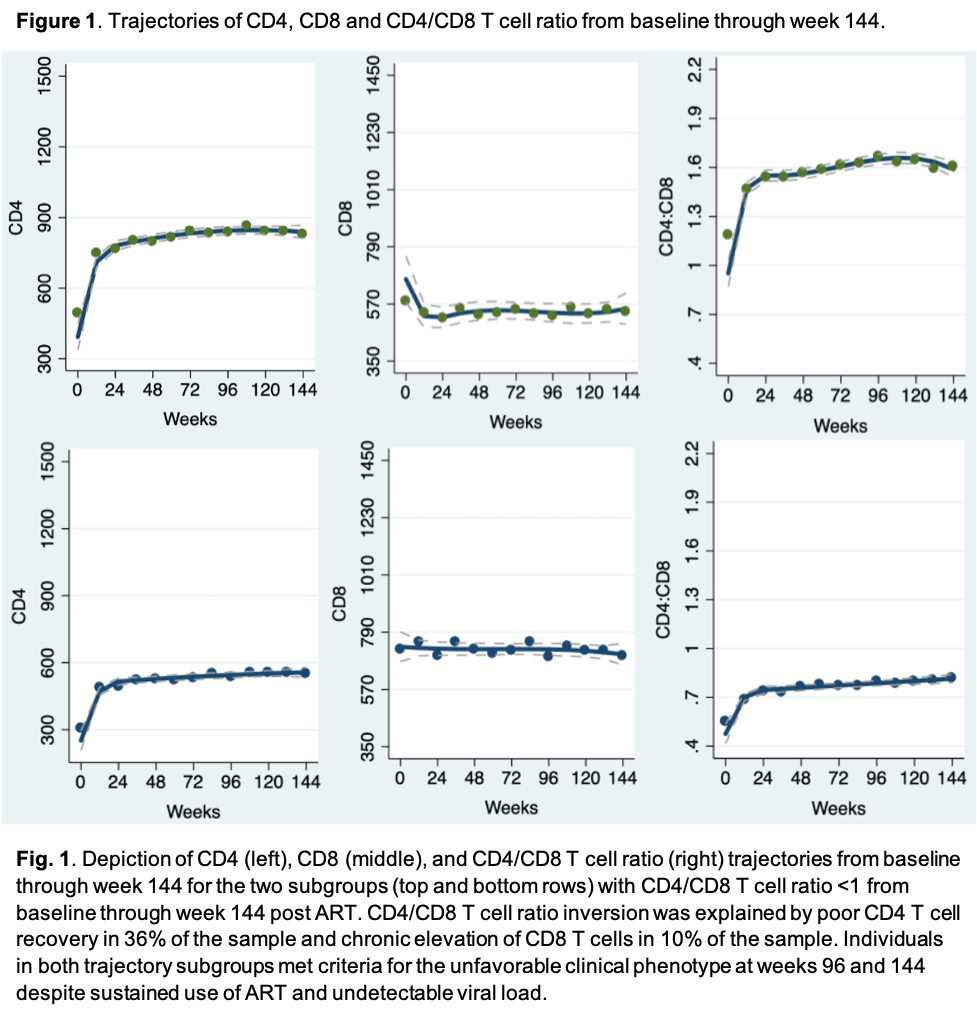
Participants were mostly male (97%), Fiebig stages I-III (86%), with a CD4 T cell count >350 at baseline and undetectable viral status by week 24. Less than half (40% and 41%) of the study sample achieved a favorable clinical phenotype at weeks 96 and 144, respectively. Baseline CD4/CD8 T cell ratio was the strongest determinant of clinical phenotype designation at both follow-up time points. Older age, increased self-report of depressive symptoms, and increased neutrophil count at baseline contributed to the prediction models. Multivariate trajectory analysis revealed five subgroups of CD4, CD8 and CD4/CD8 ratio profiles (see Figure 1). Two of the subgroups (46% of the sample) exhibited early and chronic CD4/CD8 T cell ratio inversion, owing to either incomplete CD4 T cell recovery (max CD4 <500; 36% of the sample) or persistently increased CD8 T cells in the context of robust CD4 recovery (max CD4 >850). Baseline depressive symptoms, later Fiebig stage at ART onset, and levels of IL-7, IL-23, CD27, Tim-3, and RANTES differentiated the CD4/CD8 T cell ratio trajectory subgroups and clinical phenotype designation at week 144.
A combination of psychosocial, viral, and immune factors (including myeloid and lymphocyte T cell populations) at the time of ART onset predict clinical phenotype variability after 144 weeks of treatment. Baseline risk variables differentiate CD4 and CD8 subgroups and chronic CD4/CD8 T cell ratio inversion and clinical phenotype designation.