The Veterans Aging Cohort Study (VACS) Index 1.0 incorporated general and HIV-specific health biomarkers (age, hemoglobin, FIB-4, eGFR, Hepatitis C virus [HCV], HIV-1 RNA, and CD4) and discriminated mortality risk in persons with HIV (PWH). Conversion from categorical to continuous forms of variables and the addition of BMI, total white blood count, and albumin (VACS Index 2.0) substantially improved discrimination. In preparation for estimating remaining life expectancy, our current aim is to evaluate the calibration of VACS Index 2.0 in the North American AIDS Cohort Collaboration (NA-ACCORD), which comprises over 20 cohorts in the US and Canada, including VACS.
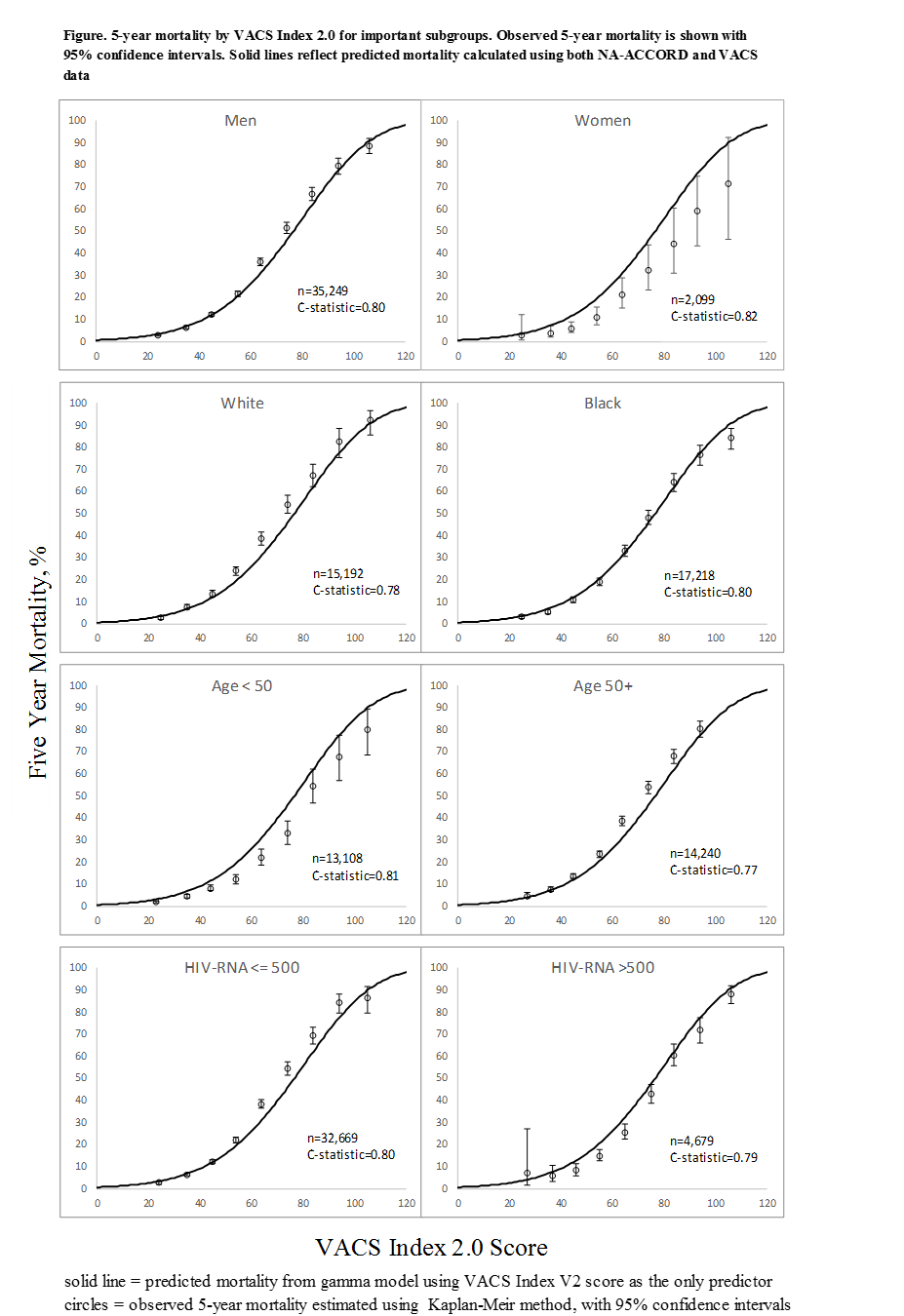
We included VACS and three other NA-ACCORD cohorts that collected the required data elements and ascertained mortality with the National Death Index. Among participants on ART for at least one year, we randomly chose a VACS Index 2.0 at least one year after start of ART as ‘baseline’ (ranging from 10/1999 – 4/2018) to ensure the sample included PWH at different stages of HIV. Five-year mortality was calculated up to 3/2019 or cohort close date. Calibration curves were generated by comparing predicted mortality overall (estimated using a gamma model with the VACS Index Score 2.0 as the only predictor) to observed mortality for the subgroups gender, age50, race, and HIV-1 RNA500 copies/mL at baseline. Observed mortality is based on Kaplan-Meier estimates, and C-statistics were generated to assess discrimination.
Of 6,429 PWH in the three NA-ACCORD cohorts and 30,919 in VACS, median age was 46 and 56 years; 20% and 3% were women; 38% and 48% were African-American, 40% and 41% White; and 24% and 22% had a history of HCV, respectively. Median follow-up time was 3.5 years (1.9-5.0). VACS Index 2.0 showed greater discrimination than VACS Index 1.0 overall (0.80 vs. 0.77, p<.001) and for all subgroups. In overall and subgroup analyses, predicted and observed mortality largely overlapped, although was overestimated among women and those less than 50 years.
VACS Index 2.0 improves discrimination over VACS Index 1.0 in NA-ACCORD and across a wide range of subgroups. Calibration is good overall although there is overestimation in certain subgroups.