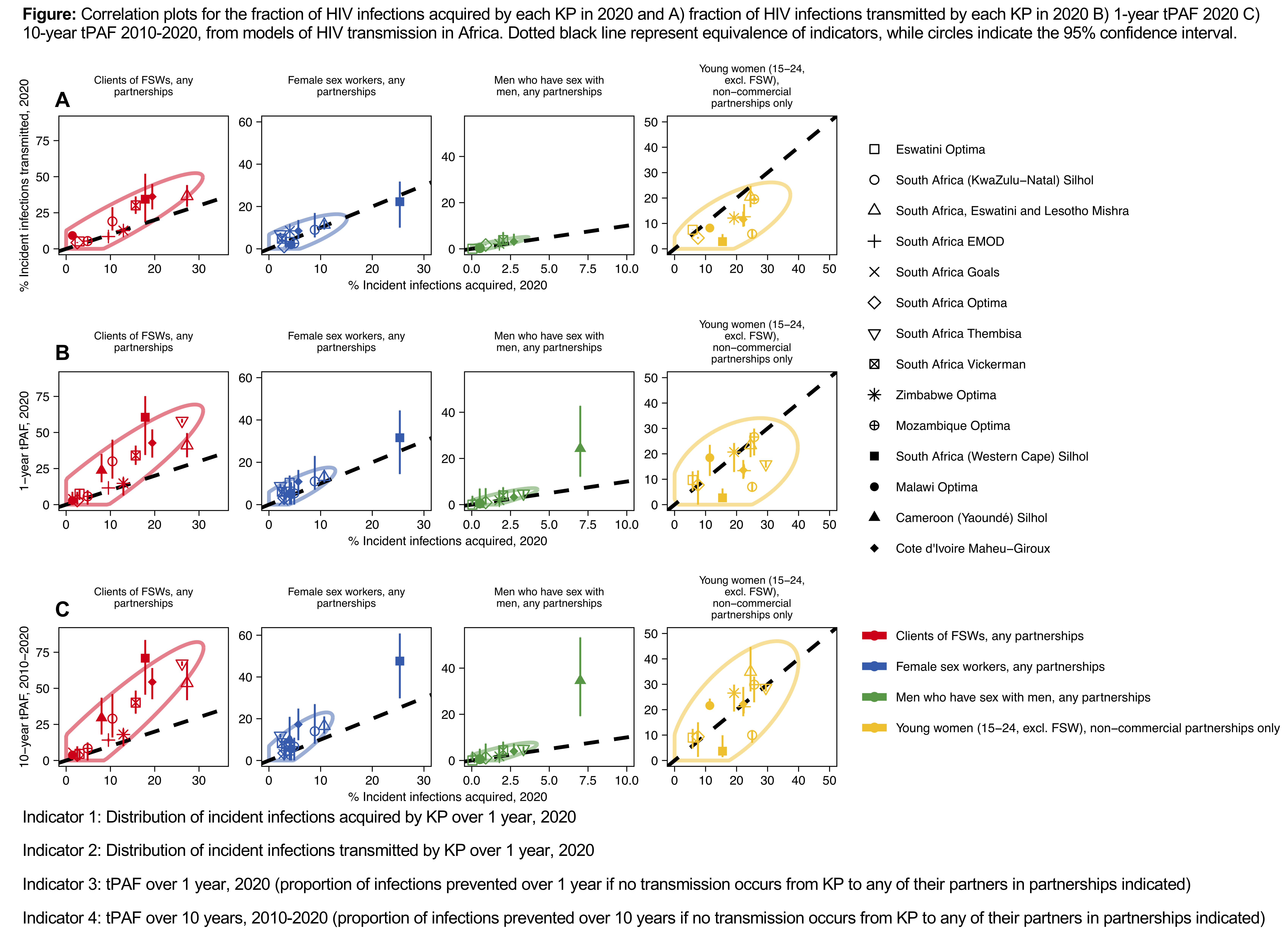
Quantifying the contribution of key populations (KP) including female sex workers (FSW), their clients, men who have sex with men (MSM) and young women (15-24 years old) to HIV epidemics due to prevention/treatment gaps is important to plan effective intervention programs. We used mathematical models to compare four different commonly used indicators of the contributions of population subgroups to HIV epidemics.
Fourteen transmission-dynamic mathematical models of HIV, calibrated to different African settings reflecting existing levels of intervention/treatment and existing gaps, were used to derive four indicators for each KP: (1) % incident infections acquired in 2020, (2) % incident infections transmitted in 2020, (3) transmission population attributable fraction (tPAF) over 1-year (2020), (4) tPAF over 10 years (2010-2020). KP-specific correlation plots were used to compare indicators and to assess the level of agreement between indicators on the greatest contributor to HIV.
Estimates of the 10-year tPAF (Fig.C) were consistently greater than the 1-year tPAF (Fig.B), which was greater than the % HIV infections transmitted in 1 year for each KP (Fig.A), reflecting increasing numbers of secondary transmissions captured by each indicator. For FSW, their clients and MSM, the acquisition indicator was consistently lower than the three transmission indicators. Whereas for young women, the acquisition indicator tended to be larger, suggesting that they acquire more infections than they transmit. Agreement on the greatest KP contributor across all indicators was rare (3 models), even for indicators related to % incident infections acquired/transmitted (4 models), but more common for the 1-year/10-year tPAFs (13 models).
Using one indicator is insufficient to fully characterize the contribution of KP resulting from HIV prevention/treatment gaps in the settings explored. Distributions of HIV acquisition and longer-term tPAF appear to most appropriately reflect the relative contribution of different KP across diverse African HIV epidemics.