With Thailand regarded as food secure for nearly a decade, at-risk groups including migrant workers still face food insecurity and have higher risk of acquiring HIV infection. People living with HIV and facing food insecurity have been documented to have higher risk of poor health and HIV treatment outcomes, notably altered risk behaviours and decreased adherence to antiretroviral therapy (ART). However, research on direct links between food insecurity and treatment outcomes such as viral suppression is scarce. The aim of this study was to investigate how food insecurity are associated with income, viral suppression, ART treatment and ART adherence in Burmese migrant workers living with HIV in Chiang Mai province of northern Thailand.
Data collected through face-to-face survey was combined with routine laboratory tests in a cohort of 316 migrants (113/203 M/F) living with HIV. 11 treatment centers for HIV in rural and urban Chiang Mai gathered data on ART use and adherence, physical and mental health, sexual behaviour, socio-demographics and food security (Household Food Insecurity Access Scale (HFIAS-III)). Using a step-down multivariate logistic regression, we calculated odds ratios (OR) and 95% confidence intervals (CI), adjusting for confounders, including ART regimen.
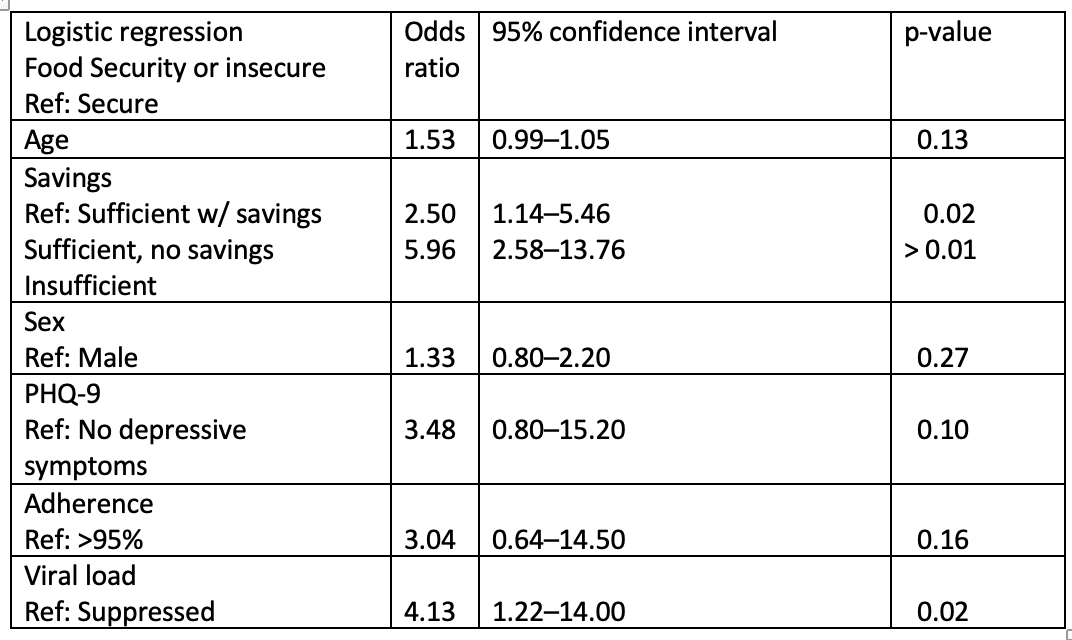
In this cross-sectional study, 48.7% (n=162) of migrant workers living with HIV reported food insecurity, and 14.2% (n=45) fulfilled criteria for severe food insecurity. Most respondents were ART-adherent 96.8% (n=305), and virally suppressed 93.5% (n=290), with 4.1% (n=13) expressing symptoms of clinical depression. In adjusted analysis, food insecurity was associated with lack of viral suppression [OR=4.13, CI=1.22–14.00] and perceived poverty/lack of income [OR=5.96, CI=2.58–13.76].
Burmese migrant workers living with HIV in Chiang Mai report high adherence to ART and are mostly virally suppressed. Food insecurity is here linked to viremia and poverty or lack of income, suggesting that a subset of migrants face multiple burdens that increase their likelihood of becoming viremic. With food insecurity and poverty rising as a result of the COVID-19 pandemic this may end up negatively impacting HIV treatment outcomes.