To curb the ongoing high HIV incidence in men who have sex with men (MSM) and transgender women (TW) in Peru, HIV control interventions would benefit from improved targeting of those at highest risk. Analysis of ‘sexual affiliation networks’, comprised of individuals and the venues where they meet sex partners, is an indirect and information-rich approach that could inform such efforts by identifying ‘high-risk’ venues for outreach. We hypothesized that sexual affiliation network analysis would reveal a subset of venues in Lima, Peru where MSM and TW in high-risk sexual networks could be contacted for HIV testing and linkage to services.
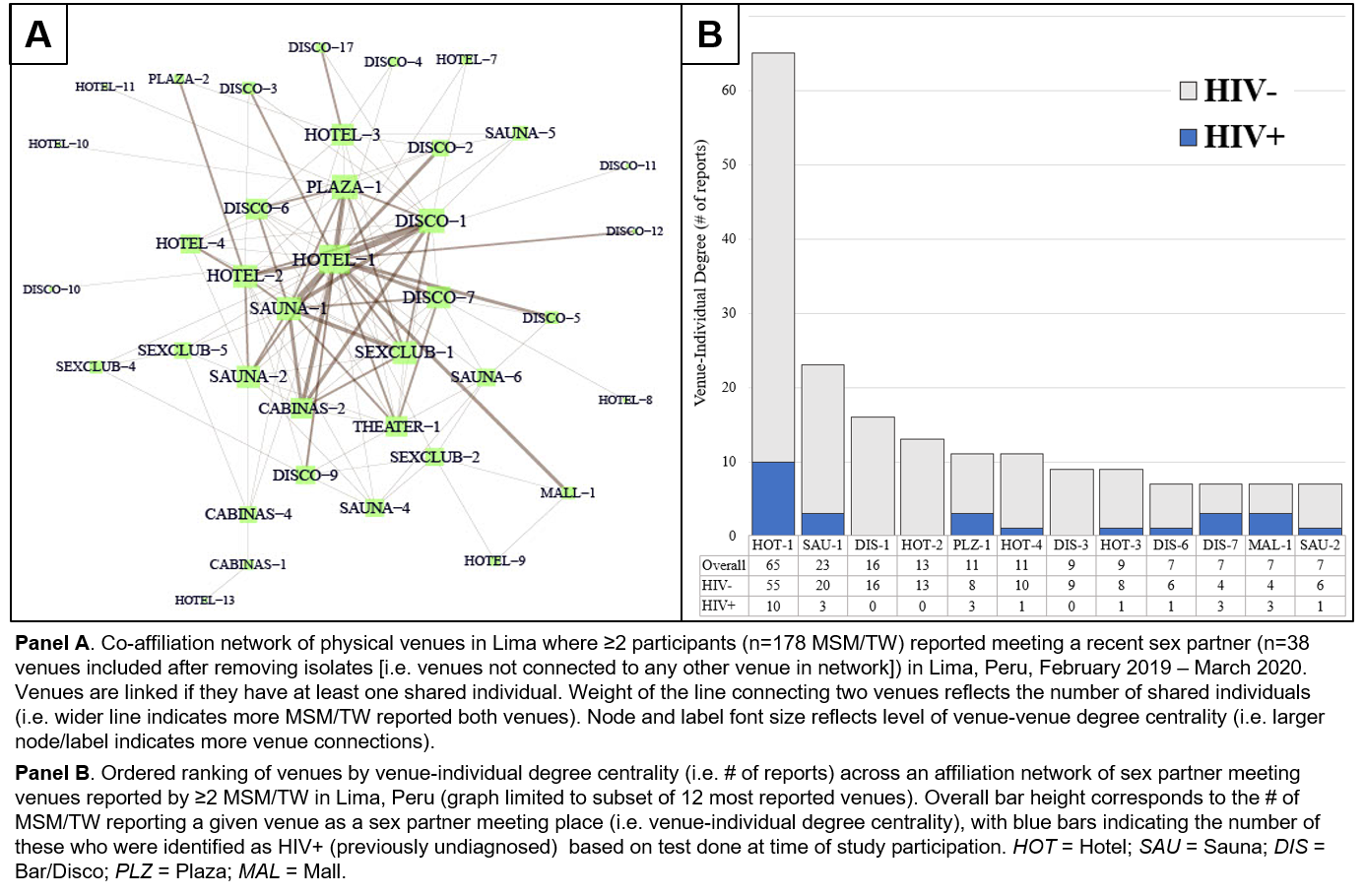
We recruited adult MSM and TW presenting for voluntary HIV testing at Via Libre, a large HIV clinic in downtown Lima, to complete a brief survey asking about the physical venues where they met a sex partner in the last 3 months. We also collected data on sexual risk behaviors and HIV test result. Using the igraph package in R, we first reconstructed the venue-individual (2-mode) affiliation network comprised of venues reported by ?2 MSM/TW and the MSM/TW who reported them. To evaluate venue connectivity, network prominence, and relationship to HIV transmission risk (based on HIV positivity rate of participants), we then analyzed the venue-venue (1-mode) co-affiliation network comprised of venues named by ?2 MSM/TW.
Of 344 (52%) total survey participants, 178 reported ?1 sex partner meeting venue (analysis population): 155 (87%) were MSM and 23 (13%) TW; median age was 26 (interquartile range [IQR], 22 – 32); and 28 (16%) tested positive for HIV on the day of the study. Overall, 44 unique venues were included in the network analysis: 14 hotels, 12 discos, 5 saunas, 4 internet ‘cabinas’, 4 sex clubs, 2 plazas, 2 malls, and 1 theater). Visualization of the venue-venue co-affiliation network (Panel A) in conjunction with ordered ranking of network centrality (superimposed with venue-level HIV positivity) (Panel B) identifies a densely connected subset of venues (e.g. Hotel-1, Sauna-1, Plaza-1) with high venue-level HIV positivity.
Sexual affiliation network analysis revealed a core subset of highly connected venues in Lima that may be ideal sites at which to reach MSM/TW in high-risk sexual networks. Our results highlight a potentially valuable role for sexual affiliation network analysis as a tool to aid public health systems in effectively targeting HIV testing and prevention interventions to interrupt HIV transmission.