The cause of the geographic variation in HIV epidemics across generalized hyperendemic settings is poorly understood. We assessed the role of geospatial clustering of HIV risk factors including viral load within nationally representative census enumeration areas (EAs) to predict prospectively observed incident infections in the hyperendemic setting of Eswatini.
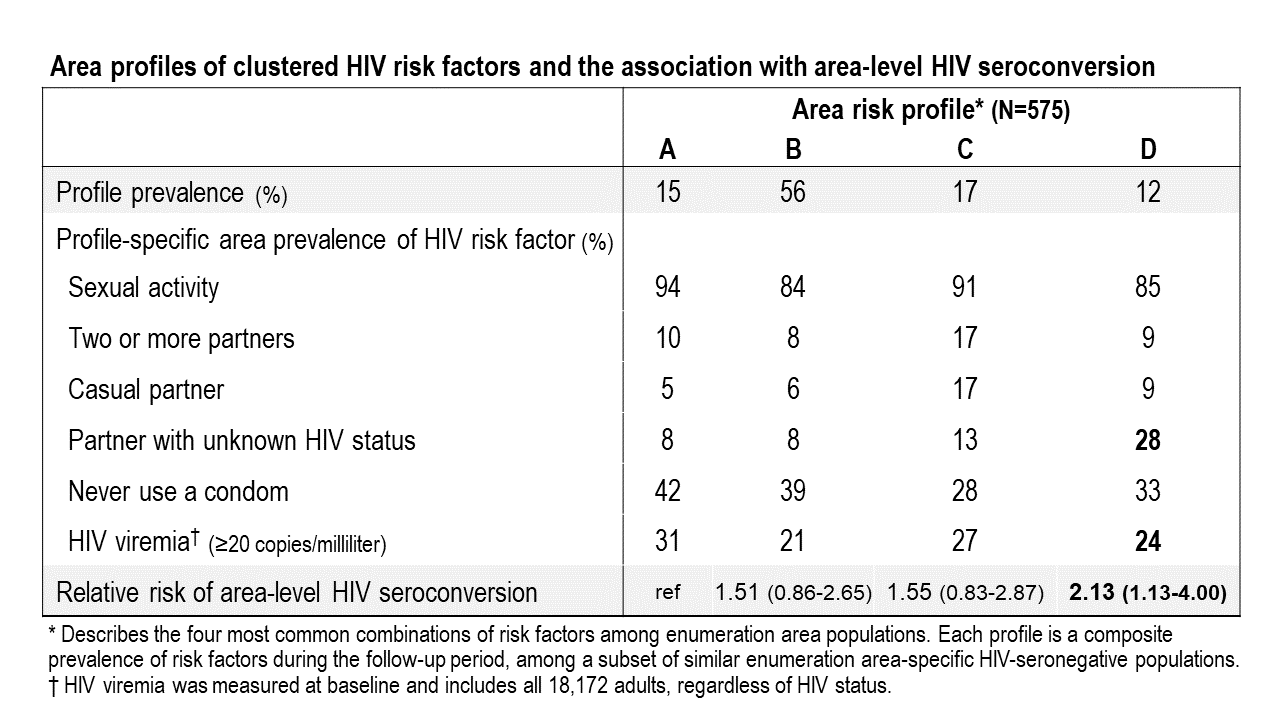
In 2011, a household-based sample of 18,172 adults, ages 18-49 years, from 575 EAs received HIV testing and completed an administered questionnaire. All HIV-seropositive samples were tested for HIV RNA. HIV-seronegative adults were retested and reinterviewed six months later. Multi-level latent class modeling was used to identify statistically significant combinations of seven HIV risk factors (i.e., sexual activity, number of partners, casual partnerships, partner HIV status, condom use, HIV viremia at ?20 copies/milliliter among all adults regardless of HIV status, and gender-age group) and to classify them into EA risk profiles of composite EA prevalences of HIV risk factors. Generalized linear regression was used to assess whether EA-level HIV seroconversion (i.e. if an EA had at least one HIV seroconversion during the follow-up period) was associated with EA risk profiles or with the observed mean EA prevalence of any single HIV risk factor across all 575 EAs.
Of 11,880 HIV uninfected adults (51% male, 45% 18-24 years), 11,155 (94%) completed follow-up. Based on all risk factors, four EA risk profiles were identified, ranging from lowest (Profile A) to highest (Profile D) risk of new infections. Prevalence of EA-level HIV seroconversion increased across profiles: A (14.3%), B (21.8%), C (24.6%) and D (30.8%). EA-level HIV seroconversion was twofold higher in Profile D than Profile A areas [relative risk 2.13, 95% confidence interval (1.13, 4.00), p=0.02]. The prevalences of unknown partner HIV status and detectable viremia in Profile D were 28% and 24%, respectively, compared to 8% and 31% in Profile A. In isolation, none of the observed mean EA prevalences of any risk factor was independently associated with EA-level HIV seroconversion.
In a generalized epidemic, a composite geospatial measure of concurrent HIV risk factors including viremia was better than viremia alone in predicting HIV incidence at an EA level. Tailoring HIV prevention and treatment interventions to area patterns of HIV risk factors may optimize the impact of national HIV response efforts in similar settings.