Accurate HIV risk assessment is needed to optimize resource allocation for HIV prevention. Existing risk scoring tools are primarily based on individual-level measures such as age and sexual behavior. Community HIV prevalence and viral load are proxies for HIV transmission potential and could inform risk prediction.
We developed and validated gender-specific HIV risk prediction models using data from the Africa Health Research Institute’s population-based cohort in rural KwaZulu-Natal, South Africa. Eligible individuals were aged 15-54 years with an HIV-negative test and at least one subsequent HIV test. Individual covariates included demographic, socioeconomic, and sexual behavior measures collected via annual household surveys. Geospatial covariates included annual small area estimates of HIV prevalence and viral load constructed from home-based surveillance. Geospatial surfaces were estimated using a 3 km bandwidth Gaussian kernel, and covariate values were assigned to each individual based on their location of residence. We trained models on data from 2012 to 2015 using Cox proportional hazards regression models with time-varying covariates and with lasso penalties selected via cross-validation. We validated model predictions on data from 2016 to 2019 and assessed performance using area under the ROC curve (AUC). We compared full models (based on both individual and geospatial covariates) to models trained only using age and geospatial covariates.
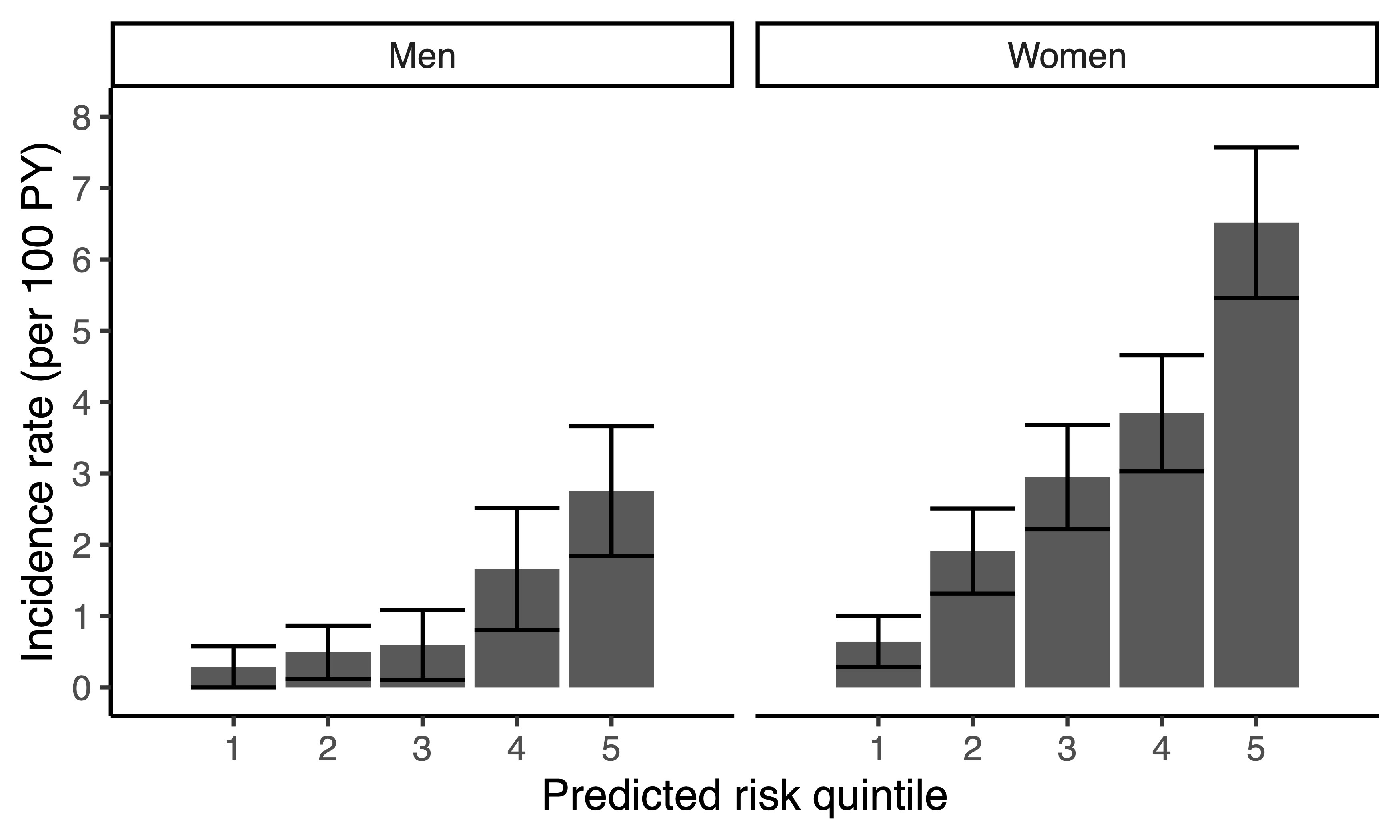
The training and validation cohorts combined included 19,556 individuals contributing 44,871 person-years (PY) at risk and 1,308 seroconversions. The full models had AUCs of 0.68 among women and 0.72 among men in validation. Incidence in the validation cohort among the highest predicted risk quintile was 6.58/100 PY among women and 2.84/100 PY among men; these quintiles accounted for 39% and 47% of new infections in women and men, respectively. Models using only age group and geospatial covariates had AUCs of 0.65 for women and 0.71 for men in validation.
Our risk prediction models identified individuals at high risk for HIV acquisition who could benefit from prevention interventions like PrEP. A geospatial model with no individual measures other than age group performed nearly as well as the full model. Geographic risk prediction models may help prioritize interventions to specific individuals and geographic areas at highest risk without the need to collect individual-level behavioral data.