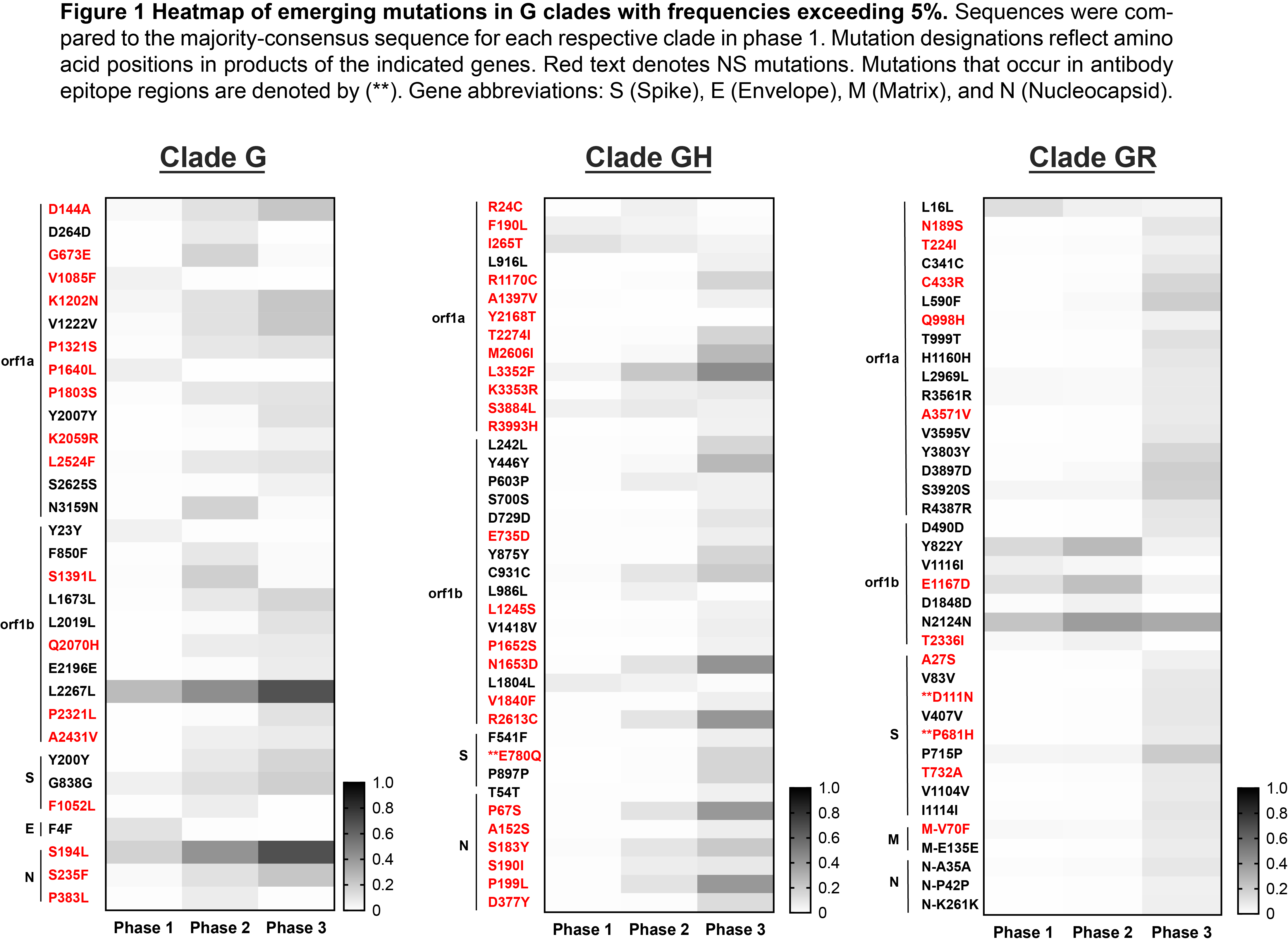
One year following the first detected SARS-CoV-2 (SC-2) infection in the U.S., there have been >26M cases and >440K deaths. During 2020, the virus spread in the U.S. in three phases: phase 1 (winter-spring), phase 2 (summer), and phase 3 (fall). We analyzed all publicly available SC-2 sequences from each phase to determine the effect of viral spread on its genetic diversity prior to the introduction of vaccines in mid-Dec 2020.
We obtained 36,299 U.S. SC-2 sequences from the GISAID submitted before Dec 15, 2020 (22,434 phase 1; 11,793 phase 2; and 2,072 phase 3). Genetic diversity was measured for each clade in each phase by percent average pair-wise distance (%APD). Sequences were analyzed to detect new mutations present at frequencies exceeding 5% in each of the 3 phases.
Six GISAID-defined clades (G/GH/GR/L/S/V) were each present in the U.S. by March 2020. The collective frequency of the three clades distinguished by the D614G mutation (G/GH/GR) increased from 83% in phase 1 to 99% in phases 2 & 3. Genetic diversity within these clades increased from 0.02% in phase 1 to 0.06% in phase 3. Non-synonymous (NS) mutations that emerged in clade G were in orf1a (7 mutations), orf1b (3), and N (3). Clade GH had the most NS mutations overall: orf1a (11), orf1b (5), S (1), and N (6), whereas Clade GR had the fewest but the most in the S gene: orf1a (6), orf1b (1), S (3), and M (1). Each of the detected mutations was unique to its respective clade. Full genome matches to variants from the U.K. (501Y.V1; clade GR) and South Africa (501Y.V2; GH) were not detected prior to Dec 15, possibly due to the delayed sequence submission to GISAID in the U.S. However, we did identify some individual S gene mutations matching those found in these variants. These mutations include 69-70del, 144del, and D1118H, and L18F, 242-244del, and E484K, respectively, each of which was already present at low frequency among sequences collected during phase 1.
Despite limited genomic sequencing in the U.S., we measured a 3-fold increase in SC-2 diversity in 2020 prior to the introduction of vaccines and identified at least 47 emerging amino acid changes. Three NS mutations in S were mapped to antibody epitopes and one (E484K) was previously shown to confer resistance to neutralizing antibodies. These findings underscore the critical importance of increased and timely genomic sequencing to ensure the future efficacy of SC-2 vaccines and treatments.