Chronic lung disease (CLD) is an emerging comorbidity among youth living with perinatally-acquired HIV (YPHIV) globally. Obstructive CLD, particularly with irreversible airflow obstruction (AFO) such as with obliterative bronchiolitis and poorly controlled asthma, may be an important subtype. We hypothesized that AFO, with and without reversibility, is common in low/middle-income and high-income settings but that risk factors, including growth deficiencies, tobacco smoke exposure and immune imbalance (low CD4/CD8) differ across settings.
We performed a cross-sectional analysis of YPHIV (10-21 years old) in the Kenyan BREATHE (n=204) and US Pulmonary Complications in the Pediatric HIV/AIDS Cohort (PCPA; n=188) studies. Sociodemographic, clinical, immune function, and spirometry data were ascertained within 3 months of enrollment. AFO was defined as a z-score <-1.64 for the ratio of forced expiratory volume in 1 second (FEV1) to forced vital capacity (GLI 2012); irreversible AFO also required post-bronchodilator FEV1 increase ?10%. We fit modified log-binomial models using generalized estimating equations with robust variances to estimate prevalence ratios (PR) of AFO by country. Wasting and stunted growth were defined as BMI- and height-for-age z-score <-2, respectively.
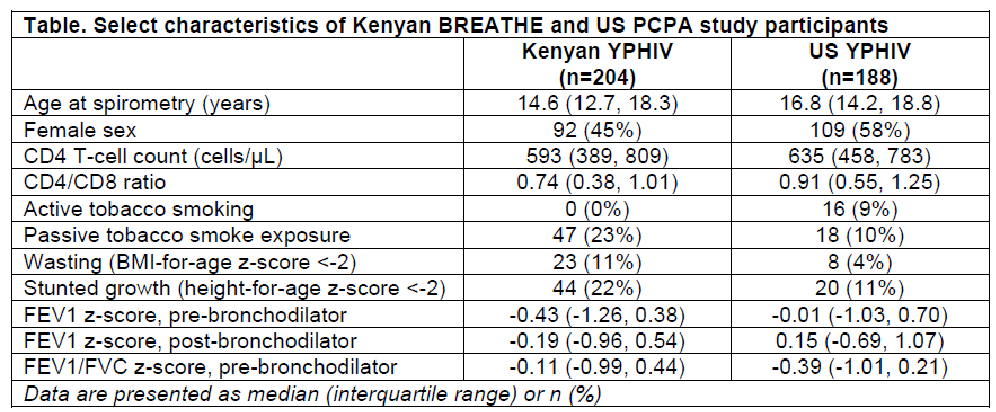
Kenyan YPHIV were younger, had more wasting and stunting, and had lower CD4/CD8 (Table) despite 99% current antiretroviral therapy use in Kenyan compared to 89% in US YPHIV. Of Kenyan YPHIV, 24 (12%) had AFO and 13 (7%) had irreversible AFO compared to 26 (14%) and 16 (9%) US YPHIV, respectively. Among Kenyan YPHIV, stunted growth was associated with AFO (PR=2.60 [95%CI 1.25-5.41], p=0.01); wasting was associated with irreversible AFO (4.62 [1.39-15.42], p=0.01). Among US YPHIV, stunted growth was associated with irreversible AFO (3.27 [1.12-9.56], p=0.03); lower CD4/CD8 was associated with AFO (2.17 [0.99-4.76], p=0.05) and irreversible AFO (2.86 [0.93-9.09], p=0.07). We detected no associations with tobacco smoke exposure.
The prevalence of AFO and irreversible AFO was similar in Kenyan and US YPHIV. Deficits in growth parameters were associated with AFO, including irreversible AFO, in both Kenyan and US YPHIV. Immune imbalance was consistent with a greater likelihood of AFO among US YPHIV. Our findings suggest that these CLD manifestations are similar across settings despite differences in risk factor prevalence, highlighting an urgent need to elucidate common pathways in CLD among YPHIV.