Vertically HIV-infected children show irreversible immune damage associated with HIV-1 infection and early antiretroviral treatment (ART) exposure. The objective of the study is to assess immune activation and senescence of vertically HIV-infected patients once they reach adulthood compared to non-HIV-infected subjects
Vertically HIV-infected group (HIV n=32) under suppressive ART for at least 5 years were selected from the Paediatric AIDS Research Network of Spain (coRISpe) and cryopreserved samples from the Spanish HIV BioBank. HIV group was compared with a non-HIV-infected Healthy Donors group (HD n=28) matched by age and sex. Subset distribution and activation, proliferation, senescence and exhaustion markers on T cells and natural killer (NK) cells was studied on peripheral blood mononuclear cells by multiparametric flow cytometry
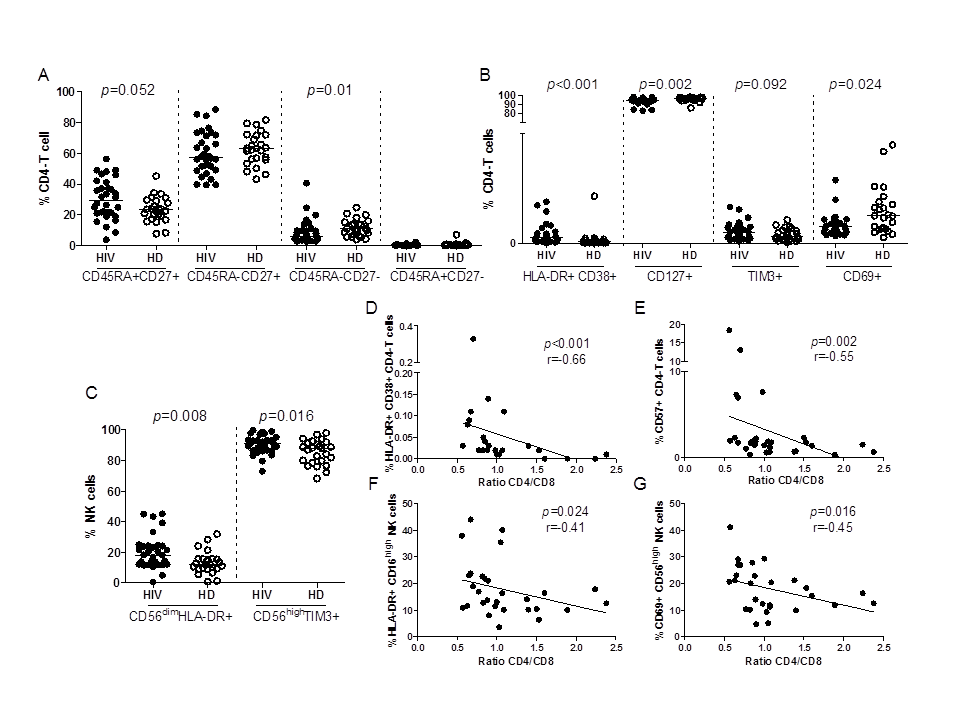
HIV (24 years [IQR:22-28] median age, 12% male, 794 [IQR:599-981] median CD4-T cells, 198 [IQR:76-330] median CD4+ Nadir, 4 [IQR:1-6] years median age at ART initiation, 20 [IQR:18-23] years since ART initiation and 8 [IQR:7-10] years under virological control) show differences in CD4-T maturation subsets (defined by CD45RA and CD27 expression, Fig A), high HLA-DR/CD38, CD127, TIM-3 and low CD69 expression on CD4-T (Fig B) and CD8-T cell subsets compared with HD. Regarding NK phenotype, HIV showed low frequency of CD56dim (p=0.057), CD16high (p=0.02), high percentage of CD56high NK subsets (p=0.166); and increased levels of HLA-DR and TIM-3 expression on CD56dim and CD56high subsets compared with HD (Fig C). Focusing on HIV, strong and direct correlations were observed between activation and senescence (HLA-DR CD38 and CD57, Fig D-E) and exhaustion (TIGIT, PD-1, p=0.002; r=-0.76, p=0.013; r=-0.45 respectively) on CD4-T cells with CD4/CD8 Ratio. On NK cells, HLA-DR and CD69 (Fig F-G) NKG2D and NKG2A expression correlated with CD4/CD8 Ratio (p=0.027; r=0.40, p=0.033; r=0.39 respectively). Direct associations between age at ART initiation and frequency of CD16high NK subset and expression of exhaustion (CD57, TIM3) and activation (NKp30) markers on NK subsets were also observed (p=0.08; r=0.31, p=0.02; r=0.41, p=0.06; r=0.32 respectively)
Vertical HIV infection leads to an irreversible immune damage not normalized once adulthood is reached, shown by an increased activation and exhaustion levels in adaptive and innate immune components that are associated with clinical parameters including ratio CD4/CD8 and age at ART initiation