Pregnant and postpartum (PP) women living with HIV (WLWH) experience elevated risk of depression. We examined longitudinal patterns and predictors of depressive symptoms among perinatal Kenyan WLWH who participated in a randomized trial of mHealth interventions.
We followed 824 WLWH enrolled in pregnancy through 24 months postpartum (PP) in 6 Nairobi and Nyanza region maternal child health (MCH) clinics. Study nurses assessed depressive symptoms during pregnancy, 6 weeks, 6, 12, 18, and 24 months PP using Patient Health Questionnaire-9 (PHQ-9). Psychosocial factors were evaluated using the: Stigma Scale for Chronic Illness, Medical Outcomes Study Social Support Survey, Abuse Assessment Screen for intimate partner violence (IPV), and Household Food Insecurity Access Scale. We evaluated prevalence of moderate-to-severe depressive symptoms (MSD; PHQ-9 score ?10) and pre-defined symptom trajectories (no MSD ever, MSD in pregnancy only, PP MSD only, and MSD in pregnancy and PP). We identified correlates of any PP MSD using generalized estimating equations with Poisson link and independent correlation clustered by participant.
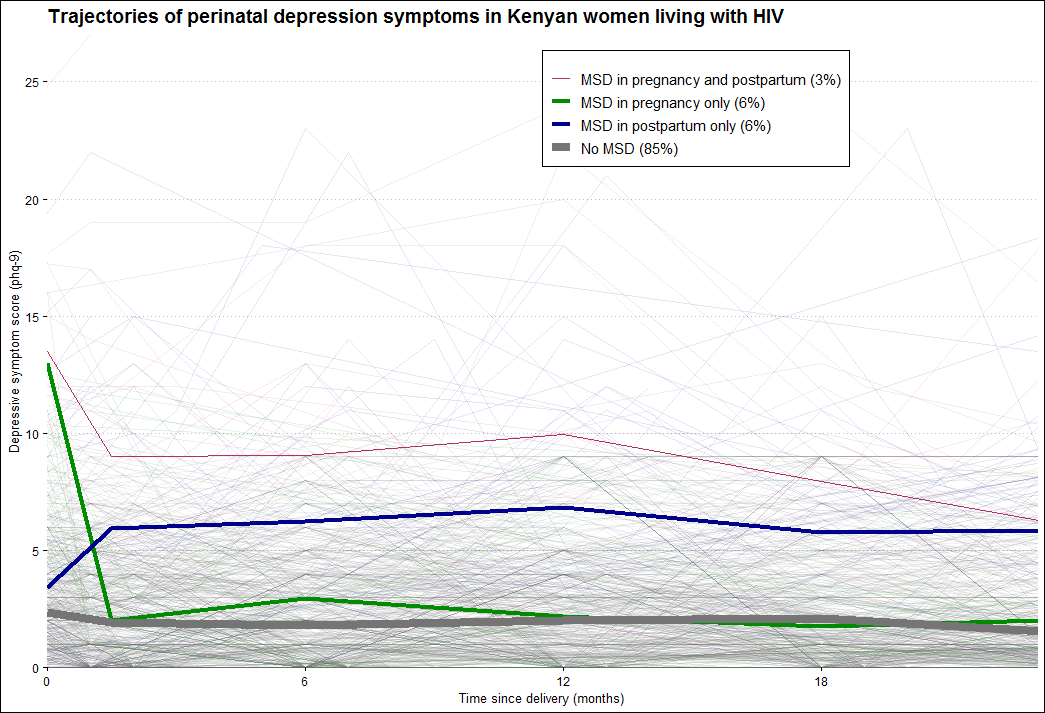
During pregnancy, 8.6% (71/824) of WLWH had MSD; 9% (70/776) reported any PP MSD. Among WLWH with ?1 PP visit, 85% (660/776) had no MSD in the perinatal period, 6% (46/776) had MSD in pregnancy only, 6% (49/776) had PP MSD only, 3% (21/776) had MSD during pregnancy and PP. Risk of any PP MSD was substantially higher among those with MSD in pregnancy (Relative Risk [RR]:5.9, 95% Confidence Interval [95% CI]:3.5-9.9), experiencing IPV ever (RR:2.9, 95% CI:1.7-4.9) and since the prior visit (RR:2.6, 95% CI:1.4-4.8), reporting stigma (RR:4.4, 95% CI:2.8-6.8), and with severe food insecurity (RR:3.4, 95% CI:2.2-5.2). Protective factors included HIV status disclosure to partner (RR:0.5, 95% CI:0.2-0.8) and higher social support (RR:0.97, 95% CI:0.96-0.98). Risk of MSD within 6 months PP was higher than >12 months PP (RR:1.8,95% CI:1.1-2.8). Risk of any PP MSD did not differ by mHealth study arm. Results were similar in WLWH with PP MSD only.
About 16% of perinatal Kenyan WLWH attending public sector MCH services had MSD over a 2 year follow-up. Interventions to address depressive symptoms should be integrated into HIV/MCH services and prioritized for those reporting IPV, stigma, or food insecurity. Interventions that encourage disclosure of HIV status, reduce HIV-related stigma, and enhance social support may decrease MSD in this population.