Challenges encountered by women during the postpartum period contribute to poor ART adherence leading to elevated maternal viral load (VL). In high-burden settings where at least 12m breastfeeding is recommended, this raises concerns about ongoing MTCT; enhanced VL monitoring during breastfeeding is widely discussed but there is little understanding of how detection of maternal viraemia is associated with infant HIV transmission risk.
We used an established Monte Carlo simulation of maternal VL dynamics and MTCT during pregnancy and breastfeeding, calibrated using best available data. Maternal VL was simulated in cohorts of 50,000 women from conception through 2 years postpartum, with a breastfeeding duration of at least 12m postpartum. We used this simulation to estimate, by infant age and maternal VL over time, the ability of maternal VL values to predict cumulative risk of infant HIV transmission. Results are expressed as positive and negative predictive values (PPV and NPV) and positive and negative likelihood ratios (LR+ and LR-). Sensitivity analyses varied distributions of maternal ART use prior to conception and levels of maternal viraemia, and incorporated hypothetical information on previous infant HIV testing at birth and 6 weeks of age.
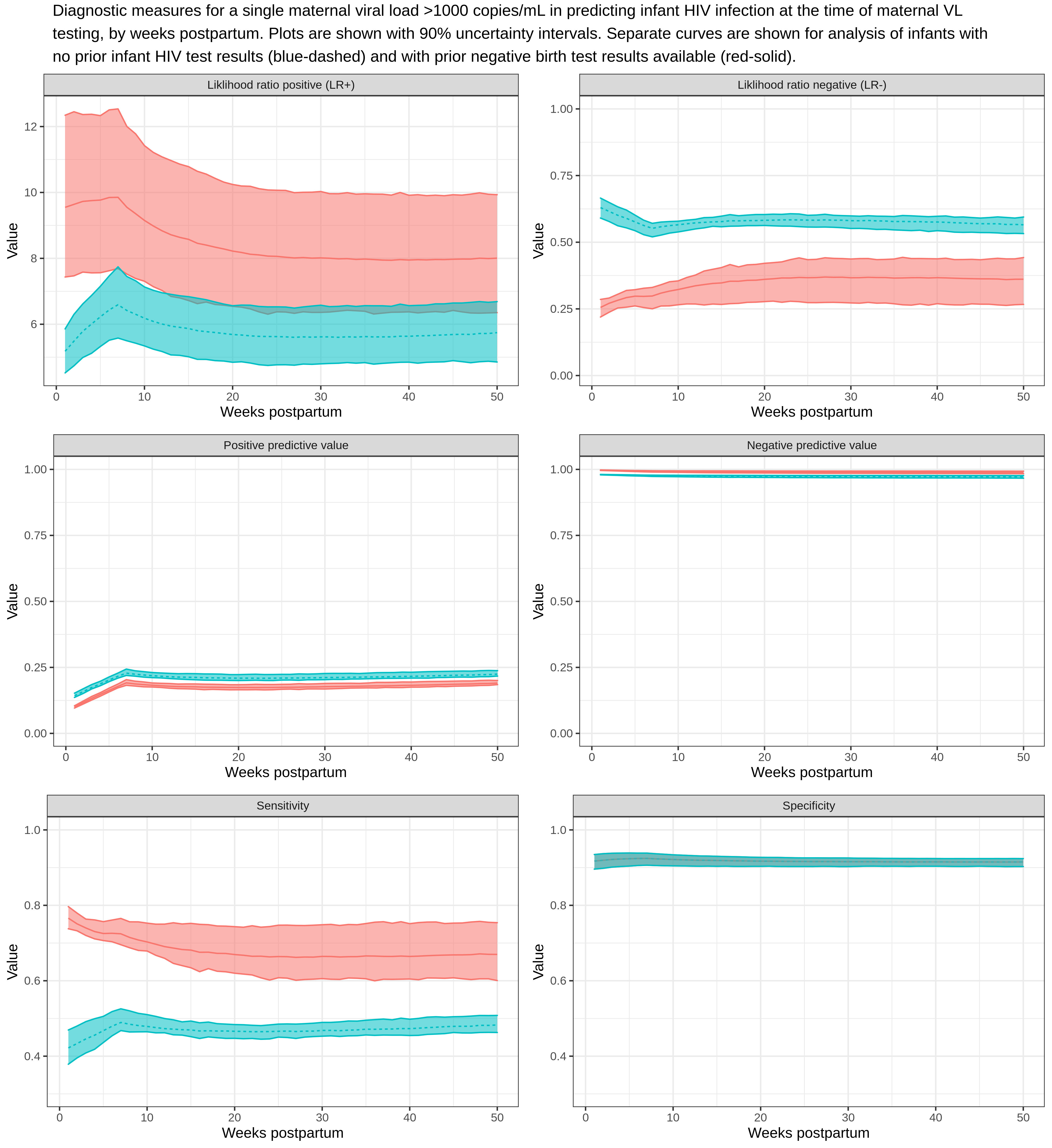
In the base simulation, 50% of women were on ART prior to conception and 50% initiated during pregnancy at median 20 weeks gestation. 89% of women had VL<50 cps/mL at delivery, 6% of women never achieved VL<50 cps/mL through 2 years postpartum, and 21% of women experienced VL>1000 cps/mL postpartum after prior VL<50 cps/mL. Cumulative MTCT risks were 2.0% at birth, 3.5% at 6w and 4.4% at 12m postpartum. Breastfeeding maternal VL>1000 cps/mL had low PPVs (5%-25%) in predicting cumulative infant HIV infection, while NPV were >96% in all scenarios. LR+ ranged from 2.5 to 12.5 and were stable across infant ages, with higher values observed in scenarios where an infant was known to have a negative HIV test result at birth (Figure). LR- were lowest (<0.3) for infants with HIV- birth testing but increased over time. Analogous results were observed when using VL thresholds of 10,000 cps/mL and findings were robust to variation in key parameters.
Elevated maternal VL observed during breastfeeding becomes more useful as a predictive tool for targeted infant testing when combined with information about prior infant HIV negative test results.