After cellular death, circulating cell-free mitochondrial (ccf-mtDNA) and genomic (ccf-gDNA) DNA fragments are released into circulation. The levels of ccf-gDNA fragments can reflect cell turnover, and ccf-mtDNA fragments can be used to distinguish the mode of cell death (apoptotic vs. necrotic) based on their size (short vs. long fragments, respectively). The utility of serum ccf-DNA as a biomarker and indication of aging among people with HIV (PWH) is unclear.
Using ultrasensitive digital PCR, ccf-gDNA and ccf-mtDNA were quantified in serum among HIV-infected and uninfected participants in the AIDS Linked to the IntraVenous Experience (ALIVE) cohort of current and former persons who inject drugs (PWID). Fried frailty phenotype was measured at semi-annual study visits. Linear regression models with generalized estimating equations (GEE) were used to compare differences in log-transformed circulating cell-free DNA fragments by HIV markers after adjusting for covariates (demographics, BMI, drug/alcohol abuse, and white blood cell count). The relationship of ccf-DNA to frailty was assessed using multinomial logistic regression with GEE.
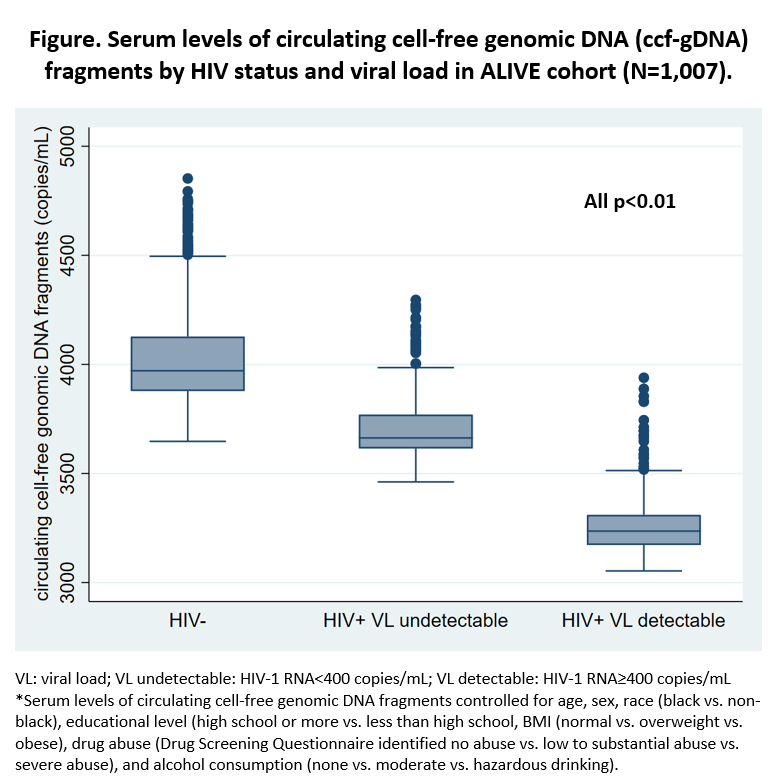
Of 1,007 participants followed for 2,810 (median: 3.5) person-years, the median age was 48 years, 46% HIV+ (50% of them virally suppressed), 64% male, 88% black, 52% overweight or obese, 6% had severe drug abuse, and 33% hazardous alcohol drinking at index visit. Compared to people without HIV, PWH with undetectable (<400 copies/mL) and detectable viral load had lower levels of ccf-gDNA (Figure, predicted mean: 4,025 vs. 3,703 and 3,263 copies/mL, respectively, p<0.01) and short (apoptotic) ccf-mtDNA fragments (predicted mean: 7,089 vs. 6,566 and 5,731 copies/mL, respectively, p<0.01) after controlling for covariates (all p<0.01). Lower levels of ccf-gDNA were significantly associated with frailty (adjusted odds ratio: 1.7, 95% CI: 1.2-2.7), independent of HIV infection, levels of inflammation (IL-6, sTNF-r1, sTNF-r2), and other demographics and behavioral covariates. Over time, ccf-gDNA and short ccf-mtDNA fragments increased significantly in all participants, while levels of long (necrotic) ccf-mtDNA fragments increased only among PWH.
Our data suggests circulating cell-free DNA fragments are a promising biomarker to study changes in the rates of cell turnover and as a predictor of higher risk status (frailty) in patients aging with HIV.