Persons with HIV (PWH) experience increased incidence and prevalence of diabetes mellitus (DM) compared to the general population. However, risk factors associated with progression from pre-DM to DM for PWH on modern antiretroviral therapy (ART) regimens have not been fully characterized.
AIDS Clinical Trials Group (ACTG) A5322 (HAILO) is an observational cohort study of PWH ?40 years old being followed for ascertainment of clinical outcomes associated with HIV, ART and aging. All participants initiated ART through an ACTG randomized clinical trial and were subsequently followed in the observational study ACTG A5000/ALLRT prior to being followed in HAILO. We used proportional hazards Cox regression models to identify risk factors for development of DM among PWH with pre-DM diagnosed either at ALLRT entry (baseline) or during follow-up in ALLRT or HAILO. Pre-DM was defined as fasting blood glucose (FBG) of 100-125 mg/dl and DM as FBG?126 mg/dl, treatment of diabetes, or clinical diagnosis. Factors associated with DM (p-value <0.10) in univariable models were included in a multivariable model.
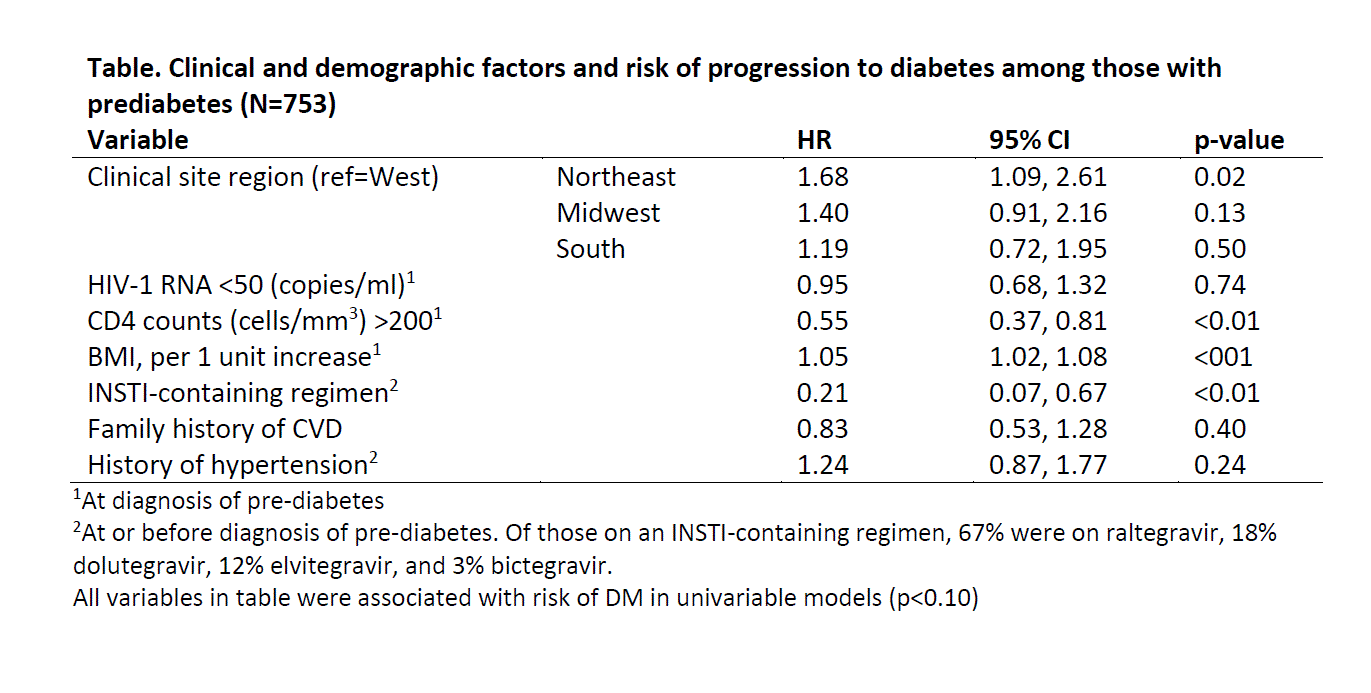
Among 1035 HAILO participants, 60 (6%) had DM and 74 (7%) had pre-DM at baseline. Another 679 (66%) developed pre-DM during follow-up. Of the 753 participants with pre-DM, 167 (22%) subsequently developed DM; median (IQR) time to DM was 45.3 weeks (18.7, 58.6). In a multivariable model (Table), the risk of developing DM among those with pre-DM increased with higher BMI at pre-DM diagnosis. INSTI use (12% of participants) at or prior to pre-DM and CD4 count >200 copies/mm3 at pre-DM diagnosis were associated with a lower risk of developing DM. In a separate multivariable model with waist circumference replacing BMI, each 1-unit increase was associated with a 3% increased risk of developing DM (HR=1.03, 95%CI=1.01, 1.04; p<0.01).
Though INSTI use has been associated with weight gain, its use was associated with a lower risk of progression to DM in this cohort. Higher CD4 was also associated with a lower risk of progression to DM, suggesting that immunosenescence and inflammation may be mediators in DM development among PWH with pre-DM. Further characterization of the metabolic effects of INSTI use and the effects of immune activation and inflammation on development of DM in PWH is needed.