Studies from the United States have demonstrated HIV to be an independent risk factor for cardiovascular disease (CVD). Although approximately 70% of the world’s population of people living with HIV (PLWH) reside in sub-Saharan Africa, there are minimal prospective data on the contributions of HIV infection to atherosclerosis in the region.
We conducted a prospective observational cohort study of PLWH on antiretroviral therapy (ART) over 40 years of age in rural Uganda, along with age- and sex-matched, population-based HIV-uninfected comparators. We collected data on CVD risk factors and carotid ultrasound measurements annually. We fitted linear mixed effects models, adjusted for CVD risk factors, to estimate the association between HIV serostatus and progression of carotid intima media thickness (cIMT). In stratified models, we estimated the contribution of HIV-specific indices on cIMT.
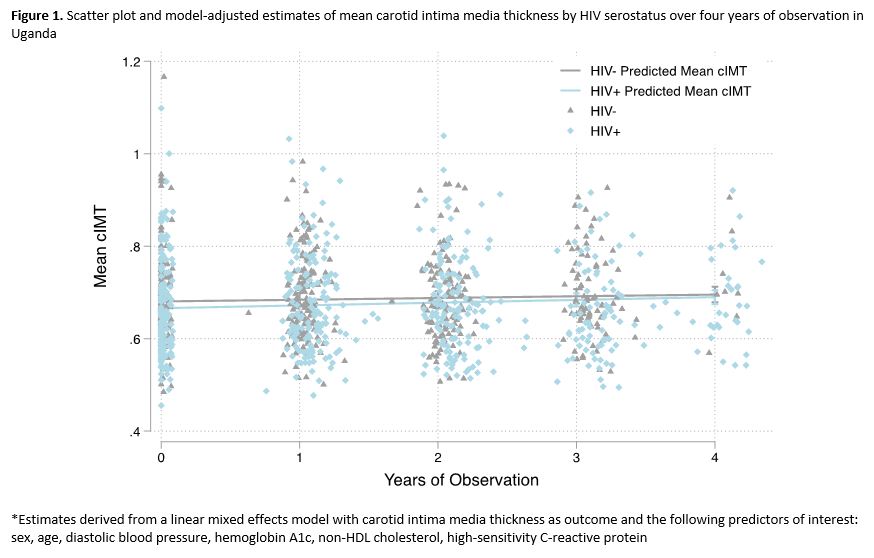
We enrolled 155 PLWH and 154 HIV-uninfected individuals and collected 5,900 cIMT images during 1,045 visits, during a median of 4 annual visits per participant (IQR 3-4, range 1-5). Age (median 50.9 years) and sex (49% female) were similar by HIV serostatus, but PLWH had a lower systolic blood pressure compared to HIV-uninfected individuals (mean 113 vs 118, P<0.01), and were less likely to be current smokers (6 vs 21%, P<0.001), conferring a lower 10-year Framingham risk score (median 4.5 vs 6.1%, P=0.02). However, PLWH had higher high sensitivity C-reactive protein (hsCRP) and soluble CD14 (sCD14) (P<0.001). At enrollment, PLWH had similar mean cIMT (0.665 versus 0.680 mm, P=0.15). In multivariable models, increasing age, blood pressure, and non-HDL cholesterol were associated with greater cIMT (P<0.05), however change in cIMT per year was similar by HIV serostatus (0.004 mm/year for HIV-negative [95% CI 0.001-0.007 mm], 0.006 mm/year for PLWH [95% CI 0.003-0.008 mm], HIV*time interaction P=0.25). Model estimates were similar after adjustment for inflammatory markers. In models restricted to PLWH, use of a protease-inhibitor based regimen was associated with 0.042 greater cIMT (95%CI 0.002-0.082 mm, P=0.04).
In rural Uganda, treated HIV infection was not associated with faster cIMT progression. These results do not support classification of treated HIV infection as a risk factor for subclinical atherosclerosis progression in rural sub-Saharan Africa.