The role of socioeconomic (SE) indices in immune activation among PLWH is unknown, especially in low income sub Saharan Africa (SSA), where the burden of non-communicable diseases (NCDs) is high.
Malawian adults with CD4<100 cells/ul starting ART in the REALITY trial (NCT01825031), and volunteers without HIV infection, had clinical assessment, socioeconomic evaluation, blood draw for cell surface and soluble activation markers, and carotid femoral pulse wave velocity (cfPWV) carried out at 2 and 42 weeks post-ART initiation. Linear regression models analysed SE associations with i) immune activation markers and ii) arterial stiffness.
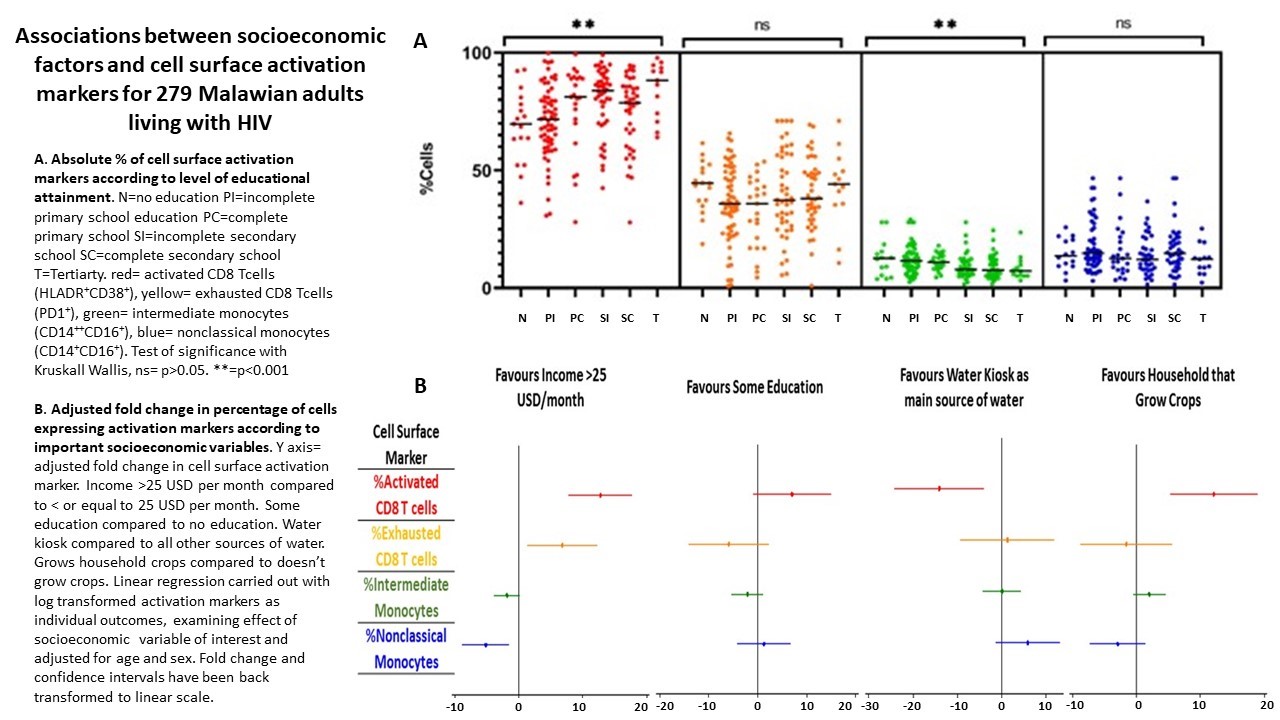
Of 279 PLWH, median (IQR) age was 36 (31-43) years and 122 (44%) were female. At baseline, T cell activation was more pronounced among those with higher SE indices. CD8 activation increased from 70% amongst those with no education to 88% amongst those with a tertiary education (p=0.002); and from 71% amongst those earning less than 10 USD/month to 87% amongst those earning between 100-150 USD/month (p=0.0001, Figure 1). Adjusting for age and sex, CD8 activation and exhaustion were higher amongst those earning >25 USD/month [fold change 12.7%, p<0.0001 and 6.77%, p=0.016 respectively]. CD8 activation was lower for water kiosk users [70% versus 81%, p=0.002] who also displayed lower rates of CMV PCR positivity [5(7%) versus 57(31%); p<0.0001]. Conversely, monocyte activation was associated with lower SE indices. In adjusted analysis, nonclassical and intermediate monocytes were lower amongst the higher income bracket (fold change -5.23, p=0.006 and -1.91, p=0.063 respectively). Participants with an earth floor displayed expanded nonclassical monocyte populations (p=0.04), but experienced a reduction after 42 weeks of ART [median change -2.2% versus 5.8%, p=0.026]. SE indices independently associated with arterial stiffness (adjusted for age, sex, blood pressure and haemoglobin) were: car ownership [fold change 1.3m/s (95% CI 1.10 to 1.56); p=0.003]; television ownership [1.12m/s (1.03 to 1.23); p=0.012]; and electricity access [1.09m/s (1.01 to 1.17); p=0.029].
For PLWH with high SE indices, a sedentary lifestyle combined with HIV driven T cell activation may increase vascular damage. For PLWH with low SE indices, innate immune stress – likely driven by infection, malnutrition, and poor water hygiene – is the predominant inflammatory pathway. Understanding these pathways and their drivers will help target interventions for NCDs.