In sub-Saharan Africa (SSA), the burden of HIV-associated malignancies remains high despite the scale-up of antiretroviral therapy (ART). Oncology providers in SSA are limited in number and manage patients with high complexity and often poor outcomes. However, little is known about the differences in burnout among oncology providers compared to HIV providers who often co-manage patients with HIV-associated malignancies.
We approached all clinical officers and nurses working in either an oncology referral clinic or one of three representative primary care clinics for HIV medicine in the AMPATH network in western Kenya from August 2019-January 2020. Burnout was measured using the self-administered 22-item Maslach Burnout Inventory (MBI) for Medical Personnel Health Services Survey adapted for the sub-Saharan African context. MBI uses sub-scales of depersonalization (scores 0 to 30, higher indicates more burnout), personal accomplishment (scores 0 to 48, higher indicates less burnout), and emotional exhaustion (scores 0 to 54, higher indicates more burnout) (Thorsen BMC Nursing; 2011; Kim PloS One 2018). In linear regression analyses we used directed acyclic graphs to assess the determinants of burnout.
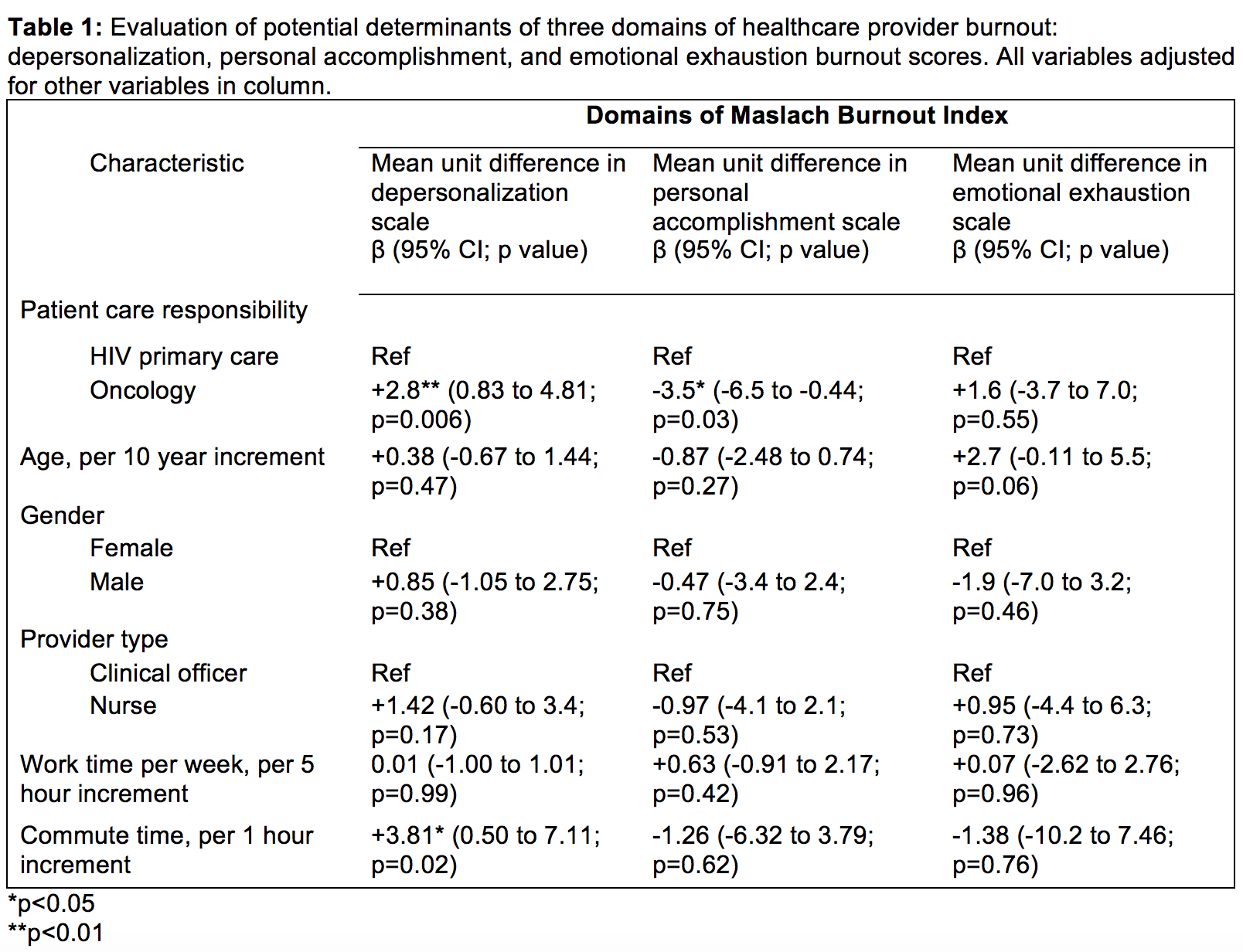
Of 89 healthcare workers enrolled (23 oncology providers, 66 HIV providers), the majority (58%) were female, the median age was 37 (IQR 31-43) years and 57% were clinical officers and 43% nurses. On the depersonalization, personal accomplishment, and emotional exhaustion scales the median scores for oncology providers were 4 (IQR 2-7), 41 (IQR 32-46) and 17 (IQR 8-28) respectively, compared to 1 (IQR 0-4), 42 (IQR 39-47) and 14 (IQR 8-21) for HIV providers. After adjusting for age, gender, provider type, hours worked per week, and commute time, the mean score on the depersonalization scale for oncology providers was 2.8 units higher (p=0.006) than HIV providers, on the personal accomplishment scale 3.5 units lower for oncology providers (p=0.03) compared to HIV providers, and not significantly different for emotional exhaustion (p=0.55) (Table 1).
Oncology providers in Kenya had higher burnout measurements compared to HIV providers. Quantifying the factors underlying oncology provider burnout may allow health systems in SSA to identify solutions to improve provider working environments and care delivery for patients with HIV-associated malignancies.