With combination antiretroviral therapy (cART), there has been a decrease in AIDS-defining cancers (ADC), however, some jurisdictions have reported increases in non-AIDS defining cancers (NADC). We sought to confirm these findings in Ontario, Canada, a province with the highest number of people living with HIV nationally and in a setting with universal access to health care.
We conducted a population-based retrospective cohort study of adults (?18 years) living with HIV using health administrative data including the provincial cancer registry. Participants were followed for incident cancers from January 1, 1997 to Dec 31, 2018. Cancers were grouped as infection-related (ADC and infection-related NADC) and infection-unrelated cancers (all other NADC). Age-standardized incidence rates (aIR) per 1,000 person-years (PY) with 95% confidence intervals (CI) were calculated using direct standardization, and stratified by sex and calendar period, using the 2011 Canadian population as the reference population. The Cochran-Armitage trend test was used to examine trends across calendar periods.
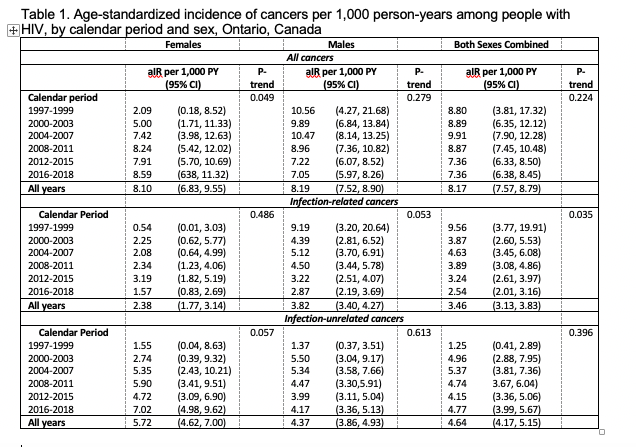
Among 17,675 individuals (78% males) followed for 166,616 PY, 1127 first primary incident cancers were diagnosed (531 [47%] infection-unrelated cancers and 596 [53%] infection-related cancers). The incidence of any cancer over the entire study period ranged from 8.8 per 1,000 PY (95% CI 3.8, 17.3) in 1997-1999 to 7.4 per 1,000 PY (6.4, 8.4) in 2016-2018 (Table 1). Infection-related cancer rates declined from 9.6 per 1,000 PY (3.8, 19.9) in 1997-1999 to 2.5 per 1,000 PY (2.0, 3.2) in 2016-2018 (p-trend 0.035). In contrast, infection-unrelated cancer incidence increased in the early cART era (1997-2003) and remained relatively stable until 2016-2018 (aIR 4.8 [4.0, 5.7] per 1,000 PY) (p-trend 0.396). When stratified by sex (Table 1), the incidence of infection-unrelated cancers among females increased and surpassed the incidence in males in 2016-2018 (aIR females: 7.02 [4.98, 9.62] vs. aIR males: 4.17 [3.36, 5.13]).
Our findings that infection-related cancer rates declined whereas infection-unrelated cancers increased could be a result of improved cART and increased longevity as the life expectancy of people with HIV approaches that of the general population. This study confirms that ongoing surveillance of cancer incidence among people with HIV using population-based estimates are needed to locally inform cancer prevention and care services planning.