Cervical cancer is a leading cause of cancer mortality in sub-Saharan Africa, with increased risk among women living with HIV (WLWH). Improved understanding of the prevalence and distribution of high-risk human papillomavirus (hrHPV) and measures of immune dysfunction among WLWH and cervical abnormalities despite antiretroviral therapy (ART) is required to inform regionally appropriate cervical cancer prevention strategies.
We developed a prospective cohort (2017-2020) of Ugandan WLWH on ART and HIV-seronegative women with abnormalities noted on cervical cancer screening with visual inspection with acetic acid (VIA). Those with VIA+ exams underwent cervical biopsies for histopathologic grading. Cervical brush specimens were tested for hrHPV DNA genotypes. Among WLWH, we further evaluated association between immune, HIV treatment-related, and social risk factors and hrHPV and cervical high grade squamous intraepithelial lesions (HSIL) findings. Associations were evaluated with Poisson regression to estimate adjusted hrHPV prevalence ratios (aPR) with robust 95% confidence intervals (95%CI).
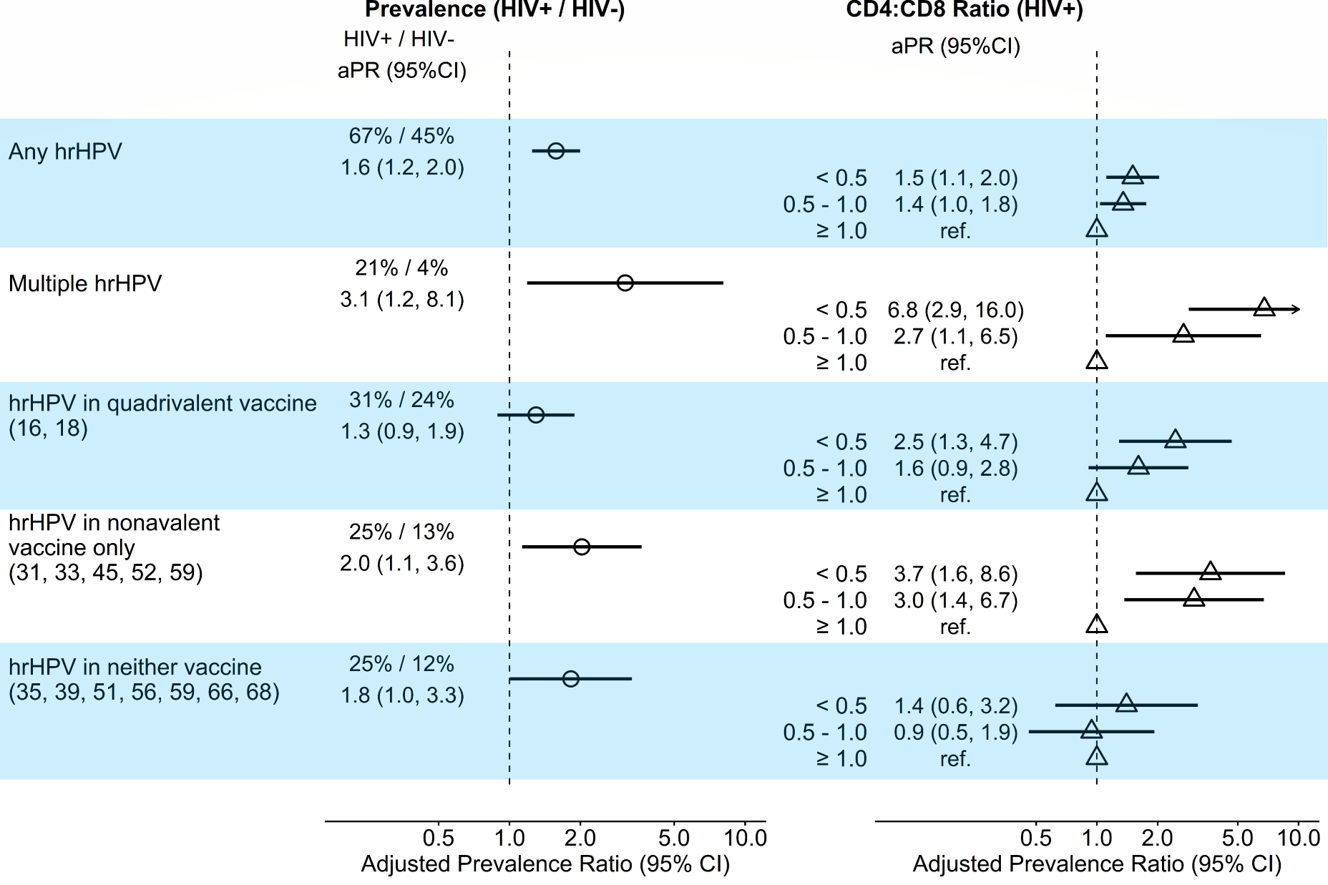
Of 16,380 women screened, 815 (5%) were VIA+, and 304 (188 WLWH, 116 HIV-seronegative) had VIA abnormalities large enough for biopsy and consented to participate. Among WLWH, median age was 34 years, ART duration 6 years, CD4 667 cells/µL, and CD4/CD8 ratio 0.9. hrHPV was detected in 67% of WLWH and 45% of HIV-seronegative women (aPR [95%CI], 1.58 [1.25, 2.00]). WLWH had increased detection of multiple hrHPV (aPR [95%CI], 3.10 [1.19, 8.08]), ?1 hrHPV covered by the nonavalent but not quadrivalent vaccine (aPR [95%CI]. 2.0 [1.1, 3.6]), and ?1hrHPV not covered by any vaccine (aPR [95%CI]. 1.8 [1.0, 3.3]). In multivariable analyses among WLWH, lower CD4/CD8 ratio was associated with any hrHPV, multiple hrHPV, and hrHPV in the nonvalent vaccine only (Figure). 29% WLWH vs 9% HIV-seronegative women had HSIL.HIV viral load 200-1000 copies/mL was associated with HSIL cervical dysplasia.
WLWH with cervical abnormalities are at increased risk for prevalent single and multiple hrHPV. Risk is associated with measures of immune dysfunction despite long-term ART. HPV vaccination with the nonavalent HPV is needed for young adolescents in populations at high-risk of HIV infection in sub-Saharan Africa. Optimization of ART and evaluation of additional immune interventions for management of cervical HSIL in WLWH on ART are warranted.