End-stage liver disease (ESLD) is a leading cause of non-AIDS death among people living with HIV (PWH). No predictive tool for hepatic decompensation currently exists in PWH. We sought to develop a risk prediction model for ESLD in a multicenter consortium of HIV cohorts with rigorously adjudicated clinical outcomes.
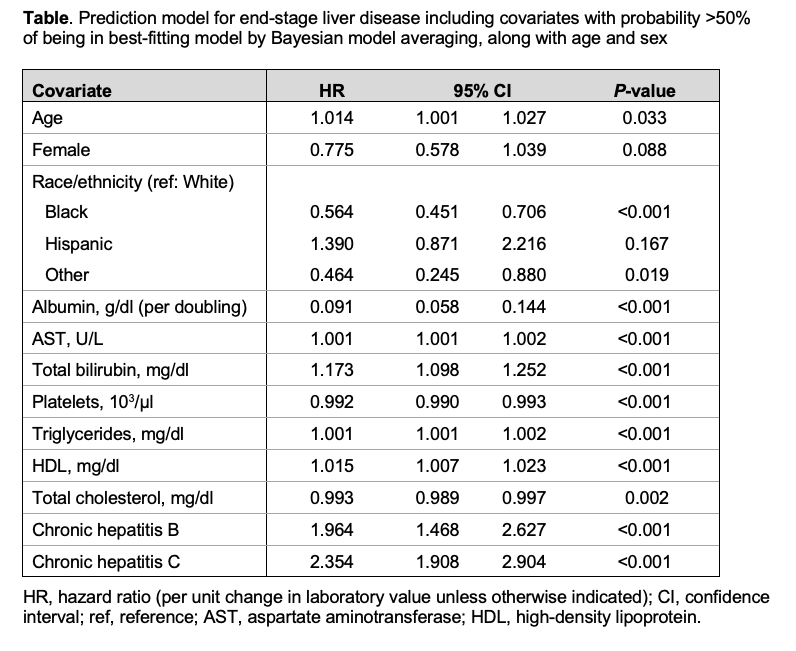
PWH who received care from one of 12 US and Canadian cohorts of the North American AIDS Cohort Collaboration on Research and Design from 2000-2016 and had FIB-4>1.45 were included. First occurrence of ascites, variceal bleed, spontaneous bacterial peritonitis or hepatic encephalopathy was verified by standardized medical record review. Those with prevalent ESLD (present from cohort entry to 180 days after) were excluded. A subset of cohorts were randomly selected until ~20% of events were achieved and set aside for testing; remainder was used for derivation. Bayesian model averaging was used to select predictors among liver and HIV biomarkers and key clinical diagnoses (HBV, HCV, diabetes and alcohol abuse/dependence). Variables with >50% probability of being in the best fitting model were included, along with age and sex. Harrell’s C statistic was used to assess model discrimination.
Of 40,106 PWH, 13,787 (34%) had FIB-4>1.45. Among these (82% male; 54% black; mean age 48 years), 390 ESLD events were identified over a mean 5.4 years. Of ESLD cases, 52% had hepatitis C, 15% hepatitis B and 31% had a history of alcohol. Twelve factors (Table) together predicted ESLD risk moderately well (C-statistic 0.78, 95% CI 0.76, 0.81). The model included age, sex, race/ethnicity and routinely collected laboratory values reflecting hepatic impairment (serum albumin, AST, total bilirubin, platelets) and lipid metabolism (triglycerides, HDL, total cholesterol). Chronic HBV and HCV were among these. Neither CD4 cell count nor HIV viral level (log-transformed) had >10% probability of being included in the best fitting predictive model for ESLD, however their predictive contribution was likely mediated through other selected variables. The testing subset comprised 3,173 PWH across 3 cohorts (90% male; 14% black; mean age 49 years) and yielded 112 ESLD events over a mean of 4.3 years follow-up. Our model performed well in this testing set (C-statistic 0.81, 95% CI 0.76, 0.86).
This model developed specifically for PWH includes readily accessible clinical parameters, appears to work well in a diverse population and may provide a convenient tool for ESLD prediction.