Background: Glycans on circulating (plasma) glycoproteins and antibodies (IgGs) play an important role in regulating inflammatory responses. In particular, reductions in IgG galactosylation (agalactosylation; loss of the monosaccharide galactose) and sialylation (hypo-sialylation; loss of sialic acid) as well as induction of bisected GlcNAc glycans, increase the pro-inflammatory function of IgGs, by enhancing Fc?R binding. These glycomic features have been linked to the development and maintenance of several inflammatory diseases. However, their levels during HIV/HCV co-infection remain unclear.
Methods: We enrolled 249 HCV-exposed (HCV antibody positive) adults mean age 56±6 years, 36% female, with and without active HIV and/or active HCV infection in four groups: (52 HCV-/HIV-; 26 HCV-/HIV+; 113 HCV+/HIV-; and 58 HCV+/HIV+), from the AIDS Linked to the IntraVenous Experience (ALIVE) cohort. N-glycans from plasma and isolated IgG were analyzed using capillary electrophoresis. Kruskal-Wallis test was used for statistical analysis. False discovery rate (FDR) was calculated using the Benjamini Hochberg approach to adjust for multiple comparisons.
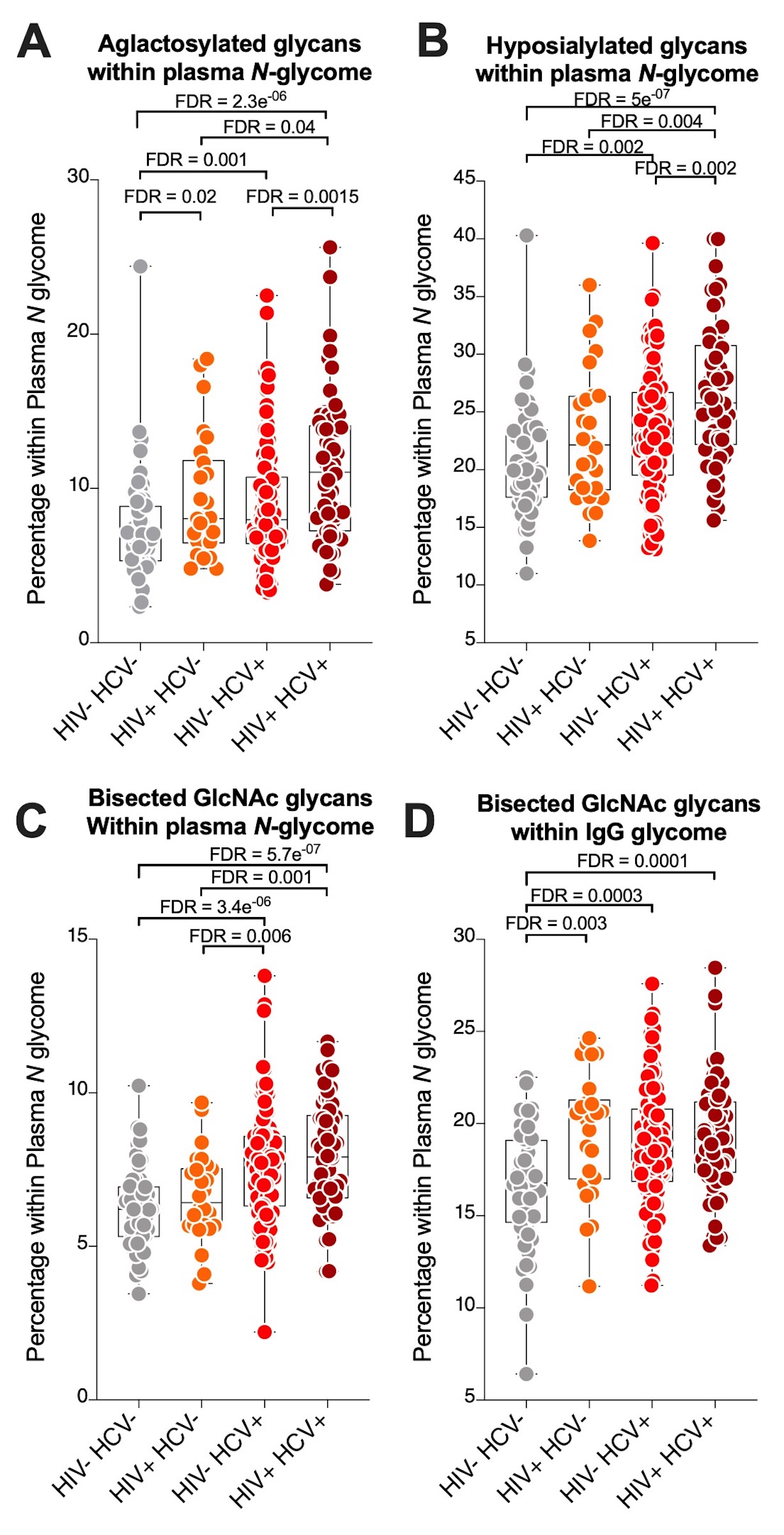
HCV mono-infection was associated with inductions in levels of pro-inflammatory glycomic traits (agalactosylated, hyposialylated, and bisected GlcNAc glycans) in plasma glycoproteins (FDR<0.002) compared to the HCV-/HIV- group (Figure A-C). Furthermore, HCV infection was associated with higher levels of the pro-inflammatory bisected GlcNAc glycans on IgG glycome (FDR=0.0003), compared to the HCV-/HIV- group (Figure D). HIV/HCV co-infection further increased these pro-inflammatory glycomic traits on plasma glycoproteins and IgG when compared to mono-infection and the HCV-/HIV- group (FDR<0.002) (Figure D).
We identified novel host glycomic factors that may contribute to higher inflammation and immune activation during HCV/HIV co-infection. The potential prognostic and functional significance of these glycomic signatures in modulating the disease course during HCV/HIV co-infection warrants further investigation.