Studies in the general population suggest that binge drinking is associated with an increased risk of death independently of the average daily consumption of alcohol. Considering the high prevalence of alcohol use disorder among persons with HIV, we assessed the impact of specific drinking patterns on mortality and the occurrence of liver events in the Swiss HIV Cohort Study.
We included all cohort participants with follow-up between January 2013 and April 2020. Based on responses to the routinely recorded Alcohol Use Disorder Identification Test (AUDIT-C), their drinking behavior was grouped into ‘abstinence’ (no alcohol consumption), ‘non-hazardous drinking’, ‘hazardous but not binge drinking (AUDIT-C ?3 in women and ?4 in men)’, and ‘binge drinking’ (?6 drinks/occasion more than monthly). We estimated adjusted incidence rate ratios (IRR) of all-cause mortality, liver-related mortality and liver events (including the development of cirrhosis) for time-varying drinking patterns using multivariable quasi-Poisson regression, adjusted for demographic characteristics, comorbidities, smoking and illicit drug use.
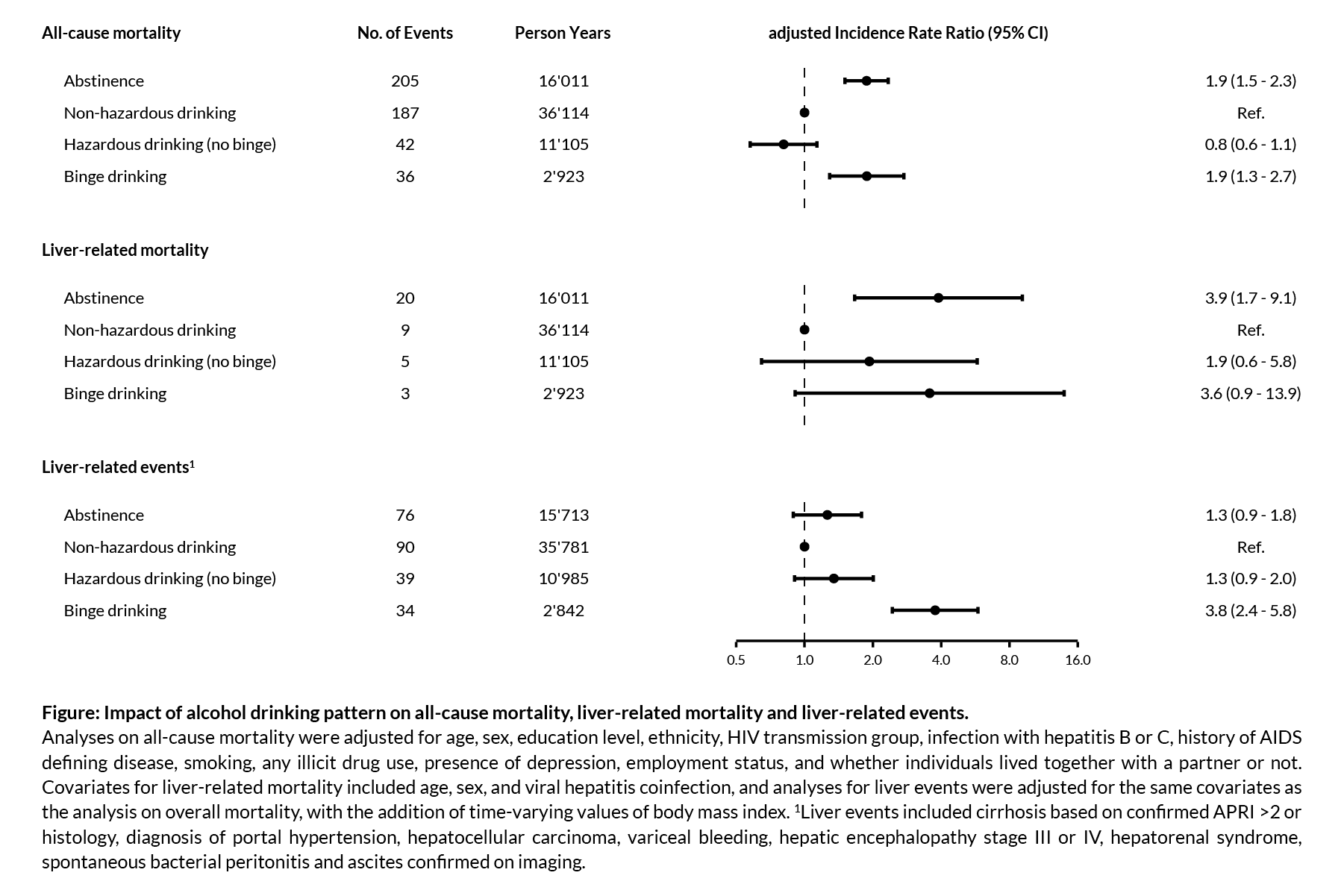
We included 11’849 individuals: 3’264 (27.5%) were female, median age was 46 years (IQR 38–53), 9’097 (76.8%) were Caucasian, 5’425 (45.8%) were men who have sex with men, 573 (4.8%) had hepatitis B coinfection and 1’116 (9.4%) hepatitis C coinfection. Over a median follow-up of 6.8 years (IQR 4.1–7.0), 470 individuals died (incidence rate [IR] 7.1/ 1’000 person-years [PY], 95% CI 6.5–7.8), of which 37 were liver-related (IR 0.6/1’000 PY, 95% CI 0.4–0.8), and 239 liver events occurred (IR 3.7/1’000 PY, 95% CI 3.2–4.2). Compared to non-hazardous drinking, binge drinking was associated with a higher rate of all-cause mortality (adjusted IRR 1.9, 95% CI 1.3–2.7) and liver events (adjusted IRR 3.8, 95% CI 2.4–5.8). All-cause (adjusted IRR 1.9, 95% CI 1.5–2.3) and liver-related mortality (adjusted IRR 3.9, 95% CI 1.7–9.1) were increased in individuals reporting abstinence compared to non-hazardous drinking. We observed no significant differences in outcome rates between non-hazardous and hazardous without binge drinking (Figure). Findings were consistent after excluding individuals with viral hepatitis.
Among persons with HIV in Switzerland, binge drinking was associated with all-cause mortality and the incidence of liver events, highlighting the importance of assessing alcohol drinking patterns to identify individuals most at risk for complications.