Despite effective antiretroviral therapy (ART), rates of end-stage liver disease (ESLD) remain high. Specific ART drugs may add to the risk of ESLD but past analyses have studied prevalent users exposed to old hepatotoxic drugs and used inadequate methods for detecting risk signals in complex data. We sought to detect which components of modern ART might contribute to ESLD risk.
We selected patients from 12 cohorts contributing validated ESLD events to the North American AIDS Cohort Collaboration on Research and Design (NA-ACCORD). We followed those initiating ART after 1 Jan 2004 with a nucleos(t)ide backbone of either abacavir/lamivudine or tenofovir/emtricitabine and a modern third (anchor) drug until a first ESLD event, death, end of a cohort’s ESLD validation period, loss to follow up or 31 Dec 2015. We estimated associations between cumulative exposure to each drug (per five years) and ESLD using a Bayesian Cox model akin to the FDA’s method for detecting signals in MedWatch data. To minimise the risk of false positives given multiple exposures and few events, we fitted a hierarchical model asserting weakly informative prior distributions based on past studies. The model allowed for variation between cohorts in the baseline hazard and included covariates for alcohol abuse, hepatitis B (HBV) and C (HCV) status, FIB-4 fibrosis score when starting ART and time updated detectable HIV RNA and CD4 cell count.
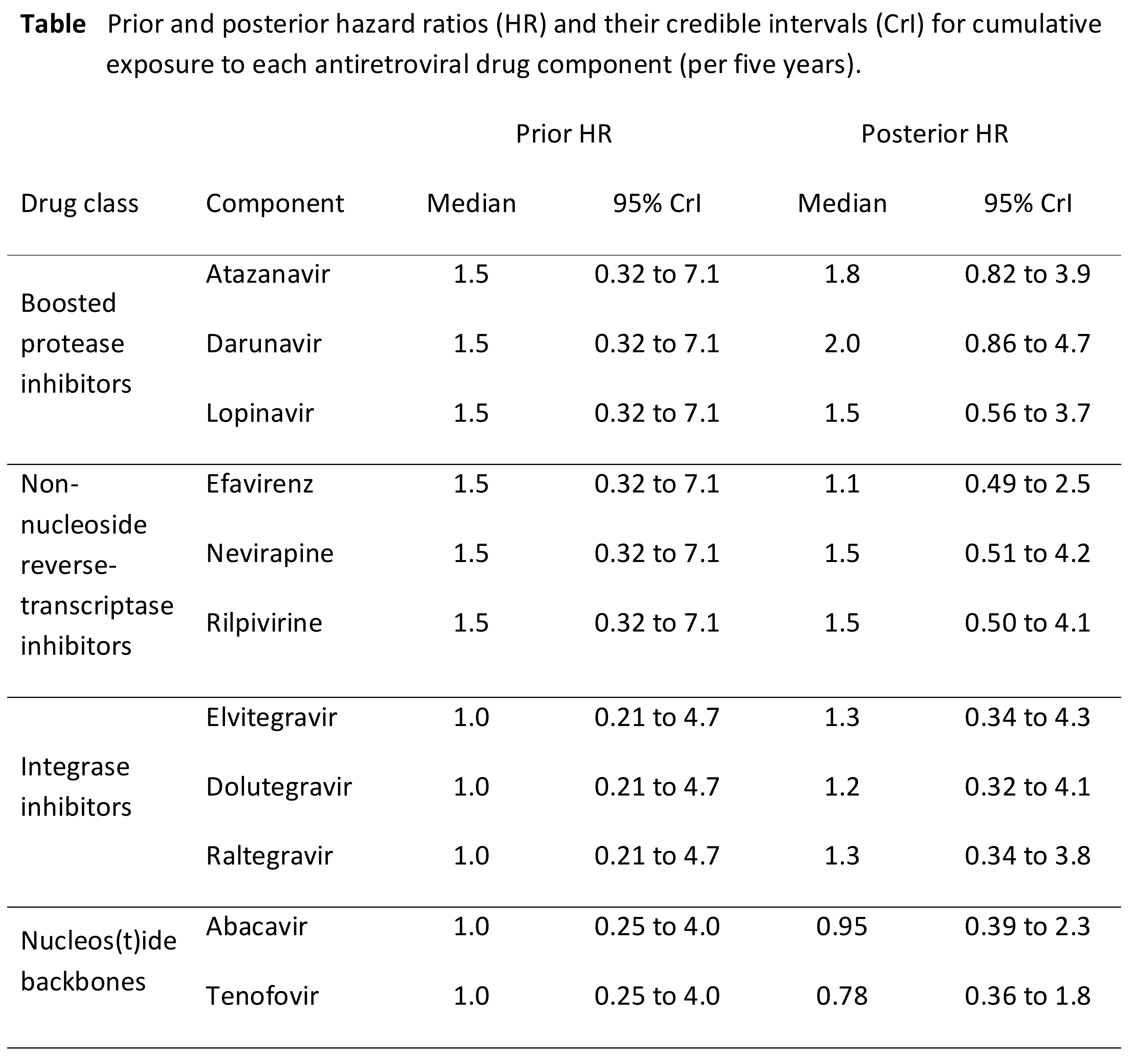
Of the 10,564 patients included, 62 had a validated ESLD event (42 ascites, 10 hepatic encephalopathy, 7 variceal hemorrhage, 3 hepatocellular carcinoma). Incidence rates (per 1000 patient years) were: 0.4 in HIV-monoinfected, 2.8 in HIV/HBV, 7.2 in HIV/HCV and 13.1 in HIV/HBV/HCV-coinfected patients. Comparing prior and posterior hazard ratios (HR), and their 95% credible intervals (CrI), shows the data contain little information about the risk associated with integrase inhibitors – prior and posterior intervals are similar (Table). Both backbones and efavirenz show no signs of liver toxicity. Of the nine anchor drugs, boosted atazanavir and darunavir have the strongest signals. By comparison, HCV was obviously harmful (HR 4.4, 95% CrI 2.8 to 7.2).
We show how new user cohort designs can be used to detect toxicity signals even with relatively few events. While modern ART poses less risk for ESLD than hepatitis coinfection, some drugs showed toxicity signals. Confirming whether these drugs contribute to ESLD risk requires designs that focus on causality.