In vitro experiments and analysis of different murine models of chronic liver disease have recently shown Rilpivirine (RPV) selectively triggers hepatic stellate cell (HSC) inactivation and apoptosis through signal transducer and activator of transcription (STAT)1-mediated pathways. These actions clearly attenuate liver inflammation and fibrosis, regardless of the etiology of liver injury. We studied the effects of this NNRTI on hepatic steatosis, inflammation and fibrosis in liver biopsies of HIV-infected subjects with identified NAFLD.
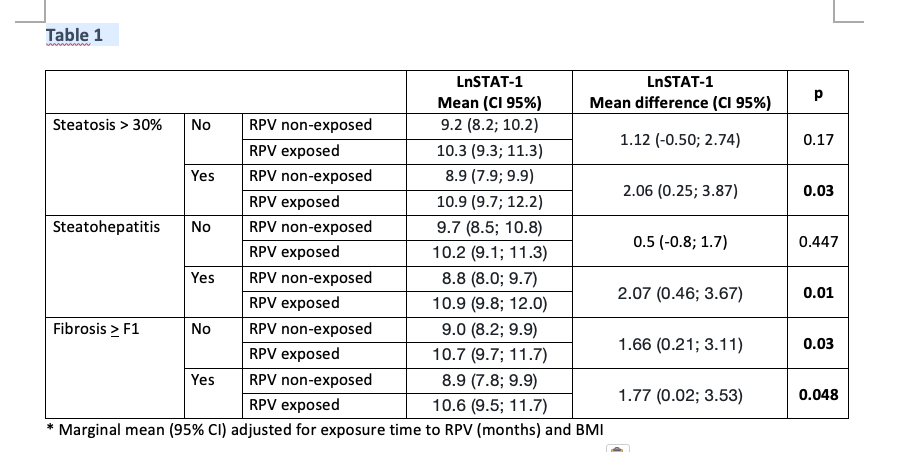
In a cross-sectional study, we analyzed 42 well-controlled PLWHIV subjects diagnosed with NAFLD by liver biopsy. Histological analysis was performed in 5?M paraffin-embedded liver sections by H&E staining and immunohistochemistry. Nuclear expression of STAT-1 was quantified and compared between subjects with and without RPV-based therapy. A log transformation (Ln) of the STAT-1 values was applied. Differences in LnSTAT-1 was analyzed by factorial analysis of variance, considering exposure to RPV and diagnoses of steatosis, steatohepatitis and fibrosis as inter-subject factors, and exposure time to RPV and BMI as covariates.
Studied subjects were 100% male, median age 49 (44-54) years, median CD4 count 802 (608-940) cells/?L, and 60% of them had metabolic syndrome. All subjects were receiving ART with undetectable HIV viral load and 45% were receiving RPV-based therapy. Liver biopsies showed 43% steatosis >30%, 60% steatohepatitis and 43% fibrosis F>1. Detection of nuclear STAT1 expression in non-parenchymal cells revealed a significant association of RPV-based therapy with enhanced activation of this transcription factor in hepatic sections of patients with identified liver injury. The protective effect of promoting STAT1-dependent HSC inactivation was observed in patients with different stages of NAFLD, from mild/intense steatosis to steatohepatitis or fibrosis. Interestingly, the increase in STAT1 activation observed in those exposed to RPV-based therapy was also evident in F0 subjects, probably due to the presence of steatosis or steatohepatitis among these subjects
PLWHIV with NAFLD who receive RPV-based therapy showed increased STAT1 activation, pointing to ongoing HSC inactivation and apoptosis to reduce the progression of hepatic damage. Our results suggest RPV-based ART would be especially indicated in HIV-infected patients with NAFLD-derived liver injury to prevent liver fibrosis and inflammation.