Technical challenges remain in the sequencing of circulating HIV vRNA due to its high intrahost diversity. This bottleneck is particularly pronounced when interrogating long-range co-evolution, which has hampered the direct observation of genetic interactions that code for protein-protein interfaces with relevance in drug and vaccine development. To overcome the read-length limitations of NGS and the problematic error rates of long-read sequencing platforms, we developed MrHAMER, a nanopore-based long-read viral sequencing pipeline that yields thousands of accurate Gag-Pol sequences from individual circulating virions in clinical samples.
MrHAMER uses concatenated sense/antisense repeats of each 5kb Gag-Pol cDNA (derived from single RNA molecules) to reduce Nanopore long-read sequencing error from 10% to 0.1%. This end-to-end pipeline is extensively validated for HIV vRNA sequencing of clinical samples containing low input amounts (as few as 2,500 copies/mL). This includes development of a novel emulsion-based series of PCR-reactions that we determined are critical to prevent artefactual template switching and without which long-range epistatic interactions cannot be resolved.
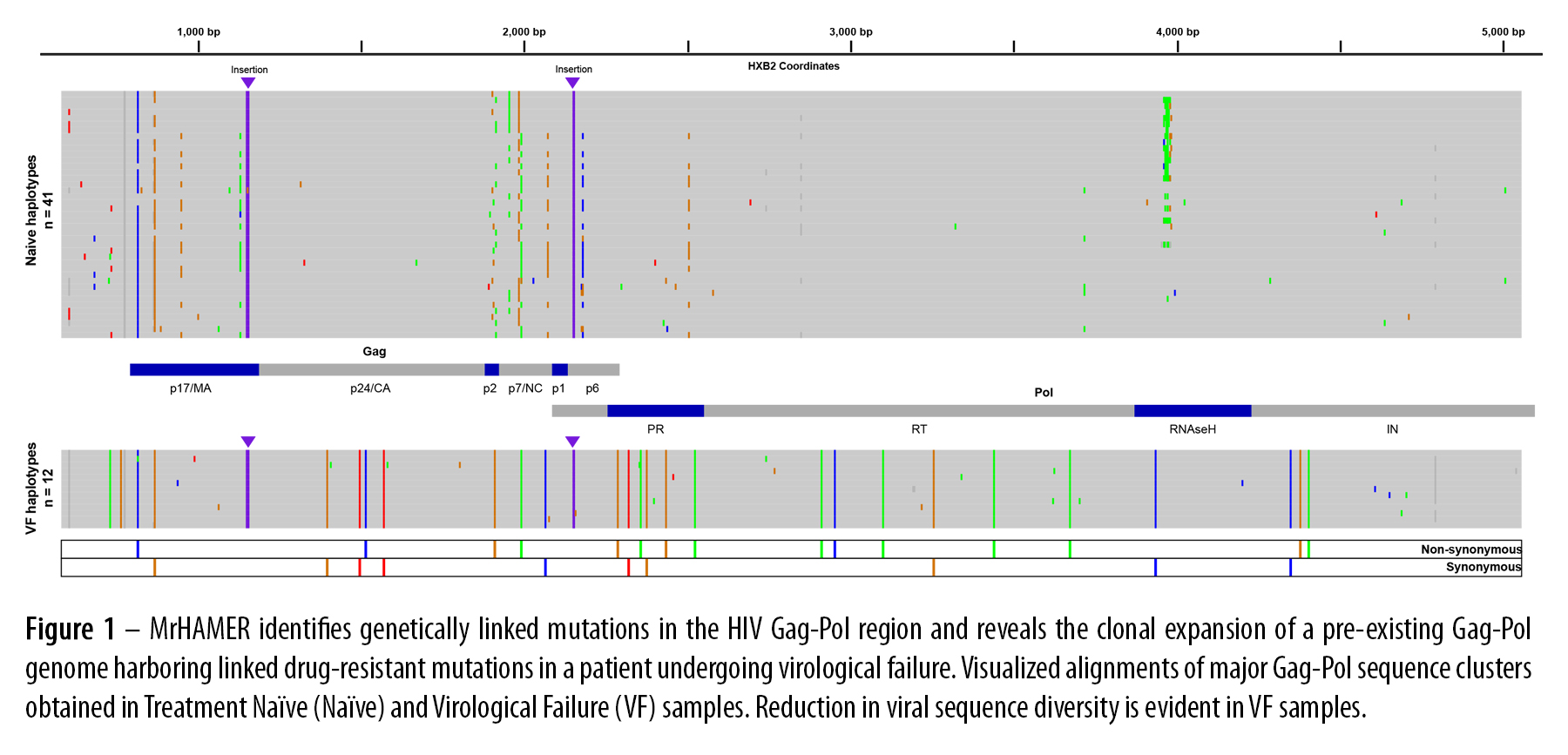
We use MrHAMER to precisely follow synonymous and non-synonymous changes in the HIV-1 Gag-Pol region (~5 kb) of individual viruses within a single host before treatment initiation and after failure of cART. We detect a hard selective sweep of a single pre-existing Gag-Pol variant containing 25 linked mutations from 0.1% enrichment prior to treatment initiation, to greater than 50% enrichment during antiviral therapy failure. These linked mutations are evenly spread throughout the Gag-Pol ORF, with 44% being synonymous, and 56% resulting in amino acid changes (including one canonical primary drug-resistance mutation that was previously undetected via clinical drug resistance testing). The enrichment of a high number of linked mutations (instead of more energetically favorable reversions) implies accumulated mutations play a compensatory role in viral fitness.
MrHAMER can identify long-range genetic correlates of intrahost viral evolution in response to antiviral therapy and immune pressure, and enable the identification of novel host-viral and viral-viral interfaces that play a role in viral pathogenesis and can be modulated for therapeutic benefit.